

DRISCOLL’S: STOP POISONING OUR SCHOOLCHILDREN
The Issue
Childhood cancer rates are increasing.
Stop toxic pesticide applications near schools!
Driscoll’s is the world’s largest producer and marketer of blueberries, blackberries, raspberries, and strawberries. Headquartered in Watsonville, California, Driscoll’s claims its growing practices are “in harmony with the communities and environment we depend on.”
But California records show at least 12 different carcinogenic pesticides are used at Driscoll’s operations, including chloropicrin and 1,3-dichloropropren – and a majority of its facilities are adjacent or extremely close to elementary and middle schools. Records show that pesticide use is INCREASING, year over year.
Sign to Demand Driscoll’s STOP applying toxic pesticides on the company’s farms and facilities near schools across the United States, beginning with its farms in Watsonville, California.
Of the six pesticide air monitors in California, five are at schools and continue to record 1,3-D air concentration levels far above the state's official Prop 65 cancer risk threshold. At one school, the 12-year average 1,3-D concentration has been 2.3 times higher than the Prop 65 cancer risk threshold. That is 230% of the lifetime cancer risk level set by California's cancer experts at the office of environmental health hazard assessment!
Watsonville's childhood cancer rates are 38% higher than the California average. Pajaro Valley residents have long complained and protested the company’s use of pesticides near schools and residential neighborhoods, even launching hunger strikes in 2025, but the company has responded with indifference.
In an interview with the nonprofit Real Organic Project, Dr. Ann López, Executive Director of Center for Farmworker Families, shared her shock over what she’s seen in Watsonville:
“I go down to Watsonville where most of the farm workers live and start knocking on doors to meet families of farm workers and almost everyone seemed to have some child with an anomaly that can be directly related to pesticide exposure. I started seeing lots of kids with ADHD, autism spectrum, learning disabilities, bone cancer, brain cancer, kids going to Stanford [Hospital] for treatment for leukemia regularly…It's no accident that they live in farming communities near fields where they are spraying toxic pesticides which have been directly linked to these kinds of anomalies.”
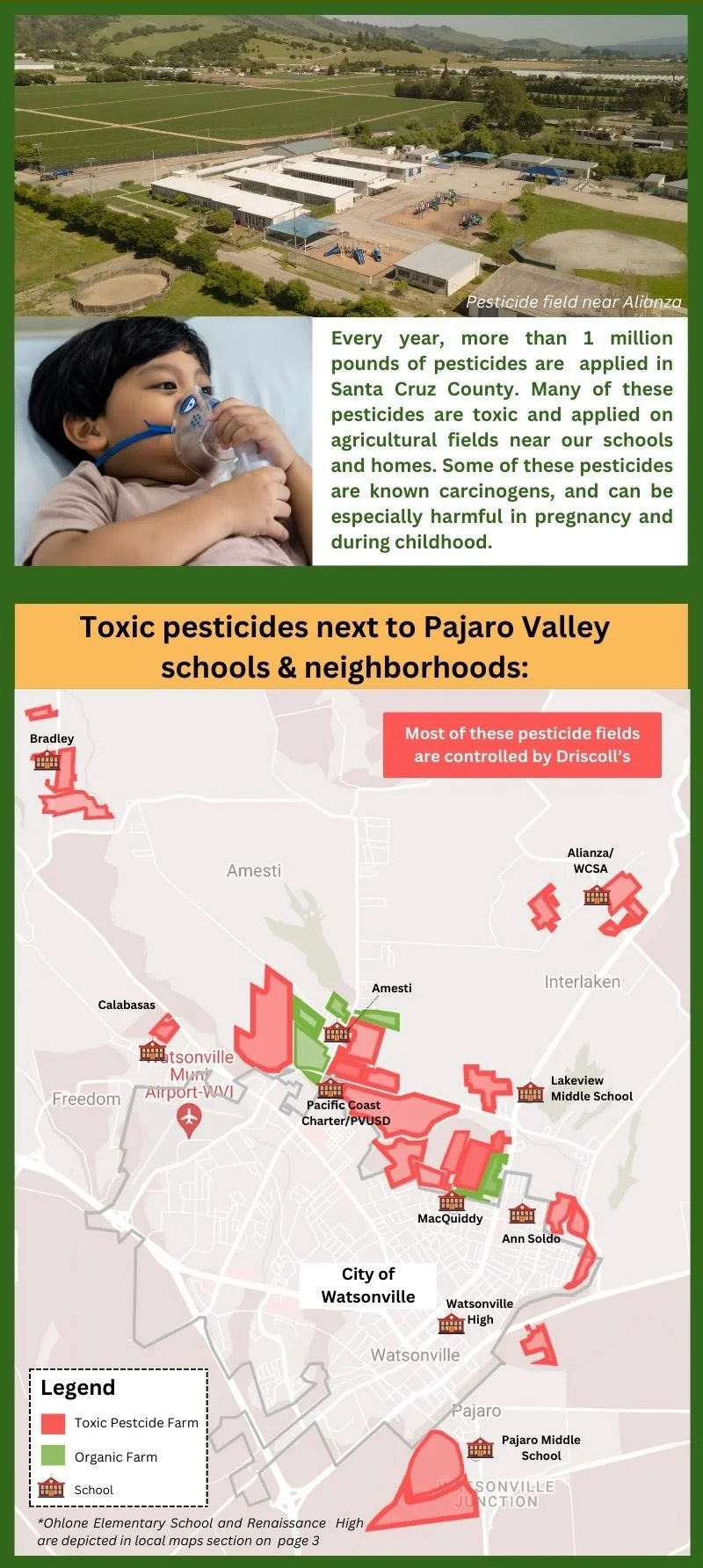
Amesti, Ann Soldo, Bradley, Calabasas, and MacQuiddy Elementary Schools, Alianza Charter School, and Lakeview and Pajaro Middle Schools all have Driscoll’s farms adjacent to them. (Image and map provided by the Center for Farmworker Families/Campaign for Organic & Regenerative Agriculture (CORA))
Highly toxic chloropicrin was manufactured for use as a poison gas in World War I and is now used by Driscoll’s as a soil fumigant.
1,3-dichloropropren (1,3-D), also used by Driscoll’s as a soil fumigant, is banned in 34 countries including the EU and is classified as a probable human carcinogen by the U.S. EPA. The pesticide is also linked to brain and nervous system disorders, respiratory diseases, including asthma, and GI and kidney disorders.
Both of these toxic fumigants are injected into the soil to kill fungi, microbes and insects. But because they are highly volatile, the chemicals readily evaporate forming vapors that can drift for miles.
Driscoll’s is exposing schoolchildren to these chemicals, and more, on a daily basis.
It’s time for Driscoll’s to take accountability and protect children. Sign the petition to demand Driscoll’s stop toxic pesticide applications at every operation within one mile of a school, starting with farms in Watsonville, and expanding to healthy farming practices for all operations near schools in the United States.
YOU CAN HELP BY:
- Signing this petition
- Sharing/ boosting this petition
- Downloading, signing and delivering a letter to your local grocery store, asking them to stop selling Driscoll’s conventional berries
Lets get to work, protect children, and stop Driscoll’s use of dangerous pesticides near schools!
Paid partnership. Diana Reeves is a Change Ambassador who receives compensation in connection with this petition.

21,402
The Issue
Childhood cancer rates are increasing.
Stop toxic pesticide applications near schools!
Driscoll’s is the world’s largest producer and marketer of blueberries, blackberries, raspberries, and strawberries. Headquartered in Watsonville, California, Driscoll’s claims its growing practices are “in harmony with the communities and environment we depend on.”
But California records show at least 12 different carcinogenic pesticides are used at Driscoll’s operations, including chloropicrin and 1,3-dichloropropren – and a majority of its facilities are adjacent or extremely close to elementary and middle schools. Records show that pesticide use is INCREASING, year over year.
Sign to Demand Driscoll’s STOP applying toxic pesticides on the company’s farms and facilities near schools across the United States, beginning with its farms in Watsonville, California.
Of the six pesticide air monitors in California, five are at schools and continue to record 1,3-D air concentration levels far above the state's official Prop 65 cancer risk threshold. At one school, the 12-year average 1,3-D concentration has been 2.3 times higher than the Prop 65 cancer risk threshold. That is 230% of the lifetime cancer risk level set by California's cancer experts at the office of environmental health hazard assessment!
Watsonville's childhood cancer rates are 38% higher than the California average. Pajaro Valley residents have long complained and protested the company’s use of pesticides near schools and residential neighborhoods, even launching hunger strikes in 2025, but the company has responded with indifference.
In an interview with the nonprofit Real Organic Project, Dr. Ann López, Executive Director of Center for Farmworker Families, shared her shock over what she’s seen in Watsonville:
“I go down to Watsonville where most of the farm workers live and start knocking on doors to meet families of farm workers and almost everyone seemed to have some child with an anomaly that can be directly related to pesticide exposure. I started seeing lots of kids with ADHD, autism spectrum, learning disabilities, bone cancer, brain cancer, kids going to Stanford [Hospital] for treatment for leukemia regularly…It's no accident that they live in farming communities near fields where they are spraying toxic pesticides which have been directly linked to these kinds of anomalies.”
Amesti, Ann Soldo, Bradley, Calabasas, and MacQuiddy Elementary Schools, Alianza Charter School, and Lakeview and Pajaro Middle Schools all have Driscoll’s farms adjacent to them. (Image and map provided by the Center for Farmworker Families/Campaign for Organic & Regenerative Agriculture (CORA))
Highly toxic chloropicrin was manufactured for use as a poison gas in World War I and is now used by Driscoll’s as a soil fumigant.
1,3-dichloropropren (1,3-D), also used by Driscoll’s as a soil fumigant, is banned in 34 countries including the EU and is classified as a probable human carcinogen by the U.S. EPA. The pesticide is also linked to brain and nervous system disorders, respiratory diseases, including asthma, and GI and kidney disorders.
Both of these toxic fumigants are injected into the soil to kill fungi, microbes and insects. But because they are highly volatile, the chemicals readily evaporate forming vapors that can drift for miles.
Driscoll’s is exposing schoolchildren to these chemicals, and more, on a daily basis.
It’s time for Driscoll’s to take accountability and protect children. Sign the petition to demand Driscoll’s stop toxic pesticide applications at every operation within one mile of a school, starting with farms in Watsonville, and expanding to healthy farming practices for all operations near schools in the United States.
YOU CAN HELP BY:
- Signing this petition
- Sharing/ boosting this petition
- Downloading, signing and delivering a letter to your local grocery store, asking them to stop selling Driscoll’s conventional berries
Lets get to work, protect children, and stop Driscoll’s use of dangerous pesticides near schools!
Paid partnership. Diana Reeves is a Change Ambassador who receives compensation in connection with this petition.
Supporter Voices
Petition Updates
Share this petition
Petition created on July 22, 2026