What the LLPT considers the ‘foundational principles of law’

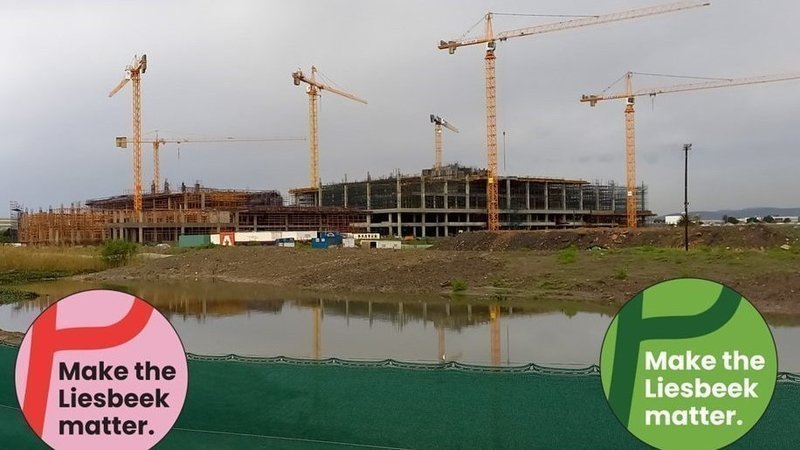
The Liesbeek Leisure Property Trust (LLPT), along with the City of Cape Town, the Western Cape Department of Environmental Affairs and Development Planning and the First Nations Collective, have now all filed to the Supreme Court of Appeal to attempt to reverse Judge Patricia Goliath’s ground breaking decision to interdict the construction of a 150 000 square metre commercial complex on the Liesbeek floodplain, intended to host Amazon Web Services’ Africa HQ. Having lost their application for leave to appeal in the Cape High Court, they have now sought to approach the Supreme Court in Bloemfontein to appeal the decision essentially on the same grounds that Judge Goliath found wanting.
We know the strategy of ratcheting up the legal challenges is designed to bury us for lack of funds to compete with the respondents’ deep pockets, since we have to raise lots more money to defend this in the Appeal Court. So, once again, we have to repeat our plea to please support our court costs at our fundraising site. Donors outside of South Africa might find it easier to donate via our BackaBuddy site.
That the LLPT should go this route is no surprise since they are able to tap huge financial resources, leveraged from Zenprop, “… one of the largest property investment and development companies in South Africa ” and have the promise of the wealthiest company in the world, Amazon, as their anchor tenant. However, it is unconscionable that our City and Provincial public authorities continue to spend citizens’ rates and taxes to pursue lawfare against a coalition of Khoi groups, civics, NGOs and faith-based organisations who back our court case to seek administrative justice under South African law.
What is most revealing in the LLPT’s application to appeal is their claim to be returning to “… foundational principles of our law” by invoking the concepts of the “… separation of powers” and “… the future of sustainable development.”
To claim the “separation of powers” when the City and provincial governments have been delinquent in decision-making is to join a long list of duplicitous government officials, politicians and those who stand to benefit from flawed government decision-making who tell the courts to back off.
But, as argued by retired Judge Denis Davis, “… the doctrine of separation of powers does not mean that a court is impotent when faced with a constitutional challenge to a decision of the executive.” In fact, our courts are obliged to ensure that decisions taken by the executive are rational. That is why the Constitutional Court has held President Zuma accountable even though he attempted to invoke this argument over separation of powers in his trial for refusing to testify to the Zondo Commission. Davis continues to explain - if the doctrine does not “… prevent a court from interrogating a decision of the President for lack of rationality…”, “…how much more so, it must follow, may a court probe the reasonableness of social and economic rights provisioning”.
It was to social and economic rights that Judge Goliath referred when she made it abundantly clear that “… this matter ultimately concerns the fundamental right to culture and heritage of indigenous groups, more particularly the Khoi and San First Nation Peoples.” And in granting the interdict, she specifically traversed the question of separation of powers, recognising that “… an interim interdict can only be granted in the clearest of cases.” Unfortunately for the LLPT, that is exactly what Judge Goliath found – that the threat of irreparable and imminent harm justified the granting of an interdict because it was a clear and extreme case.
The version of the doctrine of separation of powers that the LLPT would like to see implemented is one where the courts have no role to play in holding public officials who do the bidding of rich and powerful entities accountable. But that is a fundamental misunderstanding of the South African constitution which has the vision of ‘… the empowerment of all citizens to participate in decisions that are crucial to the outcome of their life choices.”
In the same vein, the LLPT would like us to believe that sustainable development is what they have bought in the form of sophisticated expert reports that justify the destruction of a sensitive floodplain for economic gain. We have argued that the Department of Environmental Affairs and Development Planning made a fundamentally flawed and irrational decision when granting the Environmental Authorisation by preferencing economic gain for some, over protection of the social and environmental public good.
Bear in mind that the National Environmental Management Act frames sustainable development as “The integration of social, economic and environmental factors into planning, implementation and decision-making to ensure that development serves present and future generations.” What we have seen is endless talk by the respondents about jobs for unemployed persons (which would have been achieved already had Amazon chosen any of the other appropriate sites) and a very limited provision of a small number of affordable housing opportunities. There has been no mention of the very substantial profits that will accrue to already wealthy individuals. And we have certainly not seen a recognition of the importance of the River Club site as a future national heritage site or a world heritage site, protected for future generations as a place of living memory.
It is fitting on National Youth Day that we recognise that sustainable development speaks to what High Commissioner of the Goringhaicona Khoi Khoin Indigenous Council, Tauriq Jenkins, described in his submission on the Heritage Impact Assessment for the River Club in 2019: “The River Club is the ground zero precinct from which restitution, reparation, conciliation and healing intergenerational trauma will flow. Of the Site's many important attributes, it is one that imbues its potential to heal our nation. Its symbolic power is a manifestation of everything that it embodies.” Future generations will surely thank us for fighting for sustainable development in the face of greedy profiteering.
We have just lodged our supplementary papers for the review, which we will share in a forthcoming update.
More information on the campaign at our website. Follow the Liesbeek Action Campaign on twitter: @LiesbeekAction.
Make the Liesbeek Matter!