While the Judge makes her decision, muddying narratives will emerge

Day 30 after the end of our High Court hearing and we still await Judge Goliath’s decision. We know it’s a complex case and needs a lot of careful consideration of a wide range of facts. But while we wait, the concrete continues pouring. Amazon’s HQ building is now three floors high and the bridge over the Black River – straight across the historical confluence of the Two Rivers - is being pushed hard by the ongoing construction.
In the interim, some wild and implausible new narratives have emerged from the First Nations Collective (FNC). These new narratives, all purporting to discover new facts about the site, seem more than coincidental given that they have appeared whilst Judge Goliath is deciding on the interdict. What is abundantly clear, however, is that opinions can easily be altered to suit the moment.
For example, Chief Zenzile Khoisan, in his enthusiasm to see the massive concrete buildings shoot up, has recently called the land on which the River Club stands a “marshland” that is “fit for nothing”. Presumably, that’s to negate any notion of the land being of heritage importance so as to enable the building to proceed unhindered. However, that’s an odd characterisation of land that he had previously described in a 27 February 2016 newspaper article as part of an Urban Park that “should become a heritage precinct.”
It’s also odd, given that the AFMAS First Nations Report, out of which the FNC emerged, included a range of comments from First Nation informants confirming the significance of the River Club land at the confluence of the Liesbeek and Black Rivers, for example:
- "Places where rivers are coming together, are special places. Those rivers are connected with people and memory. Water holds memory. So, wherever rivers are coming together, at that point is a ceremonial place. So, the Two Rivers, at that point, is one of them, because of the rivers coming together there. So that space holds a huge memory."
- "The confluence of the Black River and the Liesbeeck River, that embankment area is the place where the Khoi would engage in marriage ceremonies and burial rites, cremation and these kinds of things. It’s also a political hotspot, because that's where the tribes would gather and meet… So symbolically, confluences for the Khoi, had a tremendous resonance."
- "The first scene of major conflict of a group that had come to settle, to take over, to usurp occurred in those areas broadly known as the Two Rivers Urban Park. To us the confluence of the Black River and the Liesbeeck River are critical historical spaces."
Moreover, the ACO report on the Proto-history of the Two Rivers Urban Park makes it very clear that the “wetland that encompassed the Black River, Salt River and Liesbeek estuary (incorporating land in the confluence of the rivers) was of primary importance as grazing land, and was able to support thousands of head of cattle for periods of time. Frequent reference is made to the location as being the place where the Khoikhoi camped.”
It's clear that the characterisation of the land as a marshland fit for no purpose has no grounding in indigenous knowledge holders’ narratives nor in historical accounts of the site as a place where the migratory Khoekhoen found good grazing for their cattle and used the two rivers as natural protection from cattle raiders and/or the predations of wild animals.
The FNC also claim in the developer’s HIA that no “specific act of resistance, battle or encounter, whether tangibly manifested or intangibly articulated, have been attributed specifically to the River Club site.” Yet, in 2016, chief Khoisan, writing about the victorious battle against the Portuguese intruders under d’Almeida in 1510, noted that “The invaders … as an act of revenge apparently travelled up the Liesbeeck River and came upon the ancient Gorinhaiqua kraal which was situated at what is now known as Oude Molen.” How exactly they could have travelled up the Liesbeek River without passing through land associated with the River Club site is unclear.
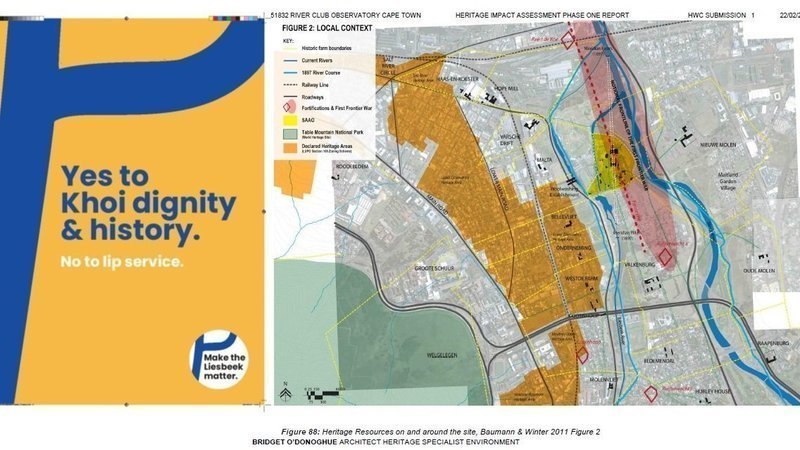
And, as we know, the site was also clearly associated with the Dutch colonists gifting of land to free burghers to farm, an act which precipitated ongoing wars between the Khoi and the colonists over the next two centuries. As can be seen in the map above from the Baseline HIA for the River Club, which depicts the Heritage Resources on the site, the frontier zone in the 17th century included the River Club site. The line connecting the forts established by the Dutch to monitor movement in the area by the Khoi, which marks the frontier zone, runs clearly through the River Club’s current land.
The developers’ heritage consultants also did a remarkable volte-face. In 2018, during a Heritage Appeal Tribunal visit to the River Club site, the LLPT’s Heritage Consultant made the statement conceding that “there’s no contesting of the significance of the site, the site is enormously important.” But in 2019, when the Basic Assessment Report was submitted, their supplementary HIA report stated, in complete contradiction, that “the HIA finds that, apart from the Liesbeek River, the site itself has little obvious heritage significance…”.
As for Amazon, whose behemoth African headquarters will overlook the “permanent heritage enclave” to be created on the site, it is conspicuously ignored by the FNC in its public pronouncements. Yet, in 2017, at exactly the time the River Club redevelopment was beginning to unfold, Chief Zenzile extolled the courage of indigenous rights activists in the United States who resisted “an oil pipeline through Indian land and sacred sites”, an act that was described as “the power of activism to stop corporate greed and government policies that lead to war, plunder and the undermining of the environment.” The profits to be accrued to the River Club property owners and their principals, and the role of Amazon, the biggest and wealthiest corporate in the world, in destroying a sacred wetland area, receive no mention in Chief Zenzile’s enthusiasm to embrace the redevelopment of the River Club redevelopment.
Whilst Judge Goliath is making her decision, it is to be expected that new narratives will emerge seeking to muddy the waters. Let’s be clear. The site is of huge heritage significance. In 2018, Khoi participants in the Heritage Appeal Tribunal found the “threats to the area and any losses that result from the development on the property, as intolerable.” No gerrymandering of history can change that.
We await Judge Goliath’s decision.
As always, please help us fund these legal costs by contributing at our fundraising site.
Visit our website and follow the Liesbeek Action Campaign on twitter: @LiesbeekAction.
Make the Liesbeek Matter!