

Deliver Us From Evil: The Veto Campaign for Fair Elections
The Issue
Hello and welcome.
I’m Rohin Vadera, founder of the Veto Campaign.
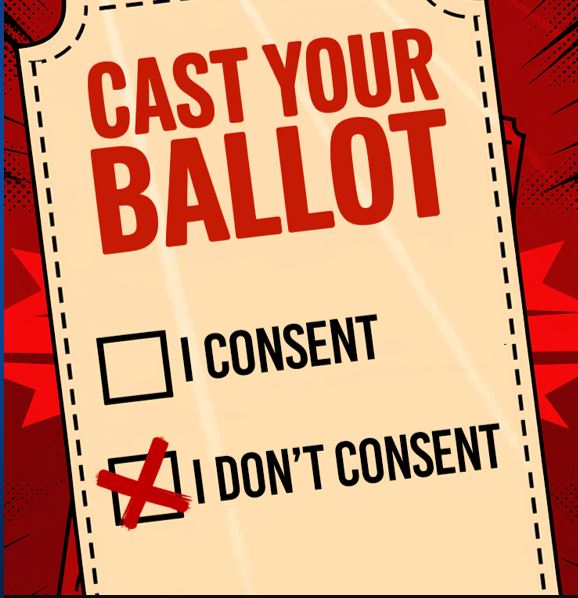
The top of every ballot for legislative positions should have an option stating, 'I VETO this election.'
This option is suitable for all electoral systems. Its effect is logically determined by the system within which it operates.
Without a veto, all electoral systems can be classified as variations of lead, follow, or get out of the way. They are gimmicks. (Don't shoot the messenger.)
The Problem
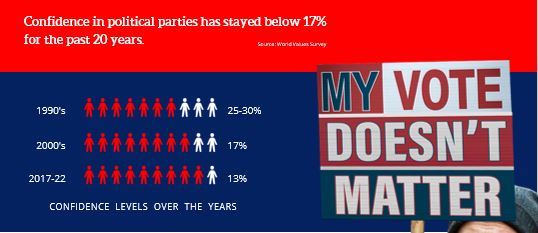
For years, millions of us have felt trapped by a system that forces us to pick from parties we don't trust. Voter turnout is plummeting, and confidence in politicians is at an all-time low. Is this system truly democratic?
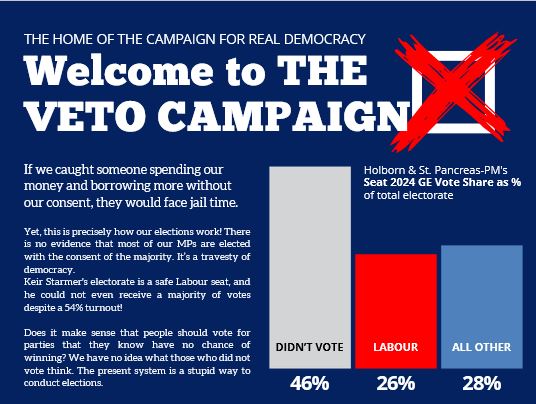
We currently have many MPs elected with few votes in constituencies where turnout is low. By what moral authority do they make decisions that affect us all? Jess Phillips received the second fewest votes, with 11,275 votes from a constituency of over 73,000 and a turnout of less than 50%. She was a minister. She was playing a central role in one of the most important enquiries the UK has ever seen. Plenty more with similar numbers.
It's crazy that people like her have so much influence over our lives.
It's time to change that.
The Solution
A new paradigm: an option to VETO elections will ensure all governments must have majority support.
In our current FPTP system:
Force a do-over: if over 50% veto, the election reruns (at 4-week intervals) – as many times as needed – until we get options we can believe in. There is no constraint on previous candidates running again; we leave it to voters to dictate the change they want to see.
This means that MPs have an interest in uniting their constituencies. Currently, the more fragmented our country is, the fewer votes an MP needs to win an election; this situation creates a perverse incentive.
If a majority does not choose the veto, it effectively functions as a ranked ballot. The current multi-party environment is wildly unsuited to an FPTP system. The veto forces the political environment to conform to the contours of the electoral model. Candidates will have to be those who can represent a majority of those who vote in order to get elected.
Any political organisation or candidate that can't muster majority support somewhere is rightly consigned to the scrapheap. Good riddance.
PR also requires a veto to address its flaw, as it allocates 100% of seats but does not guarantee representation for all people who want to vote, resulting in MPs who represent no one.
The principle that applies is that the percentage of veto votes results in the same percentage of empty seats. For example, if 30% of voters veto, then 30% of the seats will remain empty. This arrangement retains proportionality, allows more voters to be represented in future elections, and keeps pressure on elected MPs to do a competent job.
Without a veto, elections become "lead, follow, or get out of the way". This approach is not democratic and leads to poor governance and division.
The effect of the veto is to create incentives to minimise its use. The less the veto is used, the more likely it is that the common good will be maximised.
Why It Works
Democracy should work; we live with the consequences of our decisions, so we have the greatest incentive to achieve effective governance. Currently, we are just fuel for the election system, not its owners, and the results are predictable.
Reject poor choices: if you dislike all the candidates or if an acceptable candidate is unlikely or uncertain to win, you can vote to veto the election.
No more "lesser evil": this isn't about spoiling votes; it's about demanding better representation and holding parties accountable.
Imagine the impact:
Better policies for you: politicians will scramble to fix failing issues like the cost-of-living crisis, immigration, NHS wait times, or housing shortages to avoid vetoes.
Real voter power: Even before a majority veto, it highlights where dissatisfaction is highest, pushing for change nationwide. It provides a reliable measure of public dissatisfaction, which is essential feedback for consistent, effective governance.
We don't have a democratic electoral system. It's really an electoral oligarchy, where the least unpopular, at that moment, become our rulers, rather than our representatives.
Thank you for reading.
Please Sign the Petition! :)
Recent elections have shown there is a record low trust; therefore, this veto could transform UK politics by making it work for the people instead of the parties.
Visit the website to find out more: www.vetocampaign.com.
Please share this petition!

3,146
The Issue
Hello and welcome.
I’m Rohin Vadera, founder of the Veto Campaign.
The top of every ballot for legislative positions should have an option stating, 'I VETO this election.'
This option is suitable for all electoral systems. Its effect is logically determined by the system within which it operates.
Without a veto, all electoral systems can be classified as variations of lead, follow, or get out of the way. They are gimmicks. (Don't shoot the messenger.)
The Problem
For years, millions of us have felt trapped by a system that forces us to pick from parties we don't trust. Voter turnout is plummeting, and confidence in politicians is at an all-time low. Is this system truly democratic?
We currently have many MPs elected with few votes in constituencies where turnout is low. By what moral authority do they make decisions that affect us all? Jess Phillips received the second fewest votes, with 11,275 votes from a constituency of over 73,000 and a turnout of less than 50%. She was a minister. She was playing a central role in one of the most important enquiries the UK has ever seen. Plenty more with similar numbers.
It's crazy that people like her have so much influence over our lives.
It's time to change that.
The Solution
A new paradigm: an option to VETO elections will ensure all governments must have majority support.
In our current FPTP system:
Force a do-over: if over 50% veto, the election reruns (at 4-week intervals) – as many times as needed – until we get options we can believe in. There is no constraint on previous candidates running again; we leave it to voters to dictate the change they want to see.
This means that MPs have an interest in uniting their constituencies. Currently, the more fragmented our country is, the fewer votes an MP needs to win an election; this situation creates a perverse incentive.
If a majority does not choose the veto, it effectively functions as a ranked ballot. The current multi-party environment is wildly unsuited to an FPTP system. The veto forces the political environment to conform to the contours of the electoral model. Candidates will have to be those who can represent a majority of those who vote in order to get elected.
Any political organisation or candidate that can't muster majority support somewhere is rightly consigned to the scrapheap. Good riddance.
PR also requires a veto to address its flaw, as it allocates 100% of seats but does not guarantee representation for all people who want to vote, resulting in MPs who represent no one.
The principle that applies is that the percentage of veto votes results in the same percentage of empty seats. For example, if 30% of voters veto, then 30% of the seats will remain empty. This arrangement retains proportionality, allows more voters to be represented in future elections, and keeps pressure on elected MPs to do a competent job.
Without a veto, elections become "lead, follow, or get out of the way". This approach is not democratic and leads to poor governance and division.
The effect of the veto is to create incentives to minimise its use. The less the veto is used, the more likely it is that the common good will be maximised.
Why It Works
Democracy should work; we live with the consequences of our decisions, so we have the greatest incentive to achieve effective governance. Currently, we are just fuel for the election system, not its owners, and the results are predictable.
Reject poor choices: if you dislike all the candidates or if an acceptable candidate is unlikely or uncertain to win, you can vote to veto the election.
No more "lesser evil": this isn't about spoiling votes; it's about demanding better representation and holding parties accountable.
Imagine the impact:
Better policies for you: politicians will scramble to fix failing issues like the cost-of-living crisis, immigration, NHS wait times, or housing shortages to avoid vetoes.
Real voter power: Even before a majority veto, it highlights where dissatisfaction is highest, pushing for change nationwide. It provides a reliable measure of public dissatisfaction, which is essential feedback for consistent, effective governance.
We don't have a democratic electoral system. It's really an electoral oligarchy, where the least unpopular, at that moment, become our rulers, rather than our representatives.
Thank you for reading.
Please Sign the Petition! :)
Recent elections have shown there is a record low trust; therefore, this veto could transform UK politics by making it work for the people instead of the parties.
Visit the website to find out more: www.vetocampaign.com.
Please share this petition!
The Decision Makers

Supporter Voices
Petition Updates
Share this petition
Petition created on 1 July 2025