EVMs may be efficient, but they erode trust. True democracy requires transparency earns voter'strust

⚖️ Why India Should Consider Banning EVMs
The debate around Electronic Voting Machines (EVMs) in India is not just technical—it touches on constitutional principles, public trust, and democratic legitimacy. Here are the key arguments often raised by critics:
🔍 Contemporary Trust Issues
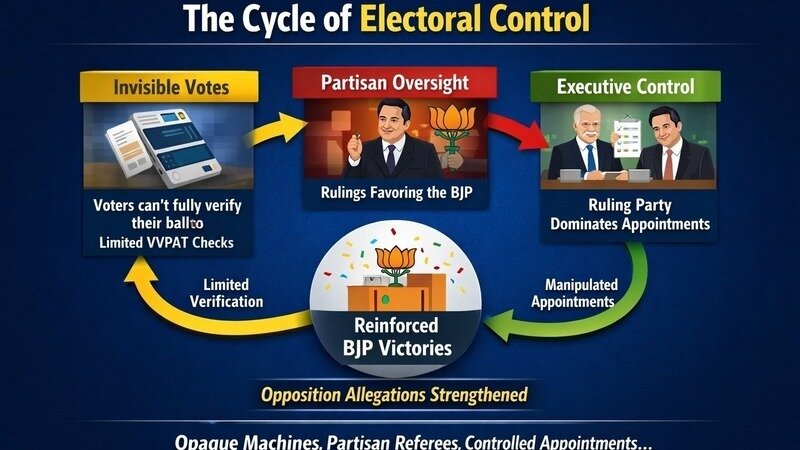
Transparency Gap: Unlike paper ballots, voters cannot independently verify that their vote was recorded correctly. The VVPAT system only shows a slip for a few seconds, and only a small sample is cross-checked.
Limited Verification: Currently, only 5 random booths per constituency undergo VVPAT verification. Critics argue this is statistically insufficient to detect tampering.
Public Suspicion: Allegations of “vote theft” and bias by the Election Commission fuel distrust. Even if machines are technically secure, the perception of manipulation undermines legitimacy.
Global Precedent: Many democracies (Germany, Netherlands, Ireland, Japan, Bangladesh) abandoned EVMs precisely because trust and transparency matter more than speed.
📜 Constitutional Concerns
Right to Know: The German Constitutional Court banned EVMs in 2009, ruling that citizens must be able to verify elections without specialized knowledge. India’s Constitution also guarantees free and fair elections under Article 324.
Equality of Vote: If voters cannot verify their vote independently, critics argue it violates the principle of equal weight and transparency in electoral participation.
Judicial Debate: While the Supreme Court of India has upheld EVMs, opposition parties argue that constitutional morality demands verifiable, transparent systems.
📊 Key Arguments for a Ban
Restoring Trust: Paper ballots, though slower, allow visible counting and reduce suspicion.
Global Alignment: India would join other democracies that prioritize transparency over efficiency.
Constitutional Safeguard: Ensures elections remain visibly free and fair, not just technically secure.
Preventing Institutional Bias: Eliminates allegations that EVMs favor ruling parties.
🔑 Takeaway
India’s continued reliance on EVMs is defended as a logistical necessity, but critics argue that democracy is built on trust, not speed. If citizens doubt the process, even secure technology becomes unconstitutional in spirit.
EVMs may be efficient, but they erode trust. True democracy requires transparency that every voter can see and verify.
🔍 Probabilities of EVM Tampering in Recent Assembly Elections
🛡️ Technical Safeguards (Why ECI Claims Tampering is “Impossible”)
Standalone Devices: Indian EVMs are not connected to the internet, reducing remote hacking risk.
Sealed Units: Machines are sealed and tracked with serial numbers, making physical replacement difficult.
Mock Polls: Conducted before voting begins, with representatives of all parties present.
VVPAT Slips: Provide a paper trail, though only a small sample is verified.
⚠️ Contemporary Trust Issues
Limited VVPAT Verification: Only 5 random booths per constituency are checked. Statistically, this is too small to detect systemic tampering.
Allegations During 2026 Polls:
Opposition raised concerns about central force intimidation and possible manipulation.
Perception Gap: Even if machines are technically secure, public suspicion remains high. Trust deficit itself is a democratic problem.
📊 Probability Analysis (Conceptual, Not Numerical)
Physical Tampering: Low probability due to strict custody and seals, but not zero—especially in remote booths with weak oversight.
Software Manipulation: Officially “impossible” since chips are one-time programmable, but critics argue lack of independent audit makes this unverifiable.
Statistical Detection: With only 5 booths checked, probability of catching tampering is extremely low if manipulation is widespread but subtle.
⚖️ Constitutional Angle
Transparency Principle: As seen in Germany’s 2009 ruling, voters must be able to verify elections without specialized knowledge. India’s limited VVPAT verification arguably fails this test.
Trust vs. Efficiency: India prioritizes speed and scale, but critics argue democracy requires visible fairness over logistical convenience.
🔑 Takeaway
Official Position: ECI and Supreme Court maintain EVMs are tamper-proof.
Opposition View: Limited verification and secrecy create a non-zero probability of manipulation, making the system unconstitutional in spirit.
Reality: The biggest risk is not technical hacking but erosion of public trust—if voters believe machines can be rigged, legitimacy suffers regardless of actual tampering.