Petition updateIn solitary confinement for over a year, a family Shepherd is denied his last days at home
“Who are you to judge the life I live? I know I'm not perfect

Gail O'ConnellSherwood, OR, United States
Nov 28, 2017
“Who are you to judge the life I live?
I know I'm not perfect
-and I don't live to be-
but before you start pointing fingers...
make sure your hands are clean!”
― Bob Marley
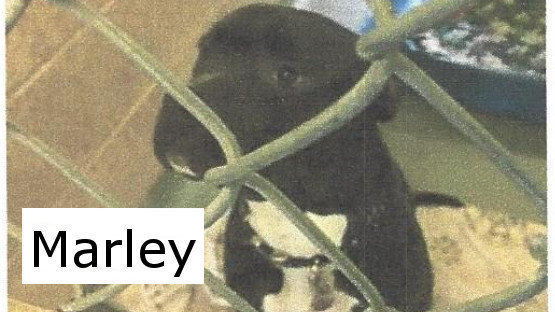
Marley, MCAS 125064, a shy 2-year-old American pit bull mix with a single accidental minor bite incident (explained by the owner as an understandable nip on the hand and face), was ordered killed by MCAS on November 02, 2017 as “Unhealthy/Untreatable,” aggressive towards people.
How did Marley go from being a family dog to a dog MCAS decided had to be killed to protect society? Why were no other options permitted? How does MCAS start the winding road towards an unjustified death?
The agency games it. A favorite technique is to begin with deceptive over-generalizations and intentional grand over simplifications that place a dog in a “risk” category. The categories fast track ordinary dogs, most with wholly correctable behaviors, to death. Events are stripped of the context that lend meaning and accuracy. Formulas substitute for thinking and discretion. All that matters is the code. It is a form of March Hare madness.
Threat Level Color coding: As part of their evaluation dogs are color coded and graded according to perceived threats to society. The colors go in descending order of perceived risk from blue, to purple, to green, ending in orange.
An Orange history includes any one of the following to qualify as threat level orange:
• Human aggression
• Severe Fear
• Dog Aggressive
• Severe Resource guarding
• Bite History
Marley’s single bite was considered provoked by the owner and the investigating officer. No charges were filed. But to MCAS and its shelter committee, only the fact of the bite mattered. Marley was immediately placed into the orange category.
There are serious information and judgment discrepancies present in the record. The e-mail chain from the owner referenced in the record supports the Officer’s decision that the incident did not merit a citation:
---
“I do not wish to make this the animals’ fault, it was an accident and he is normally a good boy. He was my friend. Please as a request do not put this animal down…he just needs better training and a calm owner” The bite on the lip (photos reveal very minor) was described as “he did not necessarily bite me on the face more or less nipped my chin whiskers.”
---
The owner surrendered Marley because he believed Marley would receive an opportunity for a better life with someone calmer who would train him. MCAS wrote the surrender reason as: “Aggressive towards people.” He now posed a generalized threat to society. He was no longer a companion dog with a correctable behavior: He had become a threat to all of us.
The Behavior Assessment followed. The owner’s information was relayed to Andrew Mathias, canine specialist who observed the BA. Mr. Mathias observed the evaluator who said he was “uncomfortable” because of a “history of bite incidents.” There is no history of multiple bite incidents. Marley was an anxious subordinate dog, His prior owner observed that if the staff saw that Marley wasn’t eating, it was because he had to be given permission to eat.
Nothing about Marley’s conduct during his BA was frightening despite the fact that the BA was the first time he had been allowed outside his cage or engaged with anyone in the 3 weeks since his impoundment on October 14. All of Marley’s behaviors were deferential and about retreating from provocative stressors. But these made the evaluator “uncomfortable.” The evaluator never once considered the effects of his own behavior on Marley or the cues he was sending to Marley. Dogs are keen observers of behavior. Anxiety is a two-way street.
---
“Stiff in kennel with low wagging tail, direct eye contact, mouth closed with ears back, able to get to sit and bring out of kennel. In room, he would only approach on his own, not when called. When I would attempt to pet when he approached me, he would freeze and lower his head with lip licking. I would immediately stop, and allow him to move away from me. He did this multiple times and at that point I did not touch him again myself as the signs I were reading from him made me very uncomfortable and were consistent with how he acted in his history and bite incidents. I attempted to use fake hand and he would stiffen, jump up and attempt to touch or grab at hand but never made contact. Started to get very anxious in room (possibly due to lots of noise outside) and would not approach again. Abel to leash and walk back to kennel, but had difficulty getting into kennel due to commotion, and had to walk him back outside to his kennel with dogs closed inside."
---
After calling the owner to inform him of the euthanasia decision, shelter manager Shaunna Ward wrote “That he understood and did not have any questions”. This statement is wholly at odds with the owner’s e-mails, his hopes and wishes. The decision by Ms Ward and staff left no room for questions. There was no counseling about options. No rescues were called. Marley was ordered killed as “unhealthy and untreatable.” “Shelter Review met and recommends humane euthanasia due to significant behavioral conditions.”
The Committee itself has its own “significant behavior conditions.” Animals’ fates are decided in closed sessions by members who seem to be primarily management, most without background in animal behavior science. No notes are kept and the reasons given for killing other than UU are vague, general and meaningless. Questions and different views, dialog and outside input or offers of help are not permitted. No “outsiders” are invited. Rescues’ views are not sought. Few are solicited to rescue anyway. MCAS does not evaluate an animal’s life with care and thought.
Without oversight or accountability, killing is easy and facilitates more killing: At MCAS more and more animals are being killed arbitrarily. The dead are labeled “unfit” for life; damaged goods, “unadoptable,” when they are not. Terms like “Under Behavior Modification” mean nothing at all when there is no program and animals are left in their cages.
Marley's records at MCAS:
https://www.scribd.com/document/365822457/MCAS-Marley-Records?secret_password=jf33ptOCIFDkoYlcHlmC
Multnomah County Animal Services' canine behavior color codes:
https://www.scribd.com/document/365820717/MCAS-Marley-Records?secret_password=R9eHxuQNBbtq6jfGrO0U
Support now
Sign this petition
Copy link
WhatsApp
Facebook
Nextdoor
Email
X