
Dear all,
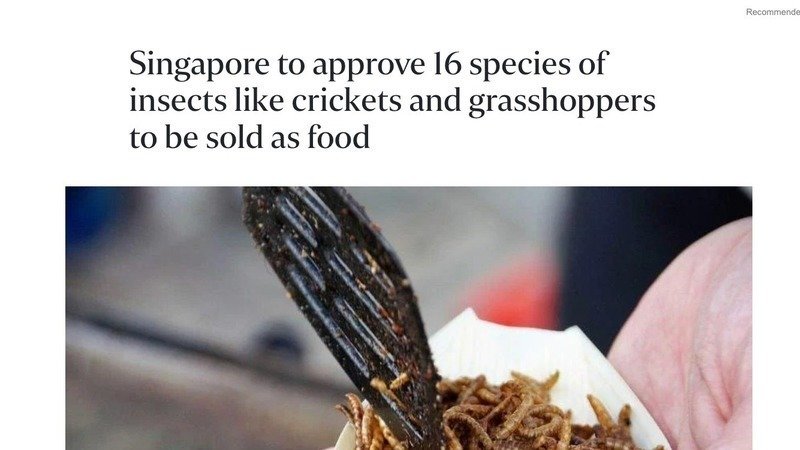
By now, you may have heard of the worrying news of Singapore to approve 16 species of insects like crickets and grasshoppers to be sold as food
This prompted me to check my email as I have earlier sent SFA to inform them about my petition.
I was also very concerned that Straits Times, did not mention our petition, signed by more than 1000 people now and merely mentioned this.
"The move comes after the agency held a public consultation exercise from Oct 5 to Dec 4, 2022, on the regulation of insects and insect products. It received 53 responses. These ranged from scepticism to feedback and concerns from industry players planning to bring in insect products."
Why is this public petition not mentioned at all?
I want to share with you the email from SFA regarding our petition.
---------------------------------------------------------------
To Iris Koh
We refer to your petition on Change.org, titled “DANGER: Say No To Eating Insects.”, which claims that eating insects is dangerous and may pose health challenges.
Background - SFA’s proposed regulations for insect and insect products
1 Insects are part of the natural diet for many food animals such as poultry or fish. While the use of insects as human food is relatively new in Singapore, several species of edible insects have traditionally been consumed in parts of Asia. For example, insects such as silkworm pupae and crickets are traditionally consumed in Korea and Thailand respectively.
2 In recent years, the commercial farming of insects for human consumption and livestock feed has been promoted by the Food and Agriculture Organization (FAO) and has received commercial interest. SFA keeps abreast of such developments in food production and innovations and has received industry queries on the import of insects as food or livestock feed.
3 SFA has taken reference from the European Union and countries such as Australia, New Zealand, Korea and Thailand, which have allowed the consumption of certain insect species as food, as well as conducted a thorough scientific review. We have assessed that specific species of insects with a history of human consumption can be allowed for use as food or livestock feed.
4 To ensure the safety of insect and insect products for human consumption, SFA will impose import conditions and licensing requirements for farming/processing of insects:
a. SFA will only allow insect species that have a known history of human consumption to be permitted as food. Those not in this list must undergo evaluation as novel food, under the novel food framework.
b. Insects must be farmed and not obtained from the wild, as this provides greater control over the inputs and cultivation process of the insects.
c. There are restrictions on substrates (i.e. material on which the insects feed on) which can be used; and riskier substrates such as manure, decomposing substrates with mould or bacteria growth, or ruminant materials which may carry prions will not be permitted in the rearing of insects for food.
d. Farms or establishments producing insects for food must have a system in place (e.g. Hazard Analysis and Critical Control Point plan (HACCP) or Food Safety Management System (FSMS)) for insect and insect products to be produced in a controlled manner to ensure that potential hazards are addressed.
5 Complementing this, SFA will put in place a surveillance regime that includes testing for parameters such as microbiological pathogens, chemical contaminants, and toxins in insect food products, as well a non-targeted screening approach to collect data on potential new hazards. Food that is found to be non-compliant with our food safety regulations will not be allowed for sale.
Response to findings in the Petition
6 We note that the findings in the petition can broadly be categorised into 3 main arguments, which are addressed accordingly:
i) Chitin in insects will cause one’s immune system to be compromised
Chitin is found in a wide variety of foods including mushrooms and crustaceans such as shrimps, crabs, and lobsters. While chitin is not allergenic, it is reported to have an impact on the immune system, which may result in allergic reactions to other allergens. As such, consumption of insects may trigger allergic reactions in persons who are sensitive to crustaceans.
Companies using insects as an ingredient in their products will be required to indicate the true nature of the product on the product packaging, so consumers are aware of food products containing insects. SFA will publish risk communication materials to inform the public that persons allergic to shellfish and crustaceans may potentially be allergic to insects.
We understand that the notion that chitin from insects can result in health effects was widely shared in a tweet in July 2022. The misinformation in this tweet has since been debunked by factchecking websites.
(Note from Iris: Please note that our petition did not cite any tweet, we cited actual medical journals)
ii) Insects carry pathogens and parasites, and parasites are linked to cancer
Though there are records of parasites in insects harvested from the wild, there is no evidence on the occurrence of parasites in farmed insects. This is because a properly managed closed farm environment would prevent parasite development. Nevertheless, SFA’s proposed regulations specifically require that insects must be farmed and not from the wild, and require companies to put in place measures such as HACCP/FSMS and heat treatment measures that will mitigate the risk of parasites in farmed insects.
iii) Insects contain chemical contaminants and heavy metals due to the substrates used and farming/processing steps applied
SFA requires that insects meant for human consumption be farmed only, where there are restrictions on the type of substrates which can be used to rear insects for food. This ensures that harmful contaminants in the substrates will not be passed on to the insects.
SFA’s proposed regulations also specifically require companies to put in place measures such as HACCP/FSMS which require companies to articulate how they will identify and control hazards such as chemical contaminants in their edible insects.
Safeguarding Singapore’s food safety and security
7 With regard to your concerns about Singapore’s food security, we would like to assure you that the Government is proactively working with the industry to safeguard Singapore’s food security through a multi-pronged approach that includes import source diversification, growing overseas, and local production. Today, Singapore imports its food from more than 170 countries and regions around the world. This ensures that disruptions from any single source does not affect Singapore too severely, as importers can turn to alternative sources to maintain stability of our food supply.
8 Building Singapore’s capability and capacity to produce food sustainably is another strategy to strengthen food security. While commonly consumed proteins like eggs and fish make up the bulk of our food supply today, other types of proteins, such as insects, have the potential to supplement Singapore’s agricultural productivity and contribute to our food security. Edible insects are an under-utilised food type with high nutritional value and has been acknowledged as such in some of the articles quoted in your petition[1].
9 However, food security is only possible with food safety. As the national authority for food safety in Singapore, SFA has in place a food safety regime based on risk and backed by science to ensure that food in Singapore is safe for consumption. SFA has taken into consideration the risks involved in consuming insects, and proposed regulations to address and mitigate them. While SFA ensures that regulatory measures are in place and properly enforced, the food industry and consumers must also do their part to safeguard food safety in Singapore. The food industry is responsible for the safety of the food it offers to the public and must comply with SFA’s food safety requirements. Consumers can also do their part by equipping themselves with knowledge of food safety risks and adopting good food safety practices. Hence, with proper measures such as those listed above in place and with the combined efforts of all stakeholders, insects can be safe for human consumption.
10 At the same time, SFA acknowledges that insects as food may not be for everyone. Consumers will be able to make informed decisions on what they choose to consume based on the mandatory labelling of food products containing insects.
11 We would like to thank you for your feedback and look forward to your support in SFA’s mission to ensure and secure a supply of safe food for Singapore.
[1] In “A parasitological evaluation of edible insects and their role in the transmission of parasitic diseases to humans and animals.” and “Looking at edible insects from a food safety perspective.”
Regards,
Siti Suriani Bte Abdul Majid
Senior Director, Joint Operations Division
Singapore Food Agency
------------------------------------------------
I'm in the midst of drafting a reply to SFA. I would welcome inputs if you have. Feel free to email me at healingthedivide@protonmail.com
Feel free to email to SFA directly. You can search for their emails from https://www.sgdi.gov.sg/ministries
I basically emailed the entire board at SFA in my first petition.
Please also feel free to write to the Straits Times and the local media and tell them how you feel.
Let's do our parts to push back as much as possible the globalist agenda to shove creepy insects down our throats. NO MEANS NO.
Thank you,
Iris Koh.