
Close the Gaps in Singapore's Community Cat Management Framework
The Issue
A Call to Close the Gaps in Singapore's Community Cat Management Framework
To: National Parks Board (NParks), Animal & Veterinary Service (AVS), Singapore Police Force (SPF), and Relevant Authorities
Community cats are everyone's responsibility — until they go missing. Then, suddenly, they belong to no one.
Under Singapore's Community Cat Management Framework, caregivers are encouraged to microchip and register community cats, facilitate sterilisation, monitor their welfare, and practise responsible caregiving.
These measures recognise that community cats are identifiable animals with established caregivers, familiar territories, and ongoing welfare needs.
Yet when these same cats go missing, caregivers may struggle to obtain meaningful assistance because the animals are deemed to have no legal owner.
How can caregivers be encouraged to assume responsibility for community cats, yet find that their relationship with these animals carries so little weight when intervention is urgently needed?
A framework that encourages responsible caregiving must also provide meaningful safeguards when the welfare of those animals is potentially at risk.
The Disappearance of Three Community Cats in Holland Village
Three well-known community cats — Sasha, Toby and Charlie — have disappeared from Holland Village within a relatively short period.
Their caregivers have been searching tirelessly for them.
Imagine caring for the same cat for years. You recognise its meow, know where it sleeps, notice when it isn't feeling well, and make sure it never goes hungry.
Then one day, it disappears.
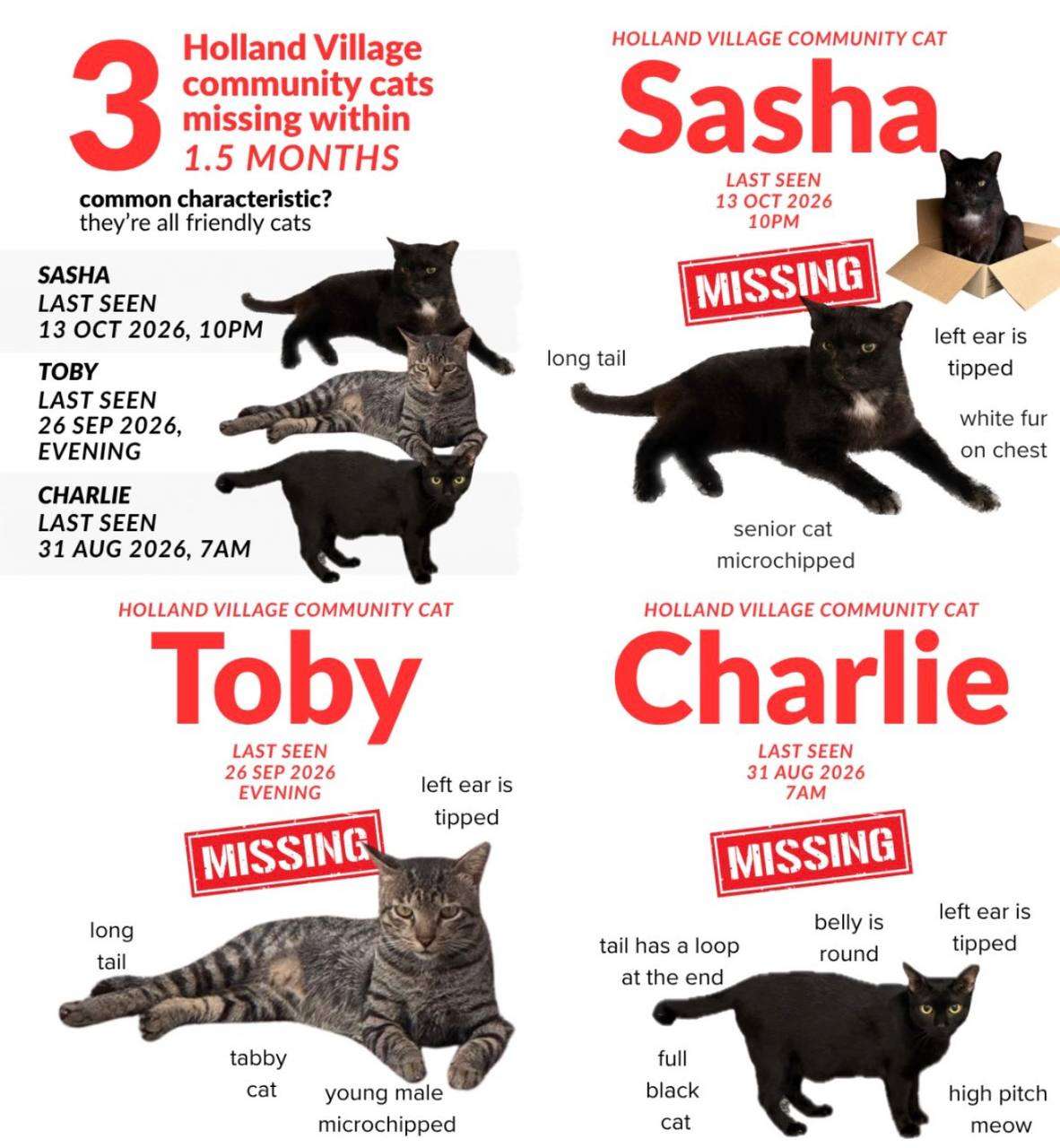
You search the neighbourhood, speak to residents, put up posters and approach the authorities, only to find that the absence of legal ownership may limit the assistance available to you.
The cat may not belong to you on paper. But does that make its disappearance any less devastating, or its welfare any less deserving of concern?
According to the caregivers, when Charlie's disappearance was reported to the police, they were informed that the cat was not anyone's property and that CCTV footage would not be reviewed. Following reports of three missing cats, the caregivers say they were told that police intervention would require a request from NParks.
These accounts raise serious concerns about how suspicious disappearances involving community animals are handled.
While the circumstances surrounding these disappearances remain unknown, three cats disappearing from the same community within a relatively short period warrants careful consideration.
We do not suggest that their disappearances necessarily establish wrongdoing. However, neither should the possibility of wrongdoing be dismissed without a reasonable assessment of the available information.
The absence of legal ownership should not translate into the absence of animal welfare protection.
A Missing Cat Should Not Have to Be Found Dead to Be Taken Seriously
The absence of a body is not evidence of the absence of wrongdoing.
A community cat should not have to be found injured or dead before credible concerns about its welfare are taken seriously.
A missing cat may have wandered away, become trapped, been relocated, been taken by an individual, or suffered harm. Without examining the available information, it may be impossible to determine what happened.
Requiring definitive proof of cruelty, abandonment or deliberate removal before even considering further inquiries creates a troubling paradox: caregivers may be expected to produce evidence that they have neither the authority nor the means to obtain.
This is particularly concerning where potentially crucial CCTV footage may be overwritten while caregivers attempt to determine which agency is responsible. By the time the question of jurisdiction is resolved, the evidence needed to establish what happened may no longer exist.
We recognise that not every disappearance indicates criminal conduct, and that investigative resources must be allocated proportionately.
However, the absence of an injured or deceased animal should not, by itself, be treated as sufficient reason to disregard credible reports of suspicious circumstances.
We are not asking the authorities to presume that a crime has occurred. We are asking them not to presume that nothing has occurred simply because a cat has vanished without a trace.
The Gap Between Policy and Practice
Singapore's Community Cat Management Framework encourages identification, traceability and responsible caregiving.
Caregivers dedicate their time, money and effort to feeding, sterilising, monitoring and seeking veterinary treatment for community cats. Many have cared for the same animals for years, often developing relationships built on familiarity and trust.
Yet when those animals disappear, caregivers may find themselves navigating an unclear system, uncertain of which authority can assist them.
This raises several important questions:
- What practical support does microchip registration provide when a community cat disappears?
- Who is responsible for assessing suspicious disappearances — NParks, AVS, SPF or another agency?
- Must caregivers wait for inter-agency referrals before potentially crucial CCTV evidence can be preserved?
- How many cats must disappear from the same vicinity before a possible pattern warrants closer examination?
- Why should the absence of a legal owner prevent credible welfare concerns from being properly assessed?
- Must a community cat be found injured or dead before its disappearance warrants further inquiry?
These questions concern more than administrative procedures. They expose a potential disconnect between the responsibilities expected of community caregivers and the practical assistance available when those animals may be at risk.
Microchipping helps identify an animal. Sterilisation helps manage the community cat population. Responsible feeding and monitoring help safeguard their day-to-day welfare.
But what happens when an identifiable, well-cared-for community cat suddenly disappears?
A framework that relies on caregivers to look after community cats should not leave those same caregivers without a clear avenue for assistance when the animals need help most.
What We Are Calling For
We respectfully urge NParks, AVS and the relevant authorities to implement the following measures:
1. Establish a clear missing-community-cat reporting protocol.
Create an accessible reporting and escalation process for suspicious disappearances, with clearly defined agency responsibilities and reasonable response timeframes.
2. Introduce an urgent CCTV preservation and referral mechanism.
Ensure that credible reports can be assessed promptly and relevant authorities can consider preserving CCTV footage before it is overwritten, subject to applicable legal requirements.
3. Recognise community cat caregivers as legitimate reporting parties.
Allow caregivers to raise welfare concerns and receive appropriate case updates without requiring them to establish legal ownership of the animals.
4. Establish escalation criteria for suspicious or repeated disappearances.
Multiple cats disappearing within the same vicinity, particularly those with established territories and predictable routines, should warrant closer assessment of possible patterns. The absence of a recovered animal or physical evidence of injury should not automatically prevent credible concerns from being assessed.
5. Strengthen inter-agency coordination and review the Community Cat Management Framework.
Clarify which agency is responsible for responding to suspicious disappearances and establish clear referral procedures so that caregivers are not left navigating administrative gaps without assistance.
We also call for publicly accessible guidance explaining how missing-community-cat reports are assessed and when further inquiries or evidence-preservation measures may be appropriate.
Community Cats Are Not Disposable
Community cats may not live in conventional households, but they are not without care, identity or significance.
Many have been fed, sterilised, vaccinated, monitored and brought for veterinary treatment by dedicated caregivers, often at considerable personal expense.
They are the cats that greet residents on their way home, wait patiently for familiar caregivers, and become part of the everyday lives of the people around them.
They are recognised members of their neighbourhoods.
Their disappearance is not insignificant simply because no individual holds legal title to them.
We are not demanding that every missing-cat report automatically result in a criminal investigation. We are asking for a reasonable, consistent and timely process through which credible concerns can be assessed and potentially crucial evidence preserved before it is too late.
A community cat should not have to belong to someone to deserve protection. Nor should it have to be found dead before its disappearance is taken seriously.
If Singapore is serious about responsible community cat management, that responsibility must extend beyond feeding, sterilisation and microchipping. It must also encompass meaningful safeguards when the welfare and safety of these animals are potentially at risk.
A framework that relies upon caregivers to monitor and protect community cats should not disregard their concerns when those very animals disappear.
Our Call to Action
We, the undersigned, believe that responsibility without protection is an incomplete framework.
We call upon NParks, AVS and the relevant authorities to close the gap between policy and practice, establish clearer inter-agency protocols, and provide a public response outlining how Singapore can better protect its community cats.
The disappearances of Sasha, Toby and Charlie have brought these concerns into focus. Their caregivers deserve a meaningful response, and Singapore's wider community of caregivers deserves a system that takes credible welfare concerns seriously.
Community cats are not merely animals to be counted, sterilised and registered. They are living beings whose welfare matters, whether or not they have a legal owner.
We cannot encourage communities to care for these animals, rely on their caregivers to support national animal management efforts, and then leave those same caregivers without a clear avenue for assistance when the animals disappear.
Because community cats should not become nobody's responsibility the moment they need help the most.
Please sign and share this petition to call for stronger protections, clearer accountability and meaningful action for Singapore's community cats.

979
The Issue
A Call to Close the Gaps in Singapore's Community Cat Management Framework
To: National Parks Board (NParks), Animal & Veterinary Service (AVS), Singapore Police Force (SPF), and Relevant Authorities
Community cats are everyone's responsibility — until they go missing. Then, suddenly, they belong to no one.
Under Singapore's Community Cat Management Framework, caregivers are encouraged to microchip and register community cats, facilitate sterilisation, monitor their welfare, and practise responsible caregiving.
These measures recognise that community cats are identifiable animals with established caregivers, familiar territories, and ongoing welfare needs.
Yet when these same cats go missing, caregivers may struggle to obtain meaningful assistance because the animals are deemed to have no legal owner.
How can caregivers be encouraged to assume responsibility for community cats, yet find that their relationship with these animals carries so little weight when intervention is urgently needed?
A framework that encourages responsible caregiving must also provide meaningful safeguards when the welfare of those animals is potentially at risk.
The Disappearance of Three Community Cats in Holland Village
Three well-known community cats — Sasha, Toby and Charlie — have disappeared from Holland Village within a relatively short period.
Their caregivers have been searching tirelessly for them.
Imagine caring for the same cat for years. You recognise its meow, know where it sleeps, notice when it isn't feeling well, and make sure it never goes hungry.
Then one day, it disappears.
You search the neighbourhood, speak to residents, put up posters and approach the authorities, only to find that the absence of legal ownership may limit the assistance available to you.
The cat may not belong to you on paper. But does that make its disappearance any less devastating, or its welfare any less deserving of concern?
According to the caregivers, when Charlie's disappearance was reported to the police, they were informed that the cat was not anyone's property and that CCTV footage would not be reviewed. Following reports of three missing cats, the caregivers say they were told that police intervention would require a request from NParks.
These accounts raise serious concerns about how suspicious disappearances involving community animals are handled.
While the circumstances surrounding these disappearances remain unknown, three cats disappearing from the same community within a relatively short period warrants careful consideration.
We do not suggest that their disappearances necessarily establish wrongdoing. However, neither should the possibility of wrongdoing be dismissed without a reasonable assessment of the available information.
The absence of legal ownership should not translate into the absence of animal welfare protection.
A Missing Cat Should Not Have to Be Found Dead to Be Taken Seriously
The absence of a body is not evidence of the absence of wrongdoing.
A community cat should not have to be found injured or dead before credible concerns about its welfare are taken seriously.
A missing cat may have wandered away, become trapped, been relocated, been taken by an individual, or suffered harm. Without examining the available information, it may be impossible to determine what happened.
Requiring definitive proof of cruelty, abandonment or deliberate removal before even considering further inquiries creates a troubling paradox: caregivers may be expected to produce evidence that they have neither the authority nor the means to obtain.
This is particularly concerning where potentially crucial CCTV footage may be overwritten while caregivers attempt to determine which agency is responsible. By the time the question of jurisdiction is resolved, the evidence needed to establish what happened may no longer exist.
We recognise that not every disappearance indicates criminal conduct, and that investigative resources must be allocated proportionately.
However, the absence of an injured or deceased animal should not, by itself, be treated as sufficient reason to disregard credible reports of suspicious circumstances.
We are not asking the authorities to presume that a crime has occurred. We are asking them not to presume that nothing has occurred simply because a cat has vanished without a trace.
The Gap Between Policy and Practice
Singapore's Community Cat Management Framework encourages identification, traceability and responsible caregiving.
Caregivers dedicate their time, money and effort to feeding, sterilising, monitoring and seeking veterinary treatment for community cats. Many have cared for the same animals for years, often developing relationships built on familiarity and trust.
Yet when those animals disappear, caregivers may find themselves navigating an unclear system, uncertain of which authority can assist them.
This raises several important questions:
- What practical support does microchip registration provide when a community cat disappears?
- Who is responsible for assessing suspicious disappearances — NParks, AVS, SPF or another agency?
- Must caregivers wait for inter-agency referrals before potentially crucial CCTV evidence can be preserved?
- How many cats must disappear from the same vicinity before a possible pattern warrants closer examination?
- Why should the absence of a legal owner prevent credible welfare concerns from being properly assessed?
- Must a community cat be found injured or dead before its disappearance warrants further inquiry?
These questions concern more than administrative procedures. They expose a potential disconnect between the responsibilities expected of community caregivers and the practical assistance available when those animals may be at risk.
Microchipping helps identify an animal. Sterilisation helps manage the community cat population. Responsible feeding and monitoring help safeguard their day-to-day welfare.
But what happens when an identifiable, well-cared-for community cat suddenly disappears?
A framework that relies on caregivers to look after community cats should not leave those same caregivers without a clear avenue for assistance when the animals need help most.
What We Are Calling For
We respectfully urge NParks, AVS and the relevant authorities to implement the following measures:
1. Establish a clear missing-community-cat reporting protocol.
Create an accessible reporting and escalation process for suspicious disappearances, with clearly defined agency responsibilities and reasonable response timeframes.
2. Introduce an urgent CCTV preservation and referral mechanism.
Ensure that credible reports can be assessed promptly and relevant authorities can consider preserving CCTV footage before it is overwritten, subject to applicable legal requirements.
3. Recognise community cat caregivers as legitimate reporting parties.
Allow caregivers to raise welfare concerns and receive appropriate case updates without requiring them to establish legal ownership of the animals.
4. Establish escalation criteria for suspicious or repeated disappearances.
Multiple cats disappearing within the same vicinity, particularly those with established territories and predictable routines, should warrant closer assessment of possible patterns. The absence of a recovered animal or physical evidence of injury should not automatically prevent credible concerns from being assessed.
5. Strengthen inter-agency coordination and review the Community Cat Management Framework.
Clarify which agency is responsible for responding to suspicious disappearances and establish clear referral procedures so that caregivers are not left navigating administrative gaps without assistance.
We also call for publicly accessible guidance explaining how missing-community-cat reports are assessed and when further inquiries or evidence-preservation measures may be appropriate.
Community Cats Are Not Disposable
Community cats may not live in conventional households, but they are not without care, identity or significance.
Many have been fed, sterilised, vaccinated, monitored and brought for veterinary treatment by dedicated caregivers, often at considerable personal expense.
They are the cats that greet residents on their way home, wait patiently for familiar caregivers, and become part of the everyday lives of the people around them.
They are recognised members of their neighbourhoods.
Their disappearance is not insignificant simply because no individual holds legal title to them.
We are not demanding that every missing-cat report automatically result in a criminal investigation. We are asking for a reasonable, consistent and timely process through which credible concerns can be assessed and potentially crucial evidence preserved before it is too late.
A community cat should not have to belong to someone to deserve protection. Nor should it have to be found dead before its disappearance is taken seriously.
If Singapore is serious about responsible community cat management, that responsibility must extend beyond feeding, sterilisation and microchipping. It must also encompass meaningful safeguards when the welfare and safety of these animals are potentially at risk.
A framework that relies upon caregivers to monitor and protect community cats should not disregard their concerns when those very animals disappear.
Our Call to Action
We, the undersigned, believe that responsibility without protection is an incomplete framework.
We call upon NParks, AVS and the relevant authorities to close the gap between policy and practice, establish clearer inter-agency protocols, and provide a public response outlining how Singapore can better protect its community cats.
The disappearances of Sasha, Toby and Charlie have brought these concerns into focus. Their caregivers deserve a meaningful response, and Singapore's wider community of caregivers deserves a system that takes credible welfare concerns seriously.
Community cats are not merely animals to be counted, sterilised and registered. They are living beings whose welfare matters, whether or not they have a legal owner.
We cannot encourage communities to care for these animals, rely on their caregivers to support national animal management efforts, and then leave those same caregivers without a clear avenue for assistance when the animals disappear.
Because community cats should not become nobody's responsibility the moment they need help the most.
Please sign and share this petition to call for stronger protections, clearer accountability and meaningful action for Singapore's community cats.
The Decision Makers

Petition Updates
Share this petition
Petition created on 19 October 2026