The Nephew-Grandson of Mitsotakis' family finally..spoke. And what did he say?

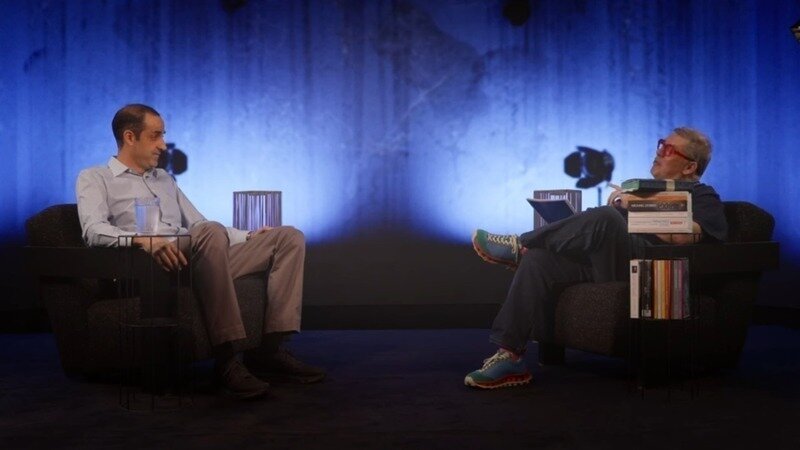
It exhausted me unbearably.. What?!
So Grigoris Dimitriadis broke his silence. Three and a half hours, five parts, with Thanasis Lalas!.. And within that mass of words, one refrain-word kept repeating like an incantation: "political responsibility." The problem is that political responsibility, once emptied of all content, is not accountability. It's a confession without confessing - a pretext for something far more ambitious than a simple image rehabilitation.
Because let's not fool ourselves: this wasn't an interview of reckoning. It was a presidential-résumé interview. The man who, he says, "took the bullet" for his boss needed three and a half hours to tell us how much he reads. He called himself a "book-eater." He invoked Kazantzakis to tell us he loves responsibility. He invoked Lee Kuan Yew, the Prime Minister of Singapore, to explain that he's a "pragmatist" beyond "left" and "right." He invoked, invoked, invoked - the living and the dead, allies and rivals alike. Politicians, philosophers, thinkers, right down to Mr. Miyagi from Karate Kid, with his inimitable wax on–wax off (he actually misspoke and said something like "wax in–was out"), philosophizing about performing tedious, repetitive tasks and efforts that secretly build core skills, muscle memory, discipline, and above all power - political power. (Even when the purpose isn't immediately clear.)
The show's narrator, in fact, introduced us to the story with the classic "once upon a time there was a man in a dark room" - something like a fairy tale with a happy ending. Obviously, and chiefly, for the... protagonist himself.
This display of erudition isn't irrelevant decoration. It is the message itself. When someone wants us to believe he thinks like a prime minister ("if I were prime minister I'd look to solve the problem"), he isn't giving an account of the past. He's building a future. The endless "flipping through" of names and whatever else fit into three and a half hours is the shop window of a man who wants to appear a thoughtful leader - not merely a former secretary-general who owes us explanations.
But what is political responsibility, really?
It's an institutional concept distinct from CRIMINAL and CIVIL liability: someone publicly acknowledges that something serious happened under their watch - regardless of whether they personally committed it - and for that reason steps down. No proof of personal guilt is required. It's enough that it happened on their watch. It's the fastest circuit of accountability, prior to or a substitute for the judicial one. In functioning democracies it means resignation or dismissal.
Formally, then, Mr. Dimitriadis has the right to invoke it: he did step down from his post as secretary-general. That is its minimal, formal version.
The question left unanswered is whether stepping down is enough as "responsibility," when at the same time he publicly declares he will protect those who operationally handled the surveillance and will never speak about it. That doesn't resemble accountability. It resembles a vow of silence in political packaging. Taking responsibility without saying who decided, who carried it out, why specific people were targeted, is not responsibility. It's a figure of speech.
The conversation with Lalas didn't have the pressure of genuine cross-examination. Mr. Dimitriadis let a great deal be implied and explained nothing concrete. He was not substantively pressed on:
The timing overlap between the National Intelligence Service's (EYP) targeting and the Predator-infected SMS sent to dozens of people.
The web of personal and business ties with executives of Intellexa and Krikel.
The export licenses for the spyware to African and other countries during the period of his own oversight.
The destruction of critical EYP files immediately after the Androulakis case came to light.
Instead, he took what he needed: the space to construct his own narrative, alone.
Two images dominated - "the Boss" and "the bullet": the communications machinery at work.
The first: the prime minister, "the Boss," knew nothing; he himself took full responsibility.
But that is exactly the problem - because if the prime minister's closest aide, entrusted with overseeing EYP, was operating on such a critical matter without informing "the Boss," then the narrative of a controlled, well-run state collapses on its own.
The second image: the "bullet" he took to protect the government, the party, and even the country. Communications-wise, this turns an institutional failure into an act of self-sacrifice. Public opinion, however, didn't read it as the sacrifice of an innocent man. It read it as the rebranding of a forced removal, so that the damage wouldn't reach the core of power.
In essence, then...
Grigoris Dimitriadis spoke for three and a half hours and said nothing substantial about the one thing that actually mattered. He devoted a few minutes to the wiretapping scandal, and the rest to the résumé of his erudition.
He took on a responsibility he doesn't explain, promised a silence he doesn't justify, and left the conversation with the narrative of the loyal soldier intact - plus something extra: the image of a man of thought, of wide reading, and of "pragmatism" worthy of higher office.
Those who were waiting for answers about the depth and workings of Predator in Greece are still waiting. Those who were waiting to learn what he read last summer went away fully satisfied.
Political responsibility without content doesn't close cases. It buries them - with better headlines and, as it turns out, with better bibliography.
The Professor Who Didn't "Buy" the "Bullet"
It didn't take political opposition to puncture the narrative of the nephew-and-grandson-and-so-on. Pavlos Eleftheriadis, Professor of Law at Oxford and, notably, a former New Democracy candidate for the European Parliament, said quite enough on his own.
In a public post titled "The Accused Grigoris Dimitriadis," he wrote that the former secretary-general remains a suspect for very serious felonies for as long as a full investigation isn't carried out, and he reminded readers that criminal liability isn't washed away by election results.
This is the point that overturns the entire staging of the "bullet" set up in a well-orchestrated, literary-style interview. Mr. Dimitriadis wants to convince us that the matter is political, moral, personal - a matter of honor between men who know how to stay silent. Eleftheriadis reminds him of something far more uncomfortable: that "the voters decided" is not an answer to questions of criminal law. A code of honor is no shield against the Supreme Court (Areios Pagos).
And for as long as he chooses to speak only in the language of "the boss" and "the bullet," he remains, in the professor's words, a suspect in the eyes of public opinion.
It's no accident that some legal circles compared his "vow of silence" to an omertà code. When the prime minister's former right-hand man talks about a commitment to never speak, he isn't describing political responsibility. He's describing something much closer to a pact of silence - and that is exactly the question the three-and-a-half-hour conversation about books and philosophers tried to bury beneath he charm of its storytelling.