
Grate our Trees, Don’t Choke them
The Issue
I tripped over the brick enclosure around a tree trunk last week. Looking at the Tree pit with its raised bricks and scraggly plants, blocking the pavement, I asked the Horticulture & Smart City persons why it was there. As the pourakarmika sometimes sweep rubbish into the tree bed, so it’s better we protect it, one replied. By creating another hazard I asked? There was silence .
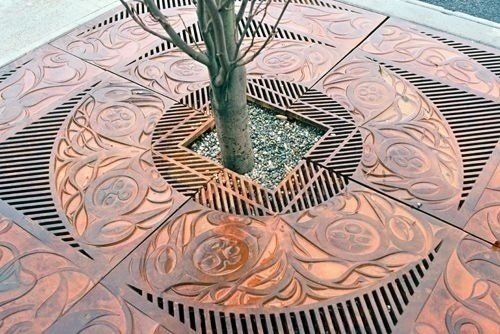
We love trees, we love to walk and use our pavements too. Many Indian states like Gujarat or Tamil Nadu, planners have recognized the need to protect trees AND pedestrians by using a simple tree grate at the base of the tree to guard the soil and roots, and integrated it into the street and city design. Trees play an important role in rainwater runoff and in flood management. These grates keep the trees safe and allows sunlight, water, and air to pass through, ensuring trees still have plenty of access to nutrients. Many civic agencies , private owners etc often concrete or choke the tree bed resulting in the tree roots weakening and tree falling , causing grave danger to pedestrians and vehicles as well. The tree grate design allows pedestrians maximum walking space and integrates the tree INTO a the pathway rather than causing a block. They prevent litter build up and weed growth as well. By allowing for tree growth, and creating safe enclosures for growing trees, it creates an aesthetic integrated feel blending into urban background that truly means a smart city.
And no, it’s not expensive! It’s as cost effective than the cumbersome, breakable brick enclosures that block the pedestrian walk way, and grates can be made in cast aluminum , cast iron or even concrete. It can be precast in the design of the city emblem or symbol, thereby creating greater ownership and deepening cultural roots. By integrating into disability standards, it covers another important aspect of walkability. A WHO report also suggests that aesthetically pleasing landscaping is linked with less violence, graffiti, vandalism, and litter in the area too.
Smart Cities itself recognises this as an integral part of the greening exercise . On World Cities Day , a report Smart Cities (in a campaign with World Economic Forum) mentioned 'The plantation drive of 100 saplings commenced in the morning along the Raj Bhavan Road. It may be noted that tree plantation, tree mapping, tree grates, and green buffer alongside the carriageway have been identified as integral components of road architecture for improving the walkability on the footpath and sustainable mobility'
Cities like Bangalore who work so hard to protect and nurture precious trees should immediately shift to this simple system that saves lives, preserves the tree, integrates it into the surroundings, creates walkability and is aesthetic and sustainable.
Let’s grate our trees, not choke them.
Useful Links:
- https://www.thehansindia.com/news/cities/bengaluru/bengaluru-plantation-drive-marks-world-cities-day-week-654064
- www.reliance-foundry.com/blog/tree-pits-vs-tree-grates
- https://smartnet.niua.org/sites/all/themes/niua_smartnet/pdf/SCM_Webinar_E_book_15_Aug.pdf
- https://chennai.citizenmatters.in/citizen-matters-panel-on-tree-cover-plantation-and-maintenance-in-chennai-2370
- https://cpwd.gov.in/Publication/LandscapeBook.pdf Tree
- https://insights.jonite.com/5-ways-tree-grates-can-make-a-difference-in-your-landscape

46
The Issue
I tripped over the brick enclosure around a tree trunk last week. Looking at the Tree pit with its raised bricks and scraggly plants, blocking the pavement, I asked the Horticulture & Smart City persons why it was there. As the pourakarmika sometimes sweep rubbish into the tree bed, so it’s better we protect it, one replied. By creating another hazard I asked? There was silence .
We love trees, we love to walk and use our pavements too. Many Indian states like Gujarat or Tamil Nadu, planners have recognized the need to protect trees AND pedestrians by using a simple tree grate at the base of the tree to guard the soil and roots, and integrated it into the street and city design. Trees play an important role in rainwater runoff and in flood management. These grates keep the trees safe and allows sunlight, water, and air to pass through, ensuring trees still have plenty of access to nutrients. Many civic agencies , private owners etc often concrete or choke the tree bed resulting in the tree roots weakening and tree falling , causing grave danger to pedestrians and vehicles as well. The tree grate design allows pedestrians maximum walking space and integrates the tree INTO a the pathway rather than causing a block. They prevent litter build up and weed growth as well. By allowing for tree growth, and creating safe enclosures for growing trees, it creates an aesthetic integrated feel blending into urban background that truly means a smart city.
And no, it’s not expensive! It’s as cost effective than the cumbersome, breakable brick enclosures that block the pedestrian walk way, and grates can be made in cast aluminum , cast iron or even concrete. It can be precast in the design of the city emblem or symbol, thereby creating greater ownership and deepening cultural roots. By integrating into disability standards, it covers another important aspect of walkability. A WHO report also suggests that aesthetically pleasing landscaping is linked with less violence, graffiti, vandalism, and litter in the area too.
Smart Cities itself recognises this as an integral part of the greening exercise . On World Cities Day , a report Smart Cities (in a campaign with World Economic Forum) mentioned 'The plantation drive of 100 saplings commenced in the morning along the Raj Bhavan Road. It may be noted that tree plantation, tree mapping, tree grates, and green buffer alongside the carriageway have been identified as integral components of road architecture for improving the walkability on the footpath and sustainable mobility'
Cities like Bangalore who work so hard to protect and nurture precious trees should immediately shift to this simple system that saves lives, preserves the tree, integrates it into the surroundings, creates walkability and is aesthetic and sustainable.
Let’s grate our trees, not choke them.
Useful Links:
- https://www.thehansindia.com/news/cities/bengaluru/bengaluru-plantation-drive-marks-world-cities-day-week-654064
- www.reliance-foundry.com/blog/tree-pits-vs-tree-grates
- https://smartnet.niua.org/sites/all/themes/niua_smartnet/pdf/SCM_Webinar_E_book_15_Aug.pdf
- https://chennai.citizenmatters.in/citizen-matters-panel-on-tree-cover-plantation-and-maintenance-in-chennai-2370
- https://cpwd.gov.in/Publication/LandscapeBook.pdf Tree
- https://insights.jonite.com/5-ways-tree-grates-can-make-a-difference-in-your-landscape
Petition Updates
Share this petition
Petition created on 28 July 2021