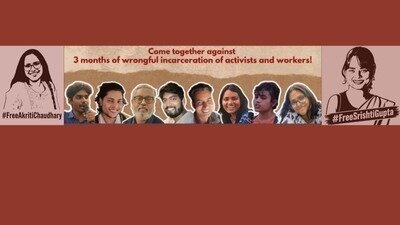

CALL FOR FREEDOM OF IMPRISONED ARTISTS SRISHTI GUPTA, AKRITI CHAUDHARY AND OTHERS
The Issue
A PETITION BY ARTISTS AND CULTURAL PRACTITIONERS CALLING FOR THE IMMEDIATE RELEASE, ON BAIL, OF ARTIST SRISHTI GUPTA, THEATRE WORKER AKRITI CHAUDHARY, AND OTHER ACTIVISTS & WORKERS ARRESTED SINCE APRIL 11, 2026, IN NOIDA, UTTAR PRADESH.
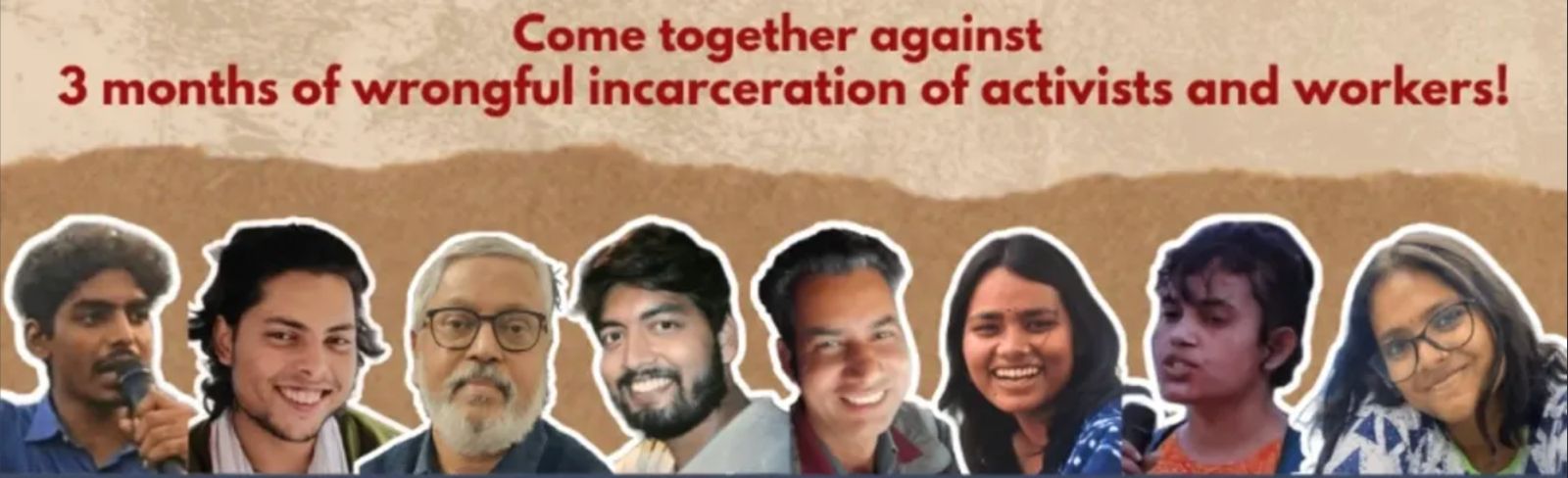
When Srishti Gupta, or Akriti Chaudhary stood, or sat, or drew pictures on the tarmac, or sang songs or read poetry into the air, breathing life into their own imaginations, and in the imaginations of an assembly of workers in the middle of a highway in Noida in April this year, they did not know that they were committing a crime. But the district judge of the Surajpur District Court in Gautam Buddha Nagar thought that being an artist can sometimes be a crime.
In the judge’s understanding of the law, an artist is ‘neither a worker, nor an employee’, and so the artist’s presence, which cannot be accounted for when it is seen unfolding in the middle of a wave of protests sweeping through Noida and elsewhere in the NCR, is itself the crime. Aesthetics and conspiracy are partners in crime.
That is why Srishti and Akriti, along with their friends and comrades - Manisha Chauhan, Rupesh Roy, Aditya Anand, Himangshu Thakur, Yogesh Meena, and Satyam Varma, (a factory worker, an auto-driver, a software programmer, a labour activist, a student, and an editor & translator, respectively) have been denied bail, and are in prison, charged with leading and conspiring to provoke violence, for the past three months.
To us, the undersigned, a group of artists, curators, creative practitioners, and friends of art, the artists’ presence as a witness, interlocutor, observer and bearer of empathy, is precisely not a crime, it is a normal and natural part of what it means to be an artist in the world today. And that is why we are expressing our disagreement with a mechanistic application of the law that criminalizes an artists’ presence in society, even in a turbulent world. For Srishti and Akriti, the natural, normal, organic engagements that they have maintained with other humans - be they children, be they women workers, be they young people their own age working in factories - are the processes that they have nurtured, and that have nurtured them, ever since they were students. These practices constitute nothing extraordinary in the lives of artists.
These have been an active part of Srishti and Akritis’ life-practices, their ways of making sense of the world, since they were students in Delhi University, in the College of Art, and in Kala Bhavan in Shantiniketan, and ever since they began building a creative life in Delhi. Thousands of artists of Srishti and Akriti’s generation (and before) have explored these practices in order to learn how to be artists, and how to be human.
Srishti and Akriti built this creative life, and shared it generously with others, through workshops, through conversations, by teaching children, by volunteering in libraries and cultural centers, by singing songs in joy, sorrow and struggle, through collaborative and convivial processes of learning, art making and discovery.
They are citizens who have long participated in public life through creative, cultural, and democratic engagement. From organizing art workshops in slums to leading medical camps to running a public library to providing education to women domestic workers, their practice evidences a way of life rooted in community work and in taking actionable steps towards a more equitable society. Their support for workers exercising their legitimate rights needs to be seen as part of this process and should not become grounds for their criminalization.
We, as artists and creative practitioners, and as friends of artists, hold that there is something joyful and wondrous about this everyday cultivation of beauty, wonder and solidarity, especially in a turbulent and unequal world. We vehemently disagree that being an artist, or being present as an artist, can ever be considered to be a crime, under any circumstances.
The never ending formation and education of an artist is based on the expansion of the human imagination that this process entails. This is what inspires humans to break free of the cages of their isolation, and breathe together, in unison and dialogue with the experience of others. This is why we have art in the world. This capacity to be with others, and to share in their joys, sorrows and dreams for a better world, for a dignified life is what turns a citizen into an artist, and an artist into a citizen. An artist, be they of the literary, visual, performing, conceptual, or filmic arts, is first and foremost an adventurer at the horizons of the human experience. She is a nurturer of solidarities and a bearer of empathy. This is what Srishti and Akriti are, and they continue to fulfill this function, even in prison, with their fellow inmates.
We, the undersigned artists, theatre workers, writers, musicians, filmmakers, cultural practitioners, scholars, and concerned citizens, believe that they must be at liberty to do so, as free citizens, and as artists, now and immediately, and for the foreseeable future. They belong, not in prison, but in the world, with us, on the streets and in the libraries, with the workers, and the children of workers whose lives that they have enriched and textured.
The prolonged deprivation of their liberty before the conclusion of any trial raises serious questions about the protection of fundamental rights in a democratic society. It punishes empathy as if it were an offense. Bail is a cornerstone of the principle that every accused person is presumed innocent until proven guilty in a court of law. Continued incarceration before conviction should not be used as a form of punishment in itself. It risks creating an atmosphere of fear in which artistic practice, cultural expression, and civic engagement are curtailed by the threat of prolonged detention and criminal prosecution.
A society that values democracy must protect the freedom of artists, writers, performers, and cultural workers to engage with the social realities of their time without fear of persecution. The criminalization of artistic and civic solidarity undermines not only individual liberty but also the cultural and democratic life of the nation. This situation demands immediate attention and corrective action. We therefore call upon the appropriate judicial authorities to ensure that they are all granted immediate release on bail and afforded a free, fair, and expeditious trial, conducted in accordance with the law and the constitutional guarantees available to every citizen. We are confident that such a trial will establish their innocence.
Link to Press Conferences: https://www.instagram.com/the.carwan/


2,360
The Issue
A PETITION BY ARTISTS AND CULTURAL PRACTITIONERS CALLING FOR THE IMMEDIATE RELEASE, ON BAIL, OF ARTIST SRISHTI GUPTA, THEATRE WORKER AKRITI CHAUDHARY, AND OTHER ACTIVISTS & WORKERS ARRESTED SINCE APRIL 11, 2026, IN NOIDA, UTTAR PRADESH.
When Srishti Gupta, or Akriti Chaudhary stood, or sat, or drew pictures on the tarmac, or sang songs or read poetry into the air, breathing life into their own imaginations, and in the imaginations of an assembly of workers in the middle of a highway in Noida in April this year, they did not know that they were committing a crime. But the district judge of the Surajpur District Court in Gautam Buddha Nagar thought that being an artist can sometimes be a crime.
In the judge’s understanding of the law, an artist is ‘neither a worker, nor an employee’, and so the artist’s presence, which cannot be accounted for when it is seen unfolding in the middle of a wave of protests sweeping through Noida and elsewhere in the NCR, is itself the crime. Aesthetics and conspiracy are partners in crime.
That is why Srishti and Akriti, along with their friends and comrades - Manisha Chauhan, Rupesh Roy, Aditya Anand, Himangshu Thakur, Yogesh Meena, and Satyam Varma, (a factory worker, an auto-driver, a software programmer, a labour activist, a student, and an editor & translator, respectively) have been denied bail, and are in prison, charged with leading and conspiring to provoke violence, for the past three months.
To us, the undersigned, a group of artists, curators, creative practitioners, and friends of art, the artists’ presence as a witness, interlocutor, observer and bearer of empathy, is precisely not a crime, it is a normal and natural part of what it means to be an artist in the world today. And that is why we are expressing our disagreement with a mechanistic application of the law that criminalizes an artists’ presence in society, even in a turbulent world. For Srishti and Akriti, the natural, normal, organic engagements that they have maintained with other humans - be they children, be they women workers, be they young people their own age working in factories - are the processes that they have nurtured, and that have nurtured them, ever since they were students. These practices constitute nothing extraordinary in the lives of artists.
These have been an active part of Srishti and Akritis’ life-practices, their ways of making sense of the world, since they were students in Delhi University, in the College of Art, and in Kala Bhavan in Shantiniketan, and ever since they began building a creative life in Delhi. Thousands of artists of Srishti and Akriti’s generation (and before) have explored these practices in order to learn how to be artists, and how to be human.
Srishti and Akriti built this creative life, and shared it generously with others, through workshops, through conversations, by teaching children, by volunteering in libraries and cultural centers, by singing songs in joy, sorrow and struggle, through collaborative and convivial processes of learning, art making and discovery.
They are citizens who have long participated in public life through creative, cultural, and democratic engagement. From organizing art workshops in slums to leading medical camps to running a public library to providing education to women domestic workers, their practice evidences a way of life rooted in community work and in taking actionable steps towards a more equitable society. Their support for workers exercising their legitimate rights needs to be seen as part of this process and should not become grounds for their criminalization.
We, as artists and creative practitioners, and as friends of artists, hold that there is something joyful and wondrous about this everyday cultivation of beauty, wonder and solidarity, especially in a turbulent and unequal world. We vehemently disagree that being an artist, or being present as an artist, can ever be considered to be a crime, under any circumstances.
The never ending formation and education of an artist is based on the expansion of the human imagination that this process entails. This is what inspires humans to break free of the cages of their isolation, and breathe together, in unison and dialogue with the experience of others. This is why we have art in the world. This capacity to be with others, and to share in their joys, sorrows and dreams for a better world, for a dignified life is what turns a citizen into an artist, and an artist into a citizen. An artist, be they of the literary, visual, performing, conceptual, or filmic arts, is first and foremost an adventurer at the horizons of the human experience. She is a nurturer of solidarities and a bearer of empathy. This is what Srishti and Akriti are, and they continue to fulfill this function, even in prison, with their fellow inmates.
We, the undersigned artists, theatre workers, writers, musicians, filmmakers, cultural practitioners, scholars, and concerned citizens, believe that they must be at liberty to do so, as free citizens, and as artists, now and immediately, and for the foreseeable future. They belong, not in prison, but in the world, with us, on the streets and in the libraries, with the workers, and the children of workers whose lives that they have enriched and textured.
The prolonged deprivation of their liberty before the conclusion of any trial raises serious questions about the protection of fundamental rights in a democratic society. It punishes empathy as if it were an offense. Bail is a cornerstone of the principle that every accused person is presumed innocent until proven guilty in a court of law. Continued incarceration before conviction should not be used as a form of punishment in itself. It risks creating an atmosphere of fear in which artistic practice, cultural expression, and civic engagement are curtailed by the threat of prolonged detention and criminal prosecution.
A society that values democracy must protect the freedom of artists, writers, performers, and cultural workers to engage with the social realities of their time without fear of persecution. The criminalization of artistic and civic solidarity undermines not only individual liberty but also the cultural and democratic life of the nation. This situation demands immediate attention and corrective action. We therefore call upon the appropriate judicial authorities to ensure that they are all granted immediate release on bail and afforded a free, fair, and expeditious trial, conducted in accordance with the law and the constitutional guarantees available to every citizen. We are confident that such a trial will establish their innocence.
Link to Press Conferences: https://www.instagram.com/the.carwan/
Petition Updates
Share this petition
Petition created on 9 July 2026