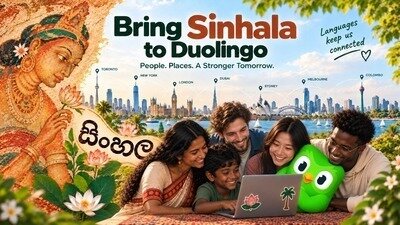

Bring Sinhala language course to Duolingo
The Issue
For many people with Sri Lankan roots who grow up abroad, learning Sinhala is harder than it should be.
Sinhala may be the language spoken by parents, grandparents or extended family, but younger generations of the diaspora do not always have the opportunity to learn it themselves. Some grow up understanding Sinhala but struggle to speak it. Others, particularly in mixed families, may have only limited exposure to the language.
And for those who want to learn or reconnect with Sinhala later, there is a surprisingly practical problem: accessible, comprehensive and structured ways to learn Sinhala online remain remarkably scarce.
This matters because Sinhala-speaking communities extend far beyond Sri Lanka.
Australia's 2021 Census recorded 85,869 people who speak Sinhala at home, including 49,501 in Victoria alone. Canada's 2021 Census recorded 33,050 people with knowledge of Sinhala.
And those numbers don't include all the children and grandchildren of Sinhala speakers who cannot yet speak the language themselves, precisely the people who could benefit most from an accessible way to learn it.
Why Duolingo?
Sinhala (සිංහල) is one of Sri Lanka's two official languages, alongside Tamil, and is spoken by millions of people. It has its own distinctive script and a literary tradition stretching back centuries.
Yet someone who wants to learn Sinhala today will often find resources scattered across textbooks, videos, websites and private tutoring rather than a widely accessible, structured learning platform.
As Duolingo has become the world's most downloaded education app, bringing Sinhala to Duolingo could help change that.
A Sinhala course for English speakers could give heritage learners around the world an accessible way to learn the language wherever they live and help families pass Sinhala on to another generation.
The potential audience is broader still. Partners and spouses of Sinhala speakers may want to communicate with their extended families. Travellers and people moving to Sri Lanka may want to communicate with Sinhala-speaking communities. Students, researchers and language enthusiasts also have relatively few structured options for learning the language.
What we're asking
We are asking Duolingo to assess the demand and feasibility of developing a Sinhala course for English speakers.
If you would use Sinhala on Duolingo, please sign and share this petition.
When signing, tell us where in the world you live and why you would like to learn Sinhala. This will help demonstrate not only how many potential learners there are, but how global that demand is.
Sinhala teachers, linguists, academics and native speakers who would be willing to contribute expertise or help test a future course are also encouraged to make themselves known.
For Sinhala to remain a living part of diaspora communities across generations, people need realistic ways to learn it. Let's make Duolingo one of them.
Sinhala is not alone
For diaspora communities, passing a language from one generation to the next can be difficult, especially when accessible and structured opportunities to learn it are limited.
Sinhala is far from alone in this. Bengali, Punjabi, Tamil, Malayalam, Tagalog (Filipino), Burmese, Thai, Persian (Farsi), Armenian, Igbo, Yoruba and Samoan are among the many languages currently absent as languages to learn on Duolingo, despite being spoken by significant diaspora communities around the world.
Their histories, circumstances and numbers of speakers differ, but they share an important challenge: for children and later generations growing up outside the regions where these languages are widely spoken, opportunities to learn, practise and reconnect with their heritage language can be much harder to find.
Digital language-learning platforms have an opportunity to help bridge that gap—not only for Sinhala speakers, but for heritage-language communities around the world.
While this campaign starts with Sinhala, we hope it can contribute to a wider conversation about making language learning more inclusive and accessible for the many diaspora communities whose languages remain underrepresented online.

82
The Issue
For many people with Sri Lankan roots who grow up abroad, learning Sinhala is harder than it should be.
Sinhala may be the language spoken by parents, grandparents or extended family, but younger generations of the diaspora do not always have the opportunity to learn it themselves. Some grow up understanding Sinhala but struggle to speak it. Others, particularly in mixed families, may have only limited exposure to the language.
And for those who want to learn or reconnect with Sinhala later, there is a surprisingly practical problem: accessible, comprehensive and structured ways to learn Sinhala online remain remarkably scarce.
This matters because Sinhala-speaking communities extend far beyond Sri Lanka.
Australia's 2021 Census recorded 85,869 people who speak Sinhala at home, including 49,501 in Victoria alone. Canada's 2021 Census recorded 33,050 people with knowledge of Sinhala.
And those numbers don't include all the children and grandchildren of Sinhala speakers who cannot yet speak the language themselves, precisely the people who could benefit most from an accessible way to learn it.
Why Duolingo?
Sinhala (සිංහල) is one of Sri Lanka's two official languages, alongside Tamil, and is spoken by millions of people. It has its own distinctive script and a literary tradition stretching back centuries.
Yet someone who wants to learn Sinhala today will often find resources scattered across textbooks, videos, websites and private tutoring rather than a widely accessible, structured learning platform.
As Duolingo has become the world's most downloaded education app, bringing Sinhala to Duolingo could help change that.
A Sinhala course for English speakers could give heritage learners around the world an accessible way to learn the language wherever they live and help families pass Sinhala on to another generation.
The potential audience is broader still. Partners and spouses of Sinhala speakers may want to communicate with their extended families. Travellers and people moving to Sri Lanka may want to communicate with Sinhala-speaking communities. Students, researchers and language enthusiasts also have relatively few structured options for learning the language.
What we're asking
We are asking Duolingo to assess the demand and feasibility of developing a Sinhala course for English speakers.
If you would use Sinhala on Duolingo, please sign and share this petition.
When signing, tell us where in the world you live and why you would like to learn Sinhala. This will help demonstrate not only how many potential learners there are, but how global that demand is.
Sinhala teachers, linguists, academics and native speakers who would be willing to contribute expertise or help test a future course are also encouraged to make themselves known.
For Sinhala to remain a living part of diaspora communities across generations, people need realistic ways to learn it. Let's make Duolingo one of them.
Sinhala is not alone
For diaspora communities, passing a language from one generation to the next can be difficult, especially when accessible and structured opportunities to learn it are limited.
Sinhala is far from alone in this. Bengali, Punjabi, Tamil, Malayalam, Tagalog (Filipino), Burmese, Thai, Persian (Farsi), Armenian, Igbo, Yoruba and Samoan are among the many languages currently absent as languages to learn on Duolingo, despite being spoken by significant diaspora communities around the world.
Their histories, circumstances and numbers of speakers differ, but they share an important challenge: for children and later generations growing up outside the regions where these languages are widely spoken, opportunities to learn, practise and reconnect with their heritage language can be much harder to find.
Digital language-learning platforms have an opportunity to help bridge that gap—not only for Sinhala speakers, but for heritage-language communities around the world.
While this campaign starts with Sinhala, we hope it can contribute to a wider conversation about making language learning more inclusive and accessible for the many diaspora communities whose languages remain underrepresented online.
The Decision Makers
Petition Updates
Share this petition
Petition created on September 17, 2026