📢 3 Days Is Not Enough — Stop the Revolving Door of Mental Health Care

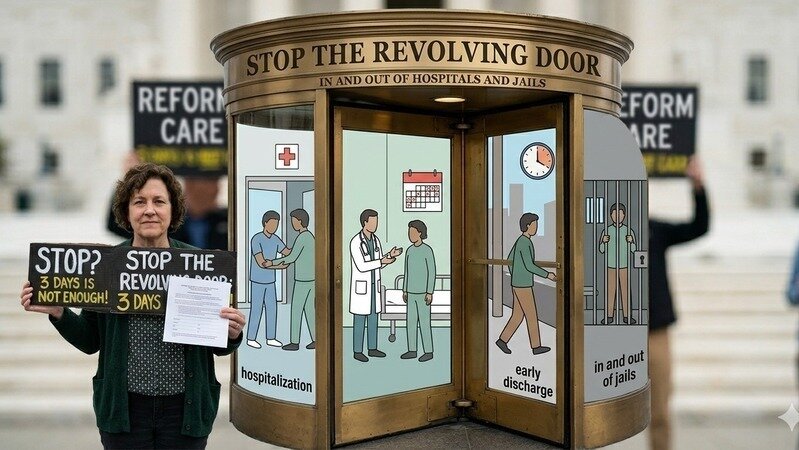
📢 Petition Update: 3 Days Is Not Enough — Stop the Revolving Door of Mental Health Care
Dear Supporters,
When someone is in the middle of a severe schizophrenic crisis, a 3-day hospital stay is not a cure. It is barely a band-aid.
Right now, our mental health system operates like a revolving door. Patients are admitted in acute psychosis, held just long enough to ensure they aren't an immediate danger to themselves or others, and then discharged back into the community.
I know this nightmare firsthand because I watch my own family member live it. Because of schizophrenia, they have been trapped in a heartbreaking loop—in and out of hospitals, and tragically, in and out of jails. When the medical system fails to provide long-term, stabilized care, the justice system becomes the default safety net. This is not just a failure of healthcare; it is a crisis of human dignity.
The data shows exactly why this approach is failing thousands of families every single day:
The Medication Gap: Antipsychotic medications take 1 to 4+ weeks** to become fully effective. Discharging a patient after 3 days means sending them home before their treatment has even had a chance to work.
The Readmission Trap: Studies show that for high-acuity schizophrenia cases discharged early, **30% to 50% are rehospitalized within just 30 to 90 days**.
The Follow-Up Failure: Without structured, supportive housing and mandatory outpatient follow-up within the first 7 days, a relapse is almost guaranteed. Within a year, **60% to 80% of individuals relapse** if their care plan falls through.
A 3-day stay doesn't mean "recovered"—it just means "safe enough to leave." But true safety requires long-term stabilization, coordinated outpatient care, and supportive environments that keep vulnerable people out of hospital beds and jail cells.
We are fighting to reform this broken cycle. We need a system that prioritizes long-term healing over rapid turnover.
Please keep sharing this petition. Let's make our voices loud enough that the lawmakers and hospital administrators cannot look away. Our loved ones deserve a door that opens to recovery, not a revolving door that leads to a jail cell.
📊 Schizophrenia & Early Discharge: The Numbers
Hospital stays that last only around 3 days are typically considered brief acute stabilization rather than a full recovery. In practice, this means a patient is deemed safe enough to leave immediate inpatient care, but they are often still actively managing symptoms like hallucinations, delusions, or limited insight into their illness.
The data below highlights the sharp contrast in outcomes based on treatment windows and timelines:
Metric
Timeline
General Statistics
Early/Rapid Discharge Context
Relapse Rates
1 Year
• 20–40% with consistent treatment/medication.
• 60–80% without proper medication and follow-up care.
Risk skyrockets if a patient is discharged before symptoms stabilize.
Readmission Rates
30 Days
• 20–30% across general psychiatric cases.
• 30–50% (up to 90 days) for high-acuity schizophrenia cases discharged early.
90 Days
• 40–60% across general psychiatric cases.
Antipsychotics typically require 1–4+ weeks to reach full therapeutic effect.
6–12 Months
• 50–80% for high-risk groups (e.g., active symptoms at discharge).
Rapid discharge often leaves patients without fully realized medication benefits.
🔄 Why Rapid Rehospitalization Occurs
When a patient is discharged after a short stay (like 3 days), they enter a highly vulnerable transition window. The most common drivers of quick readmission include:
Medication Gap: The prescribed antipsychotics haven't had enough time to become fully effective, or the patient stops taking them once they leave the structured environment.
I know this nightmare firsthand because I watch my own family member live it. Because of schizophrenia, they have been trapped in a heartbreaking loop—in and out of hospitals, and tragically, in and out of jails. When the medical system fails to provide long-term, stabilized care, the justice system becomes the default safety net. This is not just a failure of healthcare; it is a crisis of human dignity.
The data shows exactly why this approach is failing thousands of families every single day:
The Medication Gap: Antipsychotic medications take 1 to 4+ weeks to become fully effective. Discharging a patient after 3 days means sending them home before their treatment has even had a chance to work.
The Readmission Trap: Studies show that for high-acuity schizophrenia cases discharged early, 30% to 50% are rehospitalized within just 30 to 90 days.
The Follow-Up Failure: Without structured, supportive housing and mandatory outpatient follow-up within the first 7 days, a relapse is almost guaranteed. Within a year, 60% to 80% of individuals relapse if their care plan falls through.
A 3-day stay doesn't mean "recovered"—it just means "safe enough to leave." But true safety requires long-term stabilization, coordinated outpatient care, and supportive environments that keep vulnerable people out of hospital beds and jail cells.
We are fighting to reform this broken cycle. We need a system that prioritizes long-term healing over rapid turnover.
Please keep sharing this petition. Let's make our voices loud enough that the lawmakers and hospital administrators cannot look away. Our loved ones deserve a door that opens to recovery, not a revolving door that leads to a jail cell.
Here is a strong, urgent closing for your petition update. It clearly lays out the call to action, reminds supporters of what is at stake, and gives them a direct way to help you break this cycle.
✍️ How You Can Help Us Break the Cycle
We cannot change this broken system alone, but together, our voices are too loud to ignore. Every signature and every share brings us one step closer to forcing lawmakers and healthcare administrators to reform this revolving door.
Here is how you can take action right now:
Sign the Petition: If you haven't already, please add your name. Every single signature proves to our representatives that the community demands better care, longer stabilization periods, and real accountability.
Share Our Story: Please share this update on Facebook, Twitter, LinkedIn, and in your community groups. Use the hashtags #StopTheRevolvingDoor** and #MentalHealthReform**. You never know whose family is secretly fighting this exact same battle and needs to see they aren't alone.
Talk to Your Representatives: Copy the statistics from this post and email your local state officials. Let them know that a 3-day stay is a temporary band-aid, not a solution.
My family member, and thousands of others trapped between hospital walls and jail cells, deserve a healthcare system built on dignity and long-term recovery.
Click below to sign and share:
Thank you for your incredible support, your compassion, and for standing with us in this fight.
With deep gratitude,
Thank you for standing with us,
Tammy Willoughby