

Ban krill fishing in the Antarctic to prevent the extinction of whales, penguins and seals
La causa
Ban krill fishing in the Antarctic to prevent the extinction of whales, penguins and seals
Krill fishing is endangering penguins, whales and seals, the charismatic inhabitants of Antarctica. Krill is a tiny shrimp-like crustacean which is a keystone species in the Antarctic Ocean (also called Southern Ocean). Without krill the entire antarctic ecosystem collapses: it is the largest biomass of any wild animal species on the planet.
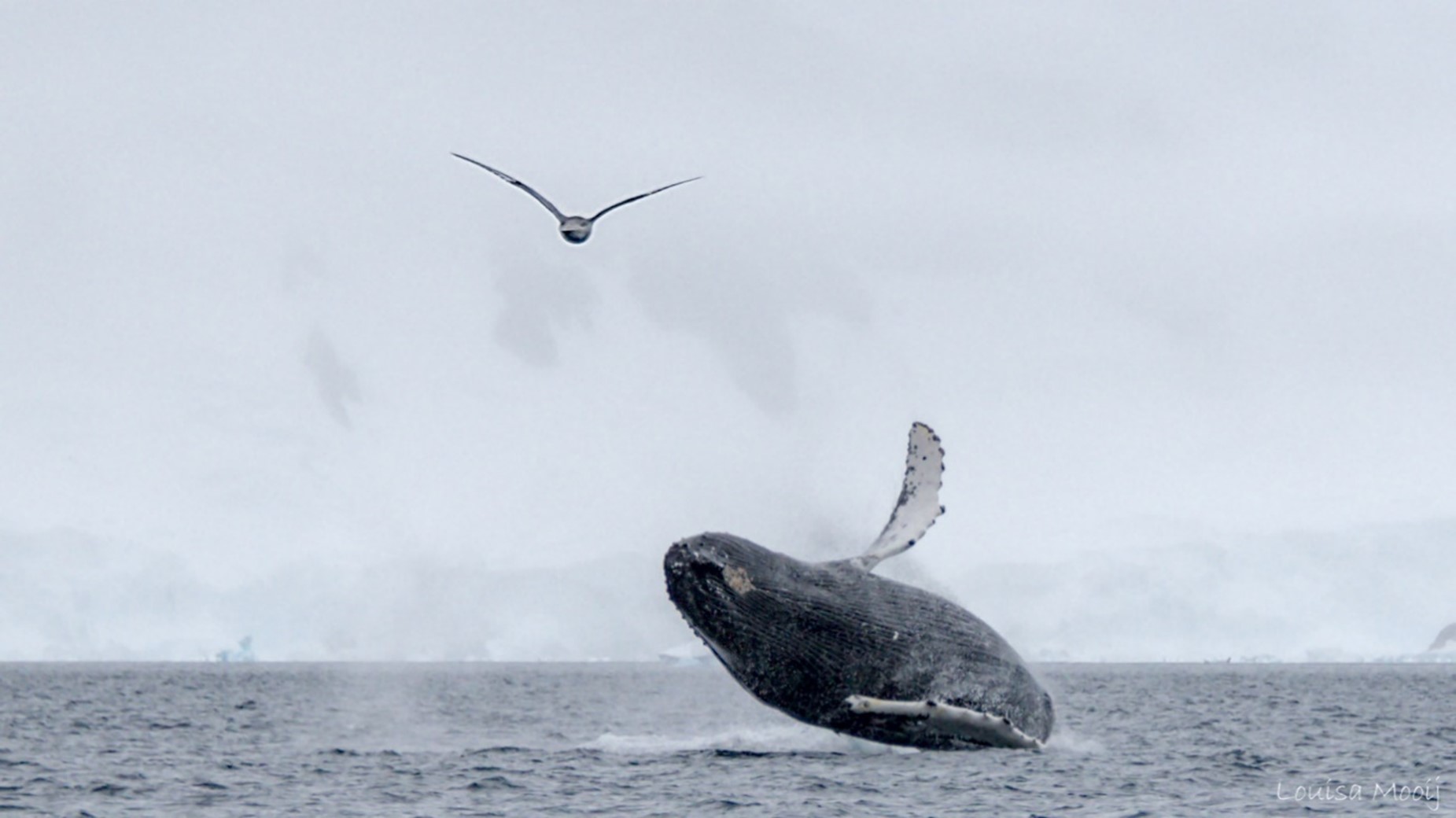
Breaching humpback whale in Recess cove (photo Marjolein Louisa Mooij)
Krill is caught by trawling ship to produce pet food, supplement farmed salmon and make omega 3 pills products, which all can be easily made with other ingredients.
We are witnessing krill fishing ships at the same place where whales, penguins and seals are feeding, competing with these animals for the same food source: krill. A humpback whale for example needs around 1.5 to 2 tons of krill per day. Two third of the world population of humpback whales (or 97000 individuals out of the 140 000 worldwide) feed in the Antarctic Ocean.
Krill fishing catch has been increasing significantly during the last two decades: from roughly 114500 tonnes in 2000 to 371500 tonnes in 2021. The catch from 2021 represents enough food to feed 212285 humpback whales, or better said, enough food to feed the world population of humpback whales for one and a half day !
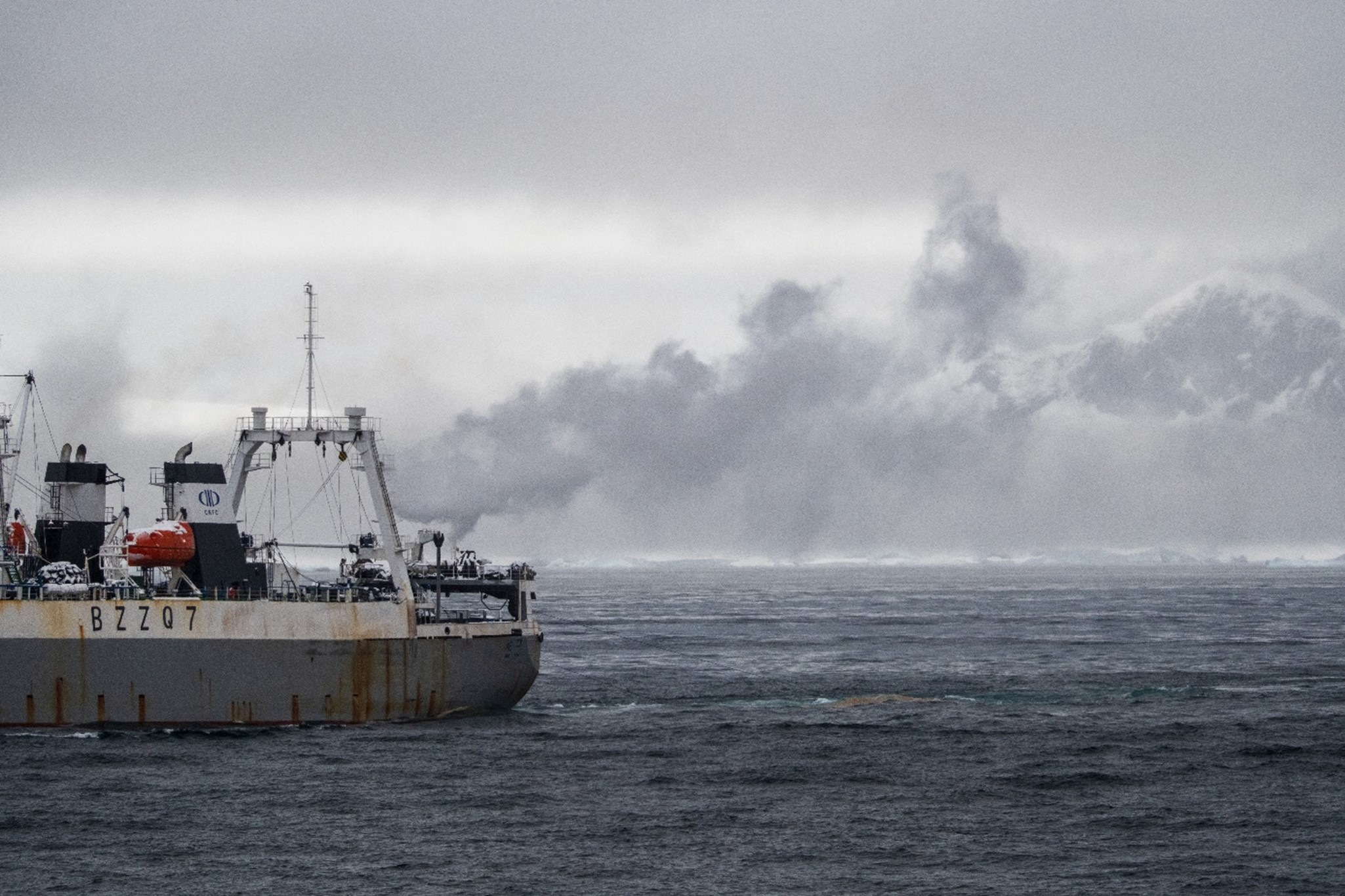
Long Fa actively trawling. The pink spot on the right is krill hauled to the surface (photo: Mara Unkefer)
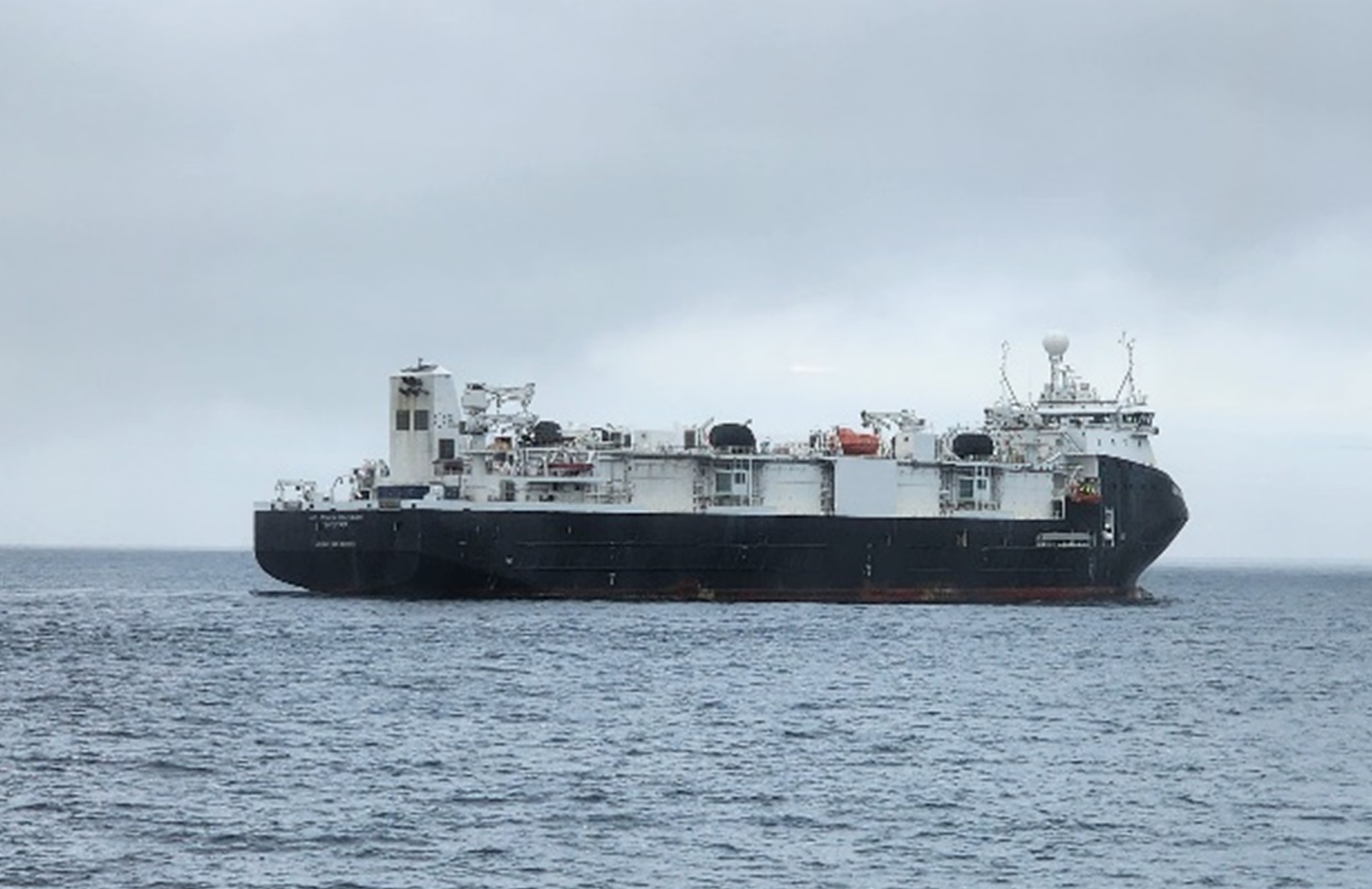
The Antarctic Provider, designed to transport krill products, crew, fuel and consumables between harvesting vessels and the logistics hub in Montevideo, navigating along the Antarctic peninsula.
(Photo Marcos Sperr)
Why save the whales if we’re going to starve them to death ?
Additionally, krill fecal pellets and moults help sequestering carbon which sink in the bottom of the ocean (useful to help solving the climate crisis). Global warming is already responsible for stress on krill development due to the warming of ocean temperature. Why should fishing activities add stress on the krill population ?
The Antarctic ecosystem is the least impacted by human activities so far. Do you want to live in a world where the last wilderness and its unique wildlife are destroyed simply for corporations to make money pulverising a keystone species to turn it into pet food, cheap feed for commercial farmed salmon and pills ?
The Antarctic Treaty System protects the Antarctic environment against oil, gas and mineral exploitation, but currently allow fishing. We must demand more robust protection for this fragile ecosystem.
The 57 countries which are part of the Antarctic Treaty System will meet in June 23rd / July 3rd 2025 in Milan, Italy, and CCAMLR (Commission for the Conservation of Antarctic Marine Living Resources) will meet in October 2025 in Hobart, Australia.
Act now by adding your signature which will be forwarded to these institutions for demanding better protection of the Antarctic Ocean.
A group of concerned Antarctic ambassadors.
December 25th, 2024
---
Bahlburg D, Hüppe L, Böhrer T, Thorpe SE, Murphy EJ, Berger U, Meyer B. 2023. Plasticity and seasonality of the vertical migration behaviour of Antarctic krill using acoustic data from fishing vessels. R. Soc. Open Sci. 10:230520. https://doi.org/10.1098/rsos.230520
https://royalsocietypublishing.org/doi/10.1098/rsos.230520
Belcher A, Henson SA., Manno C, Hill SL, Atkinson A, Thorpe SE, Fretwell P, Ireland L, Tarling GA. 2019. Krill faecal pellets drive hidden pulses of particulate organic carbon in the marginal ice zone. Nature Communications. https://doi.org/10.1038/s41467-019-08847-1
https://nora.nerc.ac.uk/id/eprint/522109/1/s41467-019-08847-1.pdf
Croxall JP, Everson I, Miller DGM. 1992. Management of the Antarctic krill fishery. Polar Record. 28(164):64-66. doi:10.1017/S0032247400020325
https://www.cambridge.org/core/journals/polar-record/article/abs/management-of-the-antarctic-krill-fishery/E3174410C0D7A68033A893F9D2C0B4F9
ASOC for CCAMLR. 2013. ‘When close is too close’ – krill fishing close to the coast. CCAMLR-XXXII/BG/17 Rev. 1
https://cdn.asoc.org/wp-content/uploads/2022/02/Rev.-1-%E2%80%98When-close-is-too-close-%E2%80%93-Krill-fishing-close-to-the-coast.pdf
Trathan PN. 2023. What is needed to implement a sustainable expansion of the Antarctic krill fishery in the Southern Ocean?. Marine Policy. 155. 105770. 10.1016/j.marpol.2023.105770
https://www.researchgate.net/publication/373588795_What_is_needed_to_implement_a_sustainable_expansion_of_the_Antarctic_krill_fishery_in_the_Southern_Ocean
Kawaguchi S, Ishida A, King R, Raymond B, Waller N, Constable A, Nicol S, Wakita M, Ishimatsu A. 2013. Risk maps for Antarctic krill under projected Southern Ocean acidification. 2013/09/01. Macmillan publisher limited. Nature Climate Change
https://www.nature.com/articles/nclimate1937
Savoca MS, Kumar M, Sylvester Z, Czapanskiy MF, Meyer B, Goldbogen JA, Brooks CM.2024. Whale recovery and the emerging human-wildlife conflict over Antarctic krill. Nat Commun 15, 7708 (2024). https://doi.org/10.1038/s41467-024-51954-x
https://www.nature.com/articles/s41467-024-51954-x
CCAMLR. 2018. Updated background paper (2018) on the Domain 1 MPA. Part A: Domain 1 MPA Model. SC-CAMLR-XXXVII/BG/07
https://meetings.ccamlr.org/en/sc-camlr-xxxvii/bg/07
Carwardine Mark. 2019. Handbook of whales, dolphins, and porpoises of the world. Published in 2020 by Princeton University Press.
https://www.lifeinnorway.net/richest-people/
https://new.nsf.gov/science-matters/antarctic-krill-superheroes-southern-ocean
https://www.superbakrill.com/
Woehler et al., Ornithological observations at Eckener Point, Antarctic Peninsula, Polar Record, 2010
Warwick-Evans, V. et al. Using habitat models for chinstrap penguins Pygoscelis antarctica to advise krill fisheries management during the penguin breeding season. Divers. Distrib. 24, 1756–1771 (2018).
Krüger, L. (2023). Decreasing Trends of Chinstrap Penguin Breeding Colonies in a Region of Major and Ongoing Rapid Environmental Changes Suggest Population Level Vulnerability. Diversity, 15(3), 327.
https://www.iucnredlist.org/species/22697761/184807209#population
Casaux, R. (2004). Diving patterns in the Antarctic shag. Waterbirds, 27(4), 382-387.
Wang, Z., Tang, H., Herrmann, B., & Xu, L. (2021). Catch pattern for Antarctic krill (Euphausia superba) of different commercial trawls in similar times and overlapping fishing grounds. Frontiers in Marine Science, 8, 670663.
Savoca, M.S., Kumar, M., Sylvester, Z. et al. Whale recovery and the emerging human-wildlife conflict over Antarctic krill. Nat Commun 15, 7708 (2024).
Trathan, P., Savoca, M., Friedlaender, A., Baines, M., Burkhardt, E., Cheeseman, T., ... & Reisinger, R. R. Integrating the needs of recovering populations of baleen whales into the revised management framework for the commercial fishery for Antarctic krill. Frontiers in Marine Science, 11, 1458042.
Forcada, J., Hoffman, J. I., Gimenez, O., Staniland, I. J., Bucktrout, P., & Wood, A. G. (2023). Ninety years of change, from commercial extinction to recovery, range expansion and decline for Antarctic fur seals at South Georgia. Global Change Biology, 29(24), 6867-6887.
https://www.ark-krill.org/fact-sheets-3
Clarke, J., Emmerson, L. M., & Otahal, P. (2006). Environmental conditions and life history constraints determine foraging range in breeding Adélie penguins. Marine Ecology Progress Series, 310, 247-261.
Adarme-Vega, T. C., Thomas-Hall, S. R., & Schenk, P. M. (2014). Towards sustainable sources for omega-3 fatty acids production. Current opinion in biotechnology, 26, 14-18.
https://www.mdpi.com/2410-3888/8/12/590
Quiñones, R. A., Fuentes, M., Montes, R. M., Soto, D., & León‐Muñoz, J. (2019). Environmental issues in Chilean salmon farming: a review. Reviews in aquaculture, 11(2), 375-402.
Noakes, D. J., Beamish, R. J., & Kent, M. L. (2000). On the decline of Pacific salmon and speculative links to salmon farming in British Columbia. Aquaculture, 183(3-4), 363-386.
Hindar, K., Fleming, I. A., McGinnity, P., & Diserud, O. (2006). Genetic and ecological effects of salmon farming on wild salmon: modelling from experimental results. ICES Journal of Marine Science, 63(7), 1234-1247.
Taranger, G. L., Karlsen, Ø., Bannister, R. J., Glover, K. A., Husa, V., Karlsbakk, E., ... & Svåsand, T. (2015). Risk assessment of the environmental impact of Norwegian Atlantic salmon farming. ICES Journal of Marine Science, 72(3), 997-1021.
Terauds, A., S. L. Chown, F. Morgan, H. J. Peat, D. J. Watts, H. Keys, P. Convey, and D. M. Bergstrom. (2012) Conservation biogeography of the Antarctic. Diversity and Distributions 18:726-741.
https://www.ccamlr.org/en/fisheries/krill-fisheries
https://www.nytimes.com/2008/05/25/business/worldbusiness/25iht-krill.1.13188108.html

2,241
La causa
Ban krill fishing in the Antarctic to prevent the extinction of whales, penguins and seals
Krill fishing is endangering penguins, whales and seals, the charismatic inhabitants of Antarctica. Krill is a tiny shrimp-like crustacean which is a keystone species in the Antarctic Ocean (also called Southern Ocean). Without krill the entire antarctic ecosystem collapses: it is the largest biomass of any wild animal species on the planet.
Breaching humpback whale in Recess cove (photo Marjolein Louisa Mooij)
Krill is caught by trawling ship to produce pet food, supplement farmed salmon and make omega 3 pills products, which all can be easily made with other ingredients.
We are witnessing krill fishing ships at the same place where whales, penguins and seals are feeding, competing with these animals for the same food source: krill. A humpback whale for example needs around 1.5 to 2 tons of krill per day. Two third of the world population of humpback whales (or 97000 individuals out of the 140 000 worldwide) feed in the Antarctic Ocean.
Krill fishing catch has been increasing significantly during the last two decades: from roughly 114500 tonnes in 2000 to 371500 tonnes in 2021. The catch from 2021 represents enough food to feed 212285 humpback whales, or better said, enough food to feed the world population of humpback whales for one and a half day !
Long Fa actively trawling. The pink spot on the right is krill hauled to the surface (photo: Mara Unkefer)
The Antarctic Provider, designed to transport krill products, crew, fuel and consumables between harvesting vessels and the logistics hub in Montevideo, navigating along the Antarctic peninsula.
(Photo Marcos Sperr)
Why save the whales if we’re going to starve them to death ?
Additionally, krill fecal pellets and moults help sequestering carbon which sink in the bottom of the ocean (useful to help solving the climate crisis). Global warming is already responsible for stress on krill development due to the warming of ocean temperature. Why should fishing activities add stress on the krill population ?
The Antarctic ecosystem is the least impacted by human activities so far. Do you want to live in a world where the last wilderness and its unique wildlife are destroyed simply for corporations to make money pulverising a keystone species to turn it into pet food, cheap feed for commercial farmed salmon and pills ?
The Antarctic Treaty System protects the Antarctic environment against oil, gas and mineral exploitation, but currently allow fishing. We must demand more robust protection for this fragile ecosystem.
The 57 countries which are part of the Antarctic Treaty System will meet in June 23rd / July 3rd 2025 in Milan, Italy, and CCAMLR (Commission for the Conservation of Antarctic Marine Living Resources) will meet in October 2025 in Hobart, Australia.
Act now by adding your signature which will be forwarded to these institutions for demanding better protection of the Antarctic Ocean.
A group of concerned Antarctic ambassadors.
December 25th, 2024
---
Bahlburg D, Hüppe L, Böhrer T, Thorpe SE, Murphy EJ, Berger U, Meyer B. 2023. Plasticity and seasonality of the vertical migration behaviour of Antarctic krill using acoustic data from fishing vessels. R. Soc. Open Sci. 10:230520. https://doi.org/10.1098/rsos.230520
https://royalsocietypublishing.org/doi/10.1098/rsos.230520
Belcher A, Henson SA., Manno C, Hill SL, Atkinson A, Thorpe SE, Fretwell P, Ireland L, Tarling GA. 2019. Krill faecal pellets drive hidden pulses of particulate organic carbon in the marginal ice zone. Nature Communications. https://doi.org/10.1038/s41467-019-08847-1
https://nora.nerc.ac.uk/id/eprint/522109/1/s41467-019-08847-1.pdf
Croxall JP, Everson I, Miller DGM. 1992. Management of the Antarctic krill fishery. Polar Record. 28(164):64-66. doi:10.1017/S0032247400020325
https://www.cambridge.org/core/journals/polar-record/article/abs/management-of-the-antarctic-krill-fishery/E3174410C0D7A68033A893F9D2C0B4F9
ASOC for CCAMLR. 2013. ‘When close is too close’ – krill fishing close to the coast. CCAMLR-XXXII/BG/17 Rev. 1
https://cdn.asoc.org/wp-content/uploads/2022/02/Rev.-1-%E2%80%98When-close-is-too-close-%E2%80%93-Krill-fishing-close-to-the-coast.pdf
Trathan PN. 2023. What is needed to implement a sustainable expansion of the Antarctic krill fishery in the Southern Ocean?. Marine Policy. 155. 105770. 10.1016/j.marpol.2023.105770
https://www.researchgate.net/publication/373588795_What_is_needed_to_implement_a_sustainable_expansion_of_the_Antarctic_krill_fishery_in_the_Southern_Ocean
Kawaguchi S, Ishida A, King R, Raymond B, Waller N, Constable A, Nicol S, Wakita M, Ishimatsu A. 2013. Risk maps for Antarctic krill under projected Southern Ocean acidification. 2013/09/01. Macmillan publisher limited. Nature Climate Change
https://www.nature.com/articles/nclimate1937
Savoca MS, Kumar M, Sylvester Z, Czapanskiy MF, Meyer B, Goldbogen JA, Brooks CM.2024. Whale recovery and the emerging human-wildlife conflict over Antarctic krill. Nat Commun 15, 7708 (2024). https://doi.org/10.1038/s41467-024-51954-x
https://www.nature.com/articles/s41467-024-51954-x
CCAMLR. 2018. Updated background paper (2018) on the Domain 1 MPA. Part A: Domain 1 MPA Model. SC-CAMLR-XXXVII/BG/07
https://meetings.ccamlr.org/en/sc-camlr-xxxvii/bg/07
Carwardine Mark. 2019. Handbook of whales, dolphins, and porpoises of the world. Published in 2020 by Princeton University Press.
https://www.lifeinnorway.net/richest-people/
https://new.nsf.gov/science-matters/antarctic-krill-superheroes-southern-ocean
https://www.superbakrill.com/
Woehler et al., Ornithological observations at Eckener Point, Antarctic Peninsula, Polar Record, 2010
Warwick-Evans, V. et al. Using habitat models for chinstrap penguins Pygoscelis antarctica to advise krill fisheries management during the penguin breeding season. Divers. Distrib. 24, 1756–1771 (2018).
Krüger, L. (2023). Decreasing Trends of Chinstrap Penguin Breeding Colonies in a Region of Major and Ongoing Rapid Environmental Changes Suggest Population Level Vulnerability. Diversity, 15(3), 327.
https://www.iucnredlist.org/species/22697761/184807209#population
Casaux, R. (2004). Diving patterns in the Antarctic shag. Waterbirds, 27(4), 382-387.
Wang, Z., Tang, H., Herrmann, B., & Xu, L. (2021). Catch pattern for Antarctic krill (Euphausia superba) of different commercial trawls in similar times and overlapping fishing grounds. Frontiers in Marine Science, 8, 670663.
Savoca, M.S., Kumar, M., Sylvester, Z. et al. Whale recovery and the emerging human-wildlife conflict over Antarctic krill. Nat Commun 15, 7708 (2024).
Trathan, P., Savoca, M., Friedlaender, A., Baines, M., Burkhardt, E., Cheeseman, T., ... & Reisinger, R. R. Integrating the needs of recovering populations of baleen whales into the revised management framework for the commercial fishery for Antarctic krill. Frontiers in Marine Science, 11, 1458042.
Forcada, J., Hoffman, J. I., Gimenez, O., Staniland, I. J., Bucktrout, P., & Wood, A. G. (2023). Ninety years of change, from commercial extinction to recovery, range expansion and decline for Antarctic fur seals at South Georgia. Global Change Biology, 29(24), 6867-6887.
https://www.ark-krill.org/fact-sheets-3
Clarke, J., Emmerson, L. M., & Otahal, P. (2006). Environmental conditions and life history constraints determine foraging range in breeding Adélie penguins. Marine Ecology Progress Series, 310, 247-261.
Adarme-Vega, T. C., Thomas-Hall, S. R., & Schenk, P. M. (2014). Towards sustainable sources for omega-3 fatty acids production. Current opinion in biotechnology, 26, 14-18.
https://www.mdpi.com/2410-3888/8/12/590
Quiñones, R. A., Fuentes, M., Montes, R. M., Soto, D., & León‐Muñoz, J. (2019). Environmental issues in Chilean salmon farming: a review. Reviews in aquaculture, 11(2), 375-402.
Noakes, D. J., Beamish, R. J., & Kent, M. L. (2000). On the decline of Pacific salmon and speculative links to salmon farming in British Columbia. Aquaculture, 183(3-4), 363-386.
Hindar, K., Fleming, I. A., McGinnity, P., & Diserud, O. (2006). Genetic and ecological effects of salmon farming on wild salmon: modelling from experimental results. ICES Journal of Marine Science, 63(7), 1234-1247.
Taranger, G. L., Karlsen, Ø., Bannister, R. J., Glover, K. A., Husa, V., Karlsbakk, E., ... & Svåsand, T. (2015). Risk assessment of the environmental impact of Norwegian Atlantic salmon farming. ICES Journal of Marine Science, 72(3), 997-1021.
Terauds, A., S. L. Chown, F. Morgan, H. J. Peat, D. J. Watts, H. Keys, P. Convey, and D. M. Bergstrom. (2012) Conservation biogeography of the Antarctic. Diversity and Distributions 18:726-741.
https://www.ccamlr.org/en/fisheries/krill-fisheries
https://www.nytimes.com/2008/05/25/business/worldbusiness/25iht-krill.1.13188108.html
Las voces de los firmantes
Actualizaciones de la petición
Compartir esta petición
Petición creada en 26 de diciembre de 2024