
Ask Conroe ISD to base special education staffing on student needs
The Issue
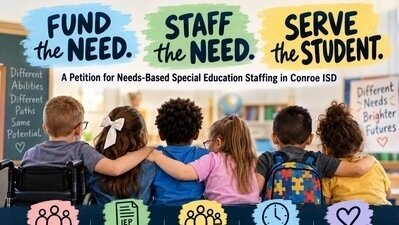
Fund the Need. Staff the Need. Serve the Student.
A Petition for Needs-Based Special Education Staffing in Conroe ISD
Every student receiving special education services is unique.
We say it in ARD meetings. We build Individualized Education Programs because a student's disability, strengths, challenges, goals, services, and required supports are specific to that individual child. If we recognize that students' needs are individualized, then the way we staff the people responsible for meeting those needs should be individualized, too.
Last year, I spent considerable time preparing and presenting information about the specific special education needs on my campus. My goal was to demonstrate what was necessary for our staff to effectively provide the services outlined in our students' IEPs. Despite those efforts, our campus lost both a special education teaching position and a paraprofessional position.
That experience brought a much larger concern into focus:
Special education staffing cannot be determined by student numbers alone.
Two campuses may each serve the same number of students receiving special education services while having dramatically different staffing needs. One student may require accommodations and specialized instruction during a limited portion of the school day. Another may require intensive academic intervention, behavioral support, communication assistance, frequent adult prompting, functional support, or special education services throughout much of the school day. On a staffing spreadsheet, those students may each count as "one." But their needs - and the personnel required to meet those needs - are not the same.
That is why we are asking Conroe ISD to reevaluate how special education staffing allocations are determined and move toward a needs-based staffing model that considers not only the number of students receiving special education services, but also the intensity and complexity of the services those students require.
Caseloads Matter, Too
We are also asking the district to establish reasonable special education caseload guidelines.
A special education teacher's caseload is not simply a list of names. Every student represents an individualized program requiring instruction, progress monitoring, data collection, documentation, parent communication, collaboration with general education teachers and service providers, ARD preparation and participation, accommodations, goals, compliance requirements, and continuous monitoring of progress. And somewhere within all of those responsibilities, special education teachers must have the time to do the most important part of their job: Teach and support students.
When caseloads become too large or too complex, educators are forced to divide finite time among an increasing number of responsibilities. That makes providing truly individualized services increasingly difficult. This is not about making educators' jobs easier. It is about making it possible for educators to do their jobs effectively and provide students the services and support their IEP teams have determined they need.
What We Are Asking Conroe ISD to Do
We respectfully ask Conroe ISD administration and the Board of Trustees to:
1. Develop a needs-based special education staffing model that considers the intensity and complexity of student needs - not simply the number of students receiving special education services.
2. Establish reasonable caseload guidelines that consider both the number of students assigned to a special education teacher and the complexity of their IEPs, services, and support needs.
3. Consider actual IEP service demands when determining staffing, including instructional minutes, behavioral needs, communication and functional needs, inclusion/ICS support, resource services, paraprofessional support, and other intensive student needs.
4. Include the people closest to the work in developing the model - special education teachers, paraprofessionals, related-service providers, campus administrators, general education teachers, and parents.
5. Establish a process for campuses to request staffing adjustments during the school year when enrollment, student needs, or service requirements significantly change.
6. Regularly review whether staffing allocations provide campuses with the personnel necessary to effectively implement students' IEPs.
This Is About Our Students
We understand that school districts must make difficult decisions involving budgets, staffing shortages, enrollment, and available resources. But special education cannot lose sight of the very principle upon which it is built: Individualization.
If an ARD committee determines that a child requires certain services and supports to access their education and make meaningful progress, we must also ensure that campuses have the human resources necessary to provide those services effectively.
A staffing formula can count students.
It cannot measure need.
It cannot show how many students require intensive behavioral support.
It cannot show how many classrooms a special education teacher must move between throughout the day.
It cannot show the complexity of an individual student's disability.
It cannot show the amount of adult assistance required for a student to access instruction.
And it cannot fully capture the workload involved in responsibly managing numerous individualized education programs while also providing direct instruction to students.
Our students deserve more than a number in an allocation formula. They deserve a system that recognizes what special education educators and parents already know:
Every student is different. Every IEP is different. Every need is different.
Our staffing model should recognize those differences.
We are asking Conroe ISD to bring educators, families, campus leaders, and district leadership together to develop a more equitable, transparent, and student-centered approach to special education staffing and caseload management. Because ultimately, this is not about positions. It is about whether we have the people necessary to provide students the education and support they have been determined to need.
Fund the need. Staff the need. Serve the student.
Please sign this petition asking Conroe ISD and its Board of Trustees to reevaluate special education staffing allocations and caseload expectations and develop a model that puts individual student needs at the center of staffing decisions.

Petition Closed
The Issue
Fund the Need. Staff the Need. Serve the Student.
A Petition for Needs-Based Special Education Staffing in Conroe ISD
Every student receiving special education services is unique.
We say it in ARD meetings. We build Individualized Education Programs because a student's disability, strengths, challenges, goals, services, and required supports are specific to that individual child. If we recognize that students' needs are individualized, then the way we staff the people responsible for meeting those needs should be individualized, too.
Last year, I spent considerable time preparing and presenting information about the specific special education needs on my campus. My goal was to demonstrate what was necessary for our staff to effectively provide the services outlined in our students' IEPs. Despite those efforts, our campus lost both a special education teaching position and a paraprofessional position.
That experience brought a much larger concern into focus:
Special education staffing cannot be determined by student numbers alone.
Two campuses may each serve the same number of students receiving special education services while having dramatically different staffing needs. One student may require accommodations and specialized instruction during a limited portion of the school day. Another may require intensive academic intervention, behavioral support, communication assistance, frequent adult prompting, functional support, or special education services throughout much of the school day. On a staffing spreadsheet, those students may each count as "one." But their needs - and the personnel required to meet those needs - are not the same.
That is why we are asking Conroe ISD to reevaluate how special education staffing allocations are determined and move toward a needs-based staffing model that considers not only the number of students receiving special education services, but also the intensity and complexity of the services those students require.
Caseloads Matter, Too
We are also asking the district to establish reasonable special education caseload guidelines.
A special education teacher's caseload is not simply a list of names. Every student represents an individualized program requiring instruction, progress monitoring, data collection, documentation, parent communication, collaboration with general education teachers and service providers, ARD preparation and participation, accommodations, goals, compliance requirements, and continuous monitoring of progress. And somewhere within all of those responsibilities, special education teachers must have the time to do the most important part of their job: Teach and support students.
When caseloads become too large or too complex, educators are forced to divide finite time among an increasing number of responsibilities. That makes providing truly individualized services increasingly difficult. This is not about making educators' jobs easier. It is about making it possible for educators to do their jobs effectively and provide students the services and support their IEP teams have determined they need.
What We Are Asking Conroe ISD to Do
We respectfully ask Conroe ISD administration and the Board of Trustees to:
1. Develop a needs-based special education staffing model that considers the intensity and complexity of student needs - not simply the number of students receiving special education services.
2. Establish reasonable caseload guidelines that consider both the number of students assigned to a special education teacher and the complexity of their IEPs, services, and support needs.
3. Consider actual IEP service demands when determining staffing, including instructional minutes, behavioral needs, communication and functional needs, inclusion/ICS support, resource services, paraprofessional support, and other intensive student needs.
4. Include the people closest to the work in developing the model - special education teachers, paraprofessionals, related-service providers, campus administrators, general education teachers, and parents.
5. Establish a process for campuses to request staffing adjustments during the school year when enrollment, student needs, or service requirements significantly change.
6. Regularly review whether staffing allocations provide campuses with the personnel necessary to effectively implement students' IEPs.
This Is About Our Students
We understand that school districts must make difficult decisions involving budgets, staffing shortages, enrollment, and available resources. But special education cannot lose sight of the very principle upon which it is built: Individualization.
If an ARD committee determines that a child requires certain services and supports to access their education and make meaningful progress, we must also ensure that campuses have the human resources necessary to provide those services effectively.
A staffing formula can count students.
It cannot measure need.
It cannot show how many students require intensive behavioral support.
It cannot show how many classrooms a special education teacher must move between throughout the day.
It cannot show the complexity of an individual student's disability.
It cannot show the amount of adult assistance required for a student to access instruction.
And it cannot fully capture the workload involved in responsibly managing numerous individualized education programs while also providing direct instruction to students.
Our students deserve more than a number in an allocation formula. They deserve a system that recognizes what special education educators and parents already know:
Every student is different. Every IEP is different. Every need is different.
Our staffing model should recognize those differences.
We are asking Conroe ISD to bring educators, families, campus leaders, and district leadership together to develop a more equitable, transparent, and student-centered approach to special education staffing and caseload management. Because ultimately, this is not about positions. It is about whether we have the people necessary to provide students the education and support they have been determined to need.
Fund the need. Staff the need. Serve the student.
Please sign this petition asking Conroe ISD and its Board of Trustees to reevaluate special education staffing allocations and caseload expectations and develop a model that puts individual student needs at the center of staffing decisions.
The Decision Makers

Petition Updates
Share this petition
Petition created on October 4, 2026