Apology from The New Yorker for Promoting Bayraktar Drones
The Issue
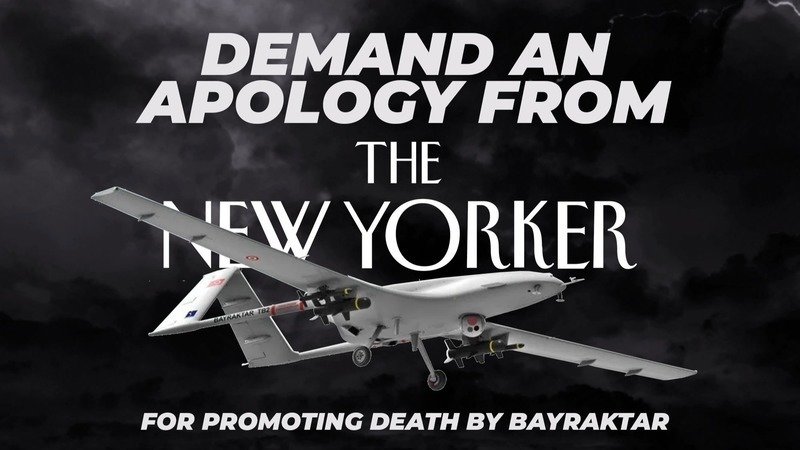
On May 13th, 2022, The New Yorker published an article entitled "The Turkish Drone That Changed the Nature of Warfare". Author Stephen Witt spares no compliments to the killing machine and its creator Selçuk Bayraktar, responsible for thousands of deaths, destruction of Armenian heritage and civilian targets during 2020 Artsakh war between Armenia and Azerbaijan.
In this blend of an ode and an ad, Mr. Witt calls the drone “a legend” while handpicking quotes describing the machine as “flagship of the Turkish defense industry” and “genius”. While he makes few mentions of the authoritarianism and human rights violations of Turkey and Azerbaijan, his portrayal of Selçuk Bayraktar is like that of a real life Tony Stark. He goes on to write, “[he] uses his account to promote youth-education initiatives, celebrate Turkish martyrs…” as if caring and loving human beings. “While we spoke, his mother, Canan; Sümeyye; and the couple’s four-year-old daughter, also named Canan, were eating dinner in an adjacent room.”
Mr. Witts article is cynical and insensitive to the suffering of thousands of Armenian soldiers killed by, or with the help of the Bayraktar drones, the thousands of family members mourning their loss.
While the war in Ukraine drew global appeal to the drone or Bayraktar's marketing needs, a publication like The New Yorker should have done thorough research to properly take into account the human impact on the people of Artsakh (Nagorno Karabakh) and Armenia who continue to duck at the sound of the specific humming of the killer machine. Witt’s article is unethical, cynical, crass, and strikingly biased for which the publication must apologize.
For an example of an ethical reaction to the use of these killer drones, one might consider the November 4, 2020 statement released by Garmin, which produces GPS navigation technology incorporated into the Bayraktar drones and used “to kill innocent civilians in Armenia and Nagorno-Karabakh (Artsakh).” The company said the product was commercially available and “is not designed or intended for military use, and it is not even designed or intended for use in drones.”

Petition Closed
The Issue
On May 13th, 2022, The New Yorker published an article entitled "The Turkish Drone That Changed the Nature of Warfare". Author Stephen Witt spares no compliments to the killing machine and its creator Selçuk Bayraktar, responsible for thousands of deaths, destruction of Armenian heritage and civilian targets during 2020 Artsakh war between Armenia and Azerbaijan.
In this blend of an ode and an ad, Mr. Witt calls the drone “a legend” while handpicking quotes describing the machine as “flagship of the Turkish defense industry” and “genius”. While he makes few mentions of the authoritarianism and human rights violations of Turkey and Azerbaijan, his portrayal of Selçuk Bayraktar is like that of a real life Tony Stark. He goes on to write, “[he] uses his account to promote youth-education initiatives, celebrate Turkish martyrs…” as if caring and loving human beings. “While we spoke, his mother, Canan; Sümeyye; and the couple’s four-year-old daughter, also named Canan, were eating dinner in an adjacent room.”
Mr. Witts article is cynical and insensitive to the suffering of thousands of Armenian soldiers killed by, or with the help of the Bayraktar drones, the thousands of family members mourning their loss.
While the war in Ukraine drew global appeal to the drone or Bayraktar's marketing needs, a publication like The New Yorker should have done thorough research to properly take into account the human impact on the people of Artsakh (Nagorno Karabakh) and Armenia who continue to duck at the sound of the specific humming of the killer machine. Witt’s article is unethical, cynical, crass, and strikingly biased for which the publication must apologize.
For an example of an ethical reaction to the use of these killer drones, one might consider the November 4, 2020 statement released by Garmin, which produces GPS navigation technology incorporated into the Bayraktar drones and used “to kill innocent civilians in Armenia and Nagorno-Karabakh (Artsakh).” The company said the product was commercially available and “is not designed or intended for military use, and it is not even designed or intended for use in drones.”
Petition Updates
Share this petition
Petition created on 14 May 2022