
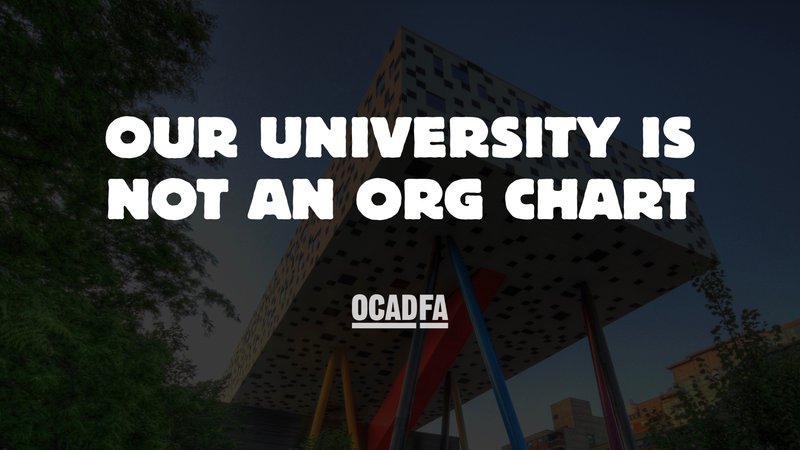
An Open Letter to the VPAP and President of OCAD University
The Issue
An Open Letter to the VPAP and President of OCAD University:
Defending Decolonization, Collegial Governance and the Future of Public Art and Design Education
Dear VPAP Gabriele and President Serrano,
c.c. Chair, Senate, Jules Goss
c.c. Chair, Board of Governors, Lanita Layton
c.c. President, Canadian Association of University Teachers, Robin Whitaker
c.c. President, OPSEU, JP Hornick
We, the undersigned faculty and academic staff of OCAD University, are deeply concerned about the academic restructuring proposals currently being advanced by the Office of the Vice-President, Academic and Provost.
We recognize that OCAD U faces significant financial and institutional challenges. We also recognize that universities must evolve to meet changing educational and social needs.
But restructuring is not simply a matter of reorganizing reporting relationships and consolidating service. It is a decision about what kind of university we want to be and whose knowledge and labour we value.
The VPAP has advanced three proposed prototypes and each raises fundamental questions about collegial governance, job cuts, working conditions, faculty workload, disciplinary integrity and the future of academic administrative support. All three include a centralized back office, despite the absence of a completed assessment of staffing needs, academic responsibilities or the consequences for curriculum delivery.
We are particularly troubled that the University proposes to select a new academic structure before completing the detailed evaluation of the work, resources and staffing required to sustain it. Additionally, we are told restructuring is necessary because of fiscal pressures but have been given no evidence that these plans have been costed or whether any actual savings will be realized.
As presented, the prototypes are not ready for decision. Yet faculty, staff and students are being asked to respond under pressure and on a compressed timeline. It is irresponsible to approve a major reorganization on this basis. This process has damaged the goodwill of faculty and staff, an asset that does not appear on a balance sheet but which the University depends on.
We believe that any process of academic restructuring must be guided by the following non-negotiable principles.
1. Decolonization must guide the entire process.
Decolonization must be the foundational principle informing how OCAD U governs itself, distributes resources, values knowledge and people. A restructuring process that concentrates authority or treats education primarily as an economic activity cannot claim to advance decolonization.
2. Academic decisions must be made through collegial governance.
The future of our academic programs cannot be determined through a top-down managerial process. Faculty, academic staff and students must have meaningful decision-making power over the structures that shape teaching, learning, research and academic life.
Senate must be able to exercise their academic governance responsibilities fully, with access to the information and time necessary for informed deliberation.
3. Protect and respect the people and relationships that make education possible.
Faculty-based administrative staff hold specialized program knowledge, institutional memory and relationships that are essential to curriculum planning, scheduling, teaching assignments and student support. These functions cannot simply be standardized or centralized without consequences.
No centralization or reduction of academic support without a demonstrated educational benefit, a full assessment of its consequences and meaningful participation by the workers affected.
4. No restructuring at the expense of workers' rights or employment security.
Academic restructuring must respect collective agreements, bargaining-unit protections and the rights of all university workers. Any proposed changes to duties, classifications, reporting relationships or employment conditions must be addressed through the appropriate collective bargaining and labour-relations processes.
5. Protect Studio Based Education.
OCAD U's strength lies in its studio-based education practices. Academic restructuring must protect our core delivery models rather than subordinate them to standardized administrative models. Our students do not come to OCAD to attend online asynchronous or big box classes. Studio-Based Education is a strength to be sustained, not an inefficiency to be eliminated.
6. Financial transparency and academic accountability are essential.
The VPAP must provide a credible and transparent financial rationale for restructuring. This includes comparative costs, projected savings, transition expenses, staffing implications and the consideration of alternatives.
Financial sustainability is a legitimate management responsibility, but fiscal austerity alone cannot justify changes that weaken teaching, learning, research or academic governance.
7. No decision before the evidence, meaningful deliberation and accountability.
The University must not finalize a restructuring model before completing and sharing comprehensive assessments of its academic, financial, staffing, workload, equity and governance implications. The University cannot decide the structure first and determine its consequences later.
8. The proposed timeline must allow faculty, staff, students and Senate to examine the evidence, propose alternatives and meaningfully influence the outcome. Instead of choosing among the three provided prototypes, there should be an opportunity to propose alternatives that reflect the lived experiences of those affected by the changes.
9. Equity must be central to any restructuring process. The process must ensure that changes do not deepen existing inequalities in workload, employment security, access to resources or decision-making power, particularly for historically marginalized and precariously employed members of our university community.
10. Student learning must be at the heart of every institutional decision. We must prioritize the people, resources and relationships that sustain high-quality, accessible and transformative education. Our working conditions are our students’ learning conditions.
Our Collective Demand
We call on the President and the University's senior leadership to halt the current decision-making timeline and commit to a genuinely collegial, transparent and decolonial process of academic planning.
- Before any restructuring model is advanced for approval, the University must:
- Complete and disclose the necessary academic, staffing, workload, financial, equity and governance assessments.
- Reconsider the predetermined centralization of academic administrative support.
- Protect collective agreement rights, employment security and academic decision-making authority.
- Ensure that faculty, staff, students and Senate have meaningful opportunities to shape the outcome.
- Demonstrate that any proposed changes will strengthen OCAD U's educational mission.
We believe in an OCAD University that honours its commitments to decolonization, values the people whose labour sustains it, protects academic freedom and collegial governance, and places teaching, learning and creative inquiry at the centre of its decisions.
OCAD University's Academic and Strategic Plan, 2022–2028, approved by both Senate and the Board of Governors, commits our institution to decolonization, equity, innovative teaching and learning, student-centred education and responsible financial stewardship. These are not optional aspirations to be set aside during a period of financial difficulty. They are the principles the University has collectively adopted to guide its future.
We are not opposed to change. We insist that change be guided by our collective values, supported by evidence and accountable to the university community.
Signed,
Members of the OCAD University community and allies
Faculty and Academic Staff

116
The Issue
An Open Letter to the VPAP and President of OCAD University:
Defending Decolonization, Collegial Governance and the Future of Public Art and Design Education
Dear VPAP Gabriele and President Serrano,
c.c. Chair, Senate, Jules Goss
c.c. Chair, Board of Governors, Lanita Layton
c.c. President, Canadian Association of University Teachers, Robin Whitaker
c.c. President, OPSEU, JP Hornick
We, the undersigned faculty and academic staff of OCAD University, are deeply concerned about the academic restructuring proposals currently being advanced by the Office of the Vice-President, Academic and Provost.
We recognize that OCAD U faces significant financial and institutional challenges. We also recognize that universities must evolve to meet changing educational and social needs.
But restructuring is not simply a matter of reorganizing reporting relationships and consolidating service. It is a decision about what kind of university we want to be and whose knowledge and labour we value.
The VPAP has advanced three proposed prototypes and each raises fundamental questions about collegial governance, job cuts, working conditions, faculty workload, disciplinary integrity and the future of academic administrative support. All three include a centralized back office, despite the absence of a completed assessment of staffing needs, academic responsibilities or the consequences for curriculum delivery.
We are particularly troubled that the University proposes to select a new academic structure before completing the detailed evaluation of the work, resources and staffing required to sustain it. Additionally, we are told restructuring is necessary because of fiscal pressures but have been given no evidence that these plans have been costed or whether any actual savings will be realized.
As presented, the prototypes are not ready for decision. Yet faculty, staff and students are being asked to respond under pressure and on a compressed timeline. It is irresponsible to approve a major reorganization on this basis. This process has damaged the goodwill of faculty and staff, an asset that does not appear on a balance sheet but which the University depends on.
We believe that any process of academic restructuring must be guided by the following non-negotiable principles.
1. Decolonization must guide the entire process.
Decolonization must be the foundational principle informing how OCAD U governs itself, distributes resources, values knowledge and people. A restructuring process that concentrates authority or treats education primarily as an economic activity cannot claim to advance decolonization.
2. Academic decisions must be made through collegial governance.
The future of our academic programs cannot be determined through a top-down managerial process. Faculty, academic staff and students must have meaningful decision-making power over the structures that shape teaching, learning, research and academic life.
Senate must be able to exercise their academic governance responsibilities fully, with access to the information and time necessary for informed deliberation.
3. Protect and respect the people and relationships that make education possible.
Faculty-based administrative staff hold specialized program knowledge, institutional memory and relationships that are essential to curriculum planning, scheduling, teaching assignments and student support. These functions cannot simply be standardized or centralized without consequences.
No centralization or reduction of academic support without a demonstrated educational benefit, a full assessment of its consequences and meaningful participation by the workers affected.
4. No restructuring at the expense of workers' rights or employment security.
Academic restructuring must respect collective agreements, bargaining-unit protections and the rights of all university workers. Any proposed changes to duties, classifications, reporting relationships or employment conditions must be addressed through the appropriate collective bargaining and labour-relations processes.
5. Protect Studio Based Education.
OCAD U's strength lies in its studio-based education practices. Academic restructuring must protect our core delivery models rather than subordinate them to standardized administrative models. Our students do not come to OCAD to attend online asynchronous or big box classes. Studio-Based Education is a strength to be sustained, not an inefficiency to be eliminated.
6. Financial transparency and academic accountability are essential.
The VPAP must provide a credible and transparent financial rationale for restructuring. This includes comparative costs, projected savings, transition expenses, staffing implications and the consideration of alternatives.
Financial sustainability is a legitimate management responsibility, but fiscal austerity alone cannot justify changes that weaken teaching, learning, research or academic governance.
7. No decision before the evidence, meaningful deliberation and accountability.
The University must not finalize a restructuring model before completing and sharing comprehensive assessments of its academic, financial, staffing, workload, equity and governance implications. The University cannot decide the structure first and determine its consequences later.
8. The proposed timeline must allow faculty, staff, students and Senate to examine the evidence, propose alternatives and meaningfully influence the outcome. Instead of choosing among the three provided prototypes, there should be an opportunity to propose alternatives that reflect the lived experiences of those affected by the changes.
9. Equity must be central to any restructuring process. The process must ensure that changes do not deepen existing inequalities in workload, employment security, access to resources or decision-making power, particularly for historically marginalized and precariously employed members of our university community.
10. Student learning must be at the heart of every institutional decision. We must prioritize the people, resources and relationships that sustain high-quality, accessible and transformative education. Our working conditions are our students’ learning conditions.
Our Collective Demand
We call on the President and the University's senior leadership to halt the current decision-making timeline and commit to a genuinely collegial, transparent and decolonial process of academic planning.
- Before any restructuring model is advanced for approval, the University must:
- Complete and disclose the necessary academic, staffing, workload, financial, equity and governance assessments.
- Reconsider the predetermined centralization of academic administrative support.
- Protect collective agreement rights, employment security and academic decision-making authority.
- Ensure that faculty, staff, students and Senate have meaningful opportunities to shape the outcome.
- Demonstrate that any proposed changes will strengthen OCAD U's educational mission.
We believe in an OCAD University that honours its commitments to decolonization, values the people whose labour sustains it, protects academic freedom and collegial governance, and places teaching, learning and creative inquiry at the centre of its decisions.
OCAD University's Academic and Strategic Plan, 2022–2028, approved by both Senate and the Board of Governors, commits our institution to decolonization, equity, innovative teaching and learning, student-centred education and responsible financial stewardship. These are not optional aspirations to be set aside during a period of financial difficulty. They are the principles the University has collectively adopted to guide its future.
We are not opposed to change. We insist that change be guided by our collective values, supported by evidence and accountable to the university community.
Signed,
Members of the OCAD University community and allies
Faculty and Academic Staff
Petition Updates
Share this petition
Petition created on November 16, 2026