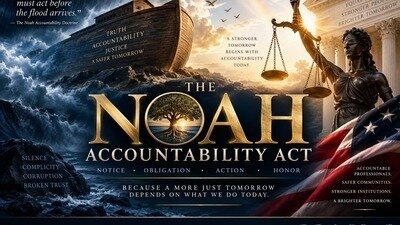

Adopt the Noah Accountability Doctrine: The Duty of Elevated Accountability
The Issue
In today's world, knowledge is not just a power- it's a responsibility. Every day, individuals armed with specialized understanding and insights are confronted with evidence of danger, corruption, or injustice. Yet, too often, they remain silent. This silence does not stem from ignorance but from a complex web of fear, complacency, and institutional barriers. This petition introduces "The Noah Accountability Doctrine," a revolutionary framework designed to transform silence into action.
**The Doctrine**:
Named after Noah- not solely a figure rooted in history or religion, but an enduring archetype of foresight and responsibility-this doctrine is based on a fundamental mandate: Knowledge creates responsibility. Its premise is simple yet powerful; those who have the expertise to recognize risks or wrongdoings must act, or they become complicit in the unfolding consequence. In a society where knowledge is a safeguard, silence is not just passive, it is dangerous.
**Why It Matters**:
This doctrine is more than a moral guideline; it's a call for systemic reform. Whistleblowers, professionals, and experts possess the knowledge to shine a light on corruption and prevent crises before they spiral out of control. However, the fear of retribution, professional ostracization, and legal repercussions too often squelch these voices. Our current system does not adequately protect or empower them to act, and that needs to change.
THE NOAH ACCOUNTABILITY ACT
The Noah Accountability and Public Trust Restoration Act
A Proposed Federal and State Reform Initiative
Petition for Legislative Action, Ethics Reform, and Professional Accountability
PREAMBLE
We, the People, recognize that justice is weakened whenever those entrusted with specialized knowledge fail to act in the presence of preventable harm.
Throughout history, societies have suffered not merely because wrongdoing occurred, but because those who possessed the authority, expertise, knowledge, or opportunity to intervene remained silent.
The legal profession, judiciary, regulatory bodies, government agencies, fiduciaries, and licensed professionals are granted extraordinary privileges through public trust.
With privilege comes responsibility.
With knowledge comes duty.
With authority comes accountability.
Therefore, we petition Congress, State Legislatures, State Supreme Courts, Bar Associations, Judicial Conduct Commissions, Licensing Boards, and Regulatory Agencies to adopt the principles contained within the Noah Accountability Act.
WHY "NOAH"?
The name Noah was chosen not merely for its historical significance, but for its symbolic meaning.
In the ancient narrative, Noah represents the individual who recognized danger before everyone else.
He did not create the storm.
He did not cause the flood.
He became accountable because he understood what was coming and acted while others ignored the warning.
The Noah Accountability Act is founded upon the same principle:
The responsibility of those who know.
By the time the flood arrives, accountability has already failed.
The purpose of law should not merely be punishment after destruction.
The purpose of law should be prevention before destruction.
THE NOAH PRINCIPLE
NOAH shall stand for:
N
Notice
A professional who becomes aware of credible evidence of fraud, corruption, abuse, unlawful conduct, ethics violations, conflicts of interest, cover-ups, or substantial public harm possesses a duty to recognize and evaluate that information.
Knowledge cannot be selectively ignored.
Deliberate blindness shall not excuse accountability.
O
Obligation
Knowledge creates obligation.
When an individual possesses specialized expertise unavailable to the general public, a corresponding duty arises to exercise that expertise responsibly.
The greater the expertise, the greater the obligation.
The greater the authority, the greater the duty.
A
Action
Accountability requires action.
Reasonable action may include:
Disclosure
Withdrawal
Reporting
Documentation
Corrective intervention
Escalation to an oversight authority
The Act does not require perfection.
It requires reasonable effort.
Silence shall not be mistaken for neutrality.
H
Honor
Public trust is sustained through honor.
Honor demands that loyalty to justice exceed loyalty to personal convenience, professional relationships, political interests, family ties, financial incentives, or institutional protection.
Honor requires that truth come before comfort.
SECTION I
PURPOSE
The purpose of this Act shall be:
To strengthen public trust in institutions.
To reduce professional misconduct.
To establish elevated accountability standards.
To discourage concealment of unlawful conduct.
To promote transparency.
To protect whistleblowers.
To ensure that specialized knowledge serves the public interest.
SECTION II
PERSONAL RELATIONSHIP ACCOUNTABILITY STANDARD
No professional duty shall be diminished, suspended, delayed, or excused because misconduct involves:
Family members
Friends
Romantic partners
Political associates
Business partners
Employers
Former employers
Professional colleagues
Public officials
Judicial officers
Personal relationships may explain conduct.
They shall not excuse misconduct.
SECTION III
DUTY TO DISCLOSE MATERIAL MISCONDUCT
Any licensed professional possessing actual knowledge of substantial misconduct shall be required to take reasonable action when:
Significant public harm is foreseeable.
Vulnerable individuals may be harmed.
Fraud or corruption is occurring.
Constitutional rights are being violated.
Public resources are being misappropriated.
Professional misconduct threatens the integrity of an institution.
Reasonable action may include documentation, reporting, recusal, withdrawal, disclosure, or referral to proper authorities.
SECTION IV
THE FLOOD TEST
Under the Noah Accountability Act, professional responsibility shall increase when all three of the following elements exist:
Knowledge
The person knew or reasonably should have known.
Capacity
The person possessed authority, expertise, influence, or ability to act.
Foreseeability
A reasonable person with similar training would have anticipated the resulting harm.
When all three elements are present, a duty of accountability arises.
SECTION V
WILLFUL BLINDNESS PROHIBITION
No individual may avoid responsibility through intentional ignorance.
Deliberate avoidance of facts shall be treated as constructive knowledge when:
Warning signs are obvious.
Evidence is readily available.
Harm is foreseeable.
The individual benefits from remaining uninformed.
SECTION VI
NATIONAL TRANSPARENCY INITIATIVE
The Act proposes the creation of a public accountability portal documenting final disciplinary findings involving:
Fraud
Corruption
Ethics violations
Abuse of fiduciary responsibility
Obstruction
Retaliation against whistleblowers
Concealment of material misconduct
Transparency strengthens trust.
Secrecy erodes it.
SECTION VII
WHISTLEBLOWER PROTECTION
Any professional who reports misconduct in good faith shall receive protection from:
Retaliation
Intimidation
Professional harassment
Blacklisting
Employment discrimination
Abuse of legal process
Truth-telling should never be punished.
SECTION VIII
THE PUBLIC TRUST DOCTRINE
The Act recognizes that all licensed professions ultimately exist for the protection of the public.
The first loyalty of every public servant and licensed professional shall be:
To the law,
To the Constitution,
To justice,
To public trust,
To future generations.
No oath, contract, relationship, position, or institution may supersede those duties.
Article I
Duty of Elevated Accountability
Any licensed attorney, regardless of specialty, practice area, employment status, or jurisdiction, shall be deemed a steward of the rule of law.
The possession of legal expertise creates a heightened societal duty beyond that expected of ordinary citizens.
Where an attorney acquires actual knowledge of:
Fraud
Corruption
Abuse of fiduciary authority
Systemic misconduct
Obstruction of justice
Judicial misconduct
Governmental misconduct
Exploitation of vulnerable persons
Misappropriation of public funds
Violations of constitutional rights
the attorney may not knowingly assist, conceal, facilitate, or materially ignore such conduct when intervention is reasonably available.
Article II
Personal Relationship Neutrality Rule
No attorney shall be excused from ethical responsibility because the subject of misconduct is:
A spouse
Former spouse
Relative
Business partner
Friend
Political ally
Employer
Financial benefactor
Professional associate
Judicial officer known personally to the attorney
Government official known personally to the attorney
Personal relationships shall never diminish public responsibilities.
Indeed, where a personal relationship exists, heightened scrutiny shall apply.
The appearance of favoritism is itself harmful to public confidence in the administration of justice. Existing conflict-of-interest principles recognize that personal interests can materially limit a lawyer's independent judgment. [americanbar.org], [americanbar.org]
Article III
Duty to Withdraw, Disclose, or Report
An attorney possessing credible evidence of significant unlawful conduct shall have a duty to select one of the following actions:
Option A
Withdraw from participation.
Option B
Provide written notice to the responsible party demanding corrective action.
Option C
Report the conduct to the appropriate authority.
Option D
Document the misconduct and preserve evidence for future review.
Silence shall not be considered neutrality where legal knowledge is affirmatively used to preserve unlawful conduct.
Article IV
Prohibition on Strategic Ignorance
No attorney may intentionally avoid knowledge to escape accountability.
Willful blindness shall be treated as actual knowledge whenever:
Facts strongly suggest unlawful conduct.
Reasonable inquiry would reveal the truth.
The attorney benefits from not knowing.
Failure to investigate obvious misconduct shall constitute professional negligence.
Article V
Public Trust Standard
Lawyers serve not only clients but the integrity of the legal system itself.
Conduct may be sanctionable where it:
Erodes public confidence.
Protects known misconduct.
Obstructs lawful investigation.
Uses legal expertise to delay accountability.
Exploits procedural complexity to defeat substantive justice.
Such conduct may be deemed prejudicial to the administration of justice, a category already recognized under professional misconduct standards. [americanbar.org]
Article VI
Failure-to-Act Liability
An attorney shall be subject to professional review where:
The attorney knew or reasonably should have known of unlawful conduct;
The attorney possessed the professional ability to intervene;
The failure to intervene materially contributed to ongoing harm.
This doctrine does not require attorneys to guarantee outcomes.
It requires reasonable action.
The legal profession should be judged not solely by what it does, but also by what it knowingly permits.
Article VII
National Registry of Sustained Ethical Findings
To promote transparency, all final disciplinary findings involving:
Dishonesty
Fraud
Conflict concealment
Abuse of client trust
Obstruction
Retaliation against whistleblowers
should be entered into a publicly accessible national database.
Citizens should not be required to discover serious disciplinary histories through fragmented state systems.
Article VIII
Whistleblower Protection for Attorneys
Attorneys who report misconduct in good faith shall receive enhanced protection from:
Retaliation
Employment termination
Harassment
Strategic lawsuits
Professional intimidation
The legal profession must stop punishing the lawyer who tells the truth and start disciplining those who punish truth-tellers.
Article IX
Duty of Competence Includes Duty of Correction
Competence cannot merely mean knowing the law.
Competence must also include:
Identifying unlawful conduct.
Advising corrective action.
Refusing participation in continuing violations.
Taking reasonable steps to prevent foreseeable legal harm.
Current competence and diligence obligations require thoroughness, preparation, diligence, and prompt action for clients. This doctrine proposes expanding those principles into a broader public-protection model. [americanbar.org], [americanbar.org]
Article X
The Public Protection Principle
The highest duty of every lawyer is not profit.
It is not prestige.
It is not professional loyalty.
It is not personal loyalty.
The highest duty of every lawyer is the preservation of lawful order, equal justice, and public trust.
Where private interests and public justice conflict, public justice shall prevail.
Petition for Legislative and Ethical Reform
We, the undersigned, call upon:
Congress
State Legislatures
State Bar Associations
Supreme Courts
Judicial Conduct Commissions
Attorneys General
Ethics Authorities
to adopt reforms consistent with the O'Quinn Accountability Doctrine so that no legal professional may evade responsibility through silence, favoritism, personal relationships, strategic ignorance, or institutional protection.
The rule of law cannot survive on expertise alone.
It survives when expertise is paired with courage.
Justice delayed may be tolerated.
Justice denied may be challenged.
But justice knowingly ignored by those sworn to protect it must never again be excused.
The measure of a lawyer is not what they know.
The measure of a lawyer is what they do when they know.
THE NOAH DECLARATION
We believe that expertise without accountability weakens justice.
We believe that silence may become complicity.
We believe that public trust cannot survive selective accountability.
We believe that personal relationships should never create exemptions from ethical responsibility.
We believe that those who recognize the coming storm possess a duty to sound the warning.
For the flood is not the beginning of the disaster.
The flood is the moment everyone finally sees what others already knew.
PETITION STATEMENT
We respectfully call upon federal, state, and local lawmakers, bar associations, judicial oversight bodies, ethics commissions, professional licensing boards, and regulatory authorities to enact reforms consistent with the principles of the Noah Accountability Act.
Our institutions do not fail because wrongdoing exists.
They fail when those entrusted to stop wrongdoing choose silence.
The time has come to restore public trust through transparency, responsibility, and courage.
NOAH: Notice. Obligation. Action. Honor.
Because those who know should not stand silent while the flood rises.
© Sirian Paralegal. The Noah Accountability Act and related materials. All Rights Reserved.
11
The Issue
In today's world, knowledge is not just a power- it's a responsibility. Every day, individuals armed with specialized understanding and insights are confronted with evidence of danger, corruption, or injustice. Yet, too often, they remain silent. This silence does not stem from ignorance but from a complex web of fear, complacency, and institutional barriers. This petition introduces "The Noah Accountability Doctrine," a revolutionary framework designed to transform silence into action.
**The Doctrine**:
Named after Noah- not solely a figure rooted in history or religion, but an enduring archetype of foresight and responsibility-this doctrine is based on a fundamental mandate: Knowledge creates responsibility. Its premise is simple yet powerful; those who have the expertise to recognize risks or wrongdoings must act, or they become complicit in the unfolding consequence. In a society where knowledge is a safeguard, silence is not just passive, it is dangerous.
**Why It Matters**:
This doctrine is more than a moral guideline; it's a call for systemic reform. Whistleblowers, professionals, and experts possess the knowledge to shine a light on corruption and prevent crises before they spiral out of control. However, the fear of retribution, professional ostracization, and legal repercussions too often squelch these voices. Our current system does not adequately protect or empower them to act, and that needs to change.
THE NOAH ACCOUNTABILITY ACT
The Noah Accountability and Public Trust Restoration Act
A Proposed Federal and State Reform Initiative
Petition for Legislative Action, Ethics Reform, and Professional Accountability
PREAMBLE
We, the People, recognize that justice is weakened whenever those entrusted with specialized knowledge fail to act in the presence of preventable harm.
Throughout history, societies have suffered not merely because wrongdoing occurred, but because those who possessed the authority, expertise, knowledge, or opportunity to intervene remained silent.
The legal profession, judiciary, regulatory bodies, government agencies, fiduciaries, and licensed professionals are granted extraordinary privileges through public trust.
With privilege comes responsibility.
With knowledge comes duty.
With authority comes accountability.
Therefore, we petition Congress, State Legislatures, State Supreme Courts, Bar Associations, Judicial Conduct Commissions, Licensing Boards, and Regulatory Agencies to adopt the principles contained within the Noah Accountability Act.
WHY "NOAH"?
The name Noah was chosen not merely for its historical significance, but for its symbolic meaning.
In the ancient narrative, Noah represents the individual who recognized danger before everyone else.
He did not create the storm.
He did not cause the flood.
He became accountable because he understood what was coming and acted while others ignored the warning.
The Noah Accountability Act is founded upon the same principle:
The responsibility of those who know.
By the time the flood arrives, accountability has already failed.
The purpose of law should not merely be punishment after destruction.
The purpose of law should be prevention before destruction.
THE NOAH PRINCIPLE
NOAH shall stand for:
N
Notice
A professional who becomes aware of credible evidence of fraud, corruption, abuse, unlawful conduct, ethics violations, conflicts of interest, cover-ups, or substantial public harm possesses a duty to recognize and evaluate that information.
Knowledge cannot be selectively ignored.
Deliberate blindness shall not excuse accountability.
O
Obligation
Knowledge creates obligation.
When an individual possesses specialized expertise unavailable to the general public, a corresponding duty arises to exercise that expertise responsibly.
The greater the expertise, the greater the obligation.
The greater the authority, the greater the duty.
A
Action
Accountability requires action.
Reasonable action may include:
Disclosure
Withdrawal
Reporting
Documentation
Corrective intervention
Escalation to an oversight authority
The Act does not require perfection.
It requires reasonable effort.
Silence shall not be mistaken for neutrality.
H
Honor
Public trust is sustained through honor.
Honor demands that loyalty to justice exceed loyalty to personal convenience, professional relationships, political interests, family ties, financial incentives, or institutional protection.
Honor requires that truth come before comfort.
SECTION I
PURPOSE
The purpose of this Act shall be:
To strengthen public trust in institutions.
To reduce professional misconduct.
To establish elevated accountability standards.
To discourage concealment of unlawful conduct.
To promote transparency.
To protect whistleblowers.
To ensure that specialized knowledge serves the public interest.
SECTION II
PERSONAL RELATIONSHIP ACCOUNTABILITY STANDARD
No professional duty shall be diminished, suspended, delayed, or excused because misconduct involves:
Family members
Friends
Romantic partners
Political associates
Business partners
Employers
Former employers
Professional colleagues
Public officials
Judicial officers
Personal relationships may explain conduct.
They shall not excuse misconduct.
SECTION III
DUTY TO DISCLOSE MATERIAL MISCONDUCT
Any licensed professional possessing actual knowledge of substantial misconduct shall be required to take reasonable action when:
Significant public harm is foreseeable.
Vulnerable individuals may be harmed.
Fraud or corruption is occurring.
Constitutional rights are being violated.
Public resources are being misappropriated.
Professional misconduct threatens the integrity of an institution.
Reasonable action may include documentation, reporting, recusal, withdrawal, disclosure, or referral to proper authorities.
SECTION IV
THE FLOOD TEST
Under the Noah Accountability Act, professional responsibility shall increase when all three of the following elements exist:
Knowledge
The person knew or reasonably should have known.
Capacity
The person possessed authority, expertise, influence, or ability to act.
Foreseeability
A reasonable person with similar training would have anticipated the resulting harm.
When all three elements are present, a duty of accountability arises.
SECTION V
WILLFUL BLINDNESS PROHIBITION
No individual may avoid responsibility through intentional ignorance.
Deliberate avoidance of facts shall be treated as constructive knowledge when:
Warning signs are obvious.
Evidence is readily available.
Harm is foreseeable.
The individual benefits from remaining uninformed.
SECTION VI
NATIONAL TRANSPARENCY INITIATIVE
The Act proposes the creation of a public accountability portal documenting final disciplinary findings involving:
Fraud
Corruption
Ethics violations
Abuse of fiduciary responsibility
Obstruction
Retaliation against whistleblowers
Concealment of material misconduct
Transparency strengthens trust.
Secrecy erodes it.
SECTION VII
WHISTLEBLOWER PROTECTION
Any professional who reports misconduct in good faith shall receive protection from:
Retaliation
Intimidation
Professional harassment
Blacklisting
Employment discrimination
Abuse of legal process
Truth-telling should never be punished.
SECTION VIII
THE PUBLIC TRUST DOCTRINE
The Act recognizes that all licensed professions ultimately exist for the protection of the public.
The first loyalty of every public servant and licensed professional shall be:
To the law,
To the Constitution,
To justice,
To public trust,
To future generations.
No oath, contract, relationship, position, or institution may supersede those duties.
Article I
Duty of Elevated Accountability
Any licensed attorney, regardless of specialty, practice area, employment status, or jurisdiction, shall be deemed a steward of the rule of law.
The possession of legal expertise creates a heightened societal duty beyond that expected of ordinary citizens.
Where an attorney acquires actual knowledge of:
Fraud
Corruption
Abuse of fiduciary authority
Systemic misconduct
Obstruction of justice
Judicial misconduct
Governmental misconduct
Exploitation of vulnerable persons
Misappropriation of public funds
Violations of constitutional rights
the attorney may not knowingly assist, conceal, facilitate, or materially ignore such conduct when intervention is reasonably available.
Article II
Personal Relationship Neutrality Rule
No attorney shall be excused from ethical responsibility because the subject of misconduct is:
A spouse
Former spouse
Relative
Business partner
Friend
Political ally
Employer
Financial benefactor
Professional associate
Judicial officer known personally to the attorney
Government official known personally to the attorney
Personal relationships shall never diminish public responsibilities.
Indeed, where a personal relationship exists, heightened scrutiny shall apply.
The appearance of favoritism is itself harmful to public confidence in the administration of justice. Existing conflict-of-interest principles recognize that personal interests can materially limit a lawyer's independent judgment. [americanbar.org], [americanbar.org]
Article III
Duty to Withdraw, Disclose, or Report
An attorney possessing credible evidence of significant unlawful conduct shall have a duty to select one of the following actions:
Option A
Withdraw from participation.
Option B
Provide written notice to the responsible party demanding corrective action.
Option C
Report the conduct to the appropriate authority.
Option D
Document the misconduct and preserve evidence for future review.
Silence shall not be considered neutrality where legal knowledge is affirmatively used to preserve unlawful conduct.
Article IV
Prohibition on Strategic Ignorance
No attorney may intentionally avoid knowledge to escape accountability.
Willful blindness shall be treated as actual knowledge whenever:
Facts strongly suggest unlawful conduct.
Reasonable inquiry would reveal the truth.
The attorney benefits from not knowing.
Failure to investigate obvious misconduct shall constitute professional negligence.
Article V
Public Trust Standard
Lawyers serve not only clients but the integrity of the legal system itself.
Conduct may be sanctionable where it:
Erodes public confidence.
Protects known misconduct.
Obstructs lawful investigation.
Uses legal expertise to delay accountability.
Exploits procedural complexity to defeat substantive justice.
Such conduct may be deemed prejudicial to the administration of justice, a category already recognized under professional misconduct standards. [americanbar.org]
Article VI
Failure-to-Act Liability
An attorney shall be subject to professional review where:
The attorney knew or reasonably should have known of unlawful conduct;
The attorney possessed the professional ability to intervene;
The failure to intervene materially contributed to ongoing harm.
This doctrine does not require attorneys to guarantee outcomes.
It requires reasonable action.
The legal profession should be judged not solely by what it does, but also by what it knowingly permits.
Article VII
National Registry of Sustained Ethical Findings
To promote transparency, all final disciplinary findings involving:
Dishonesty
Fraud
Conflict concealment
Abuse of client trust
Obstruction
Retaliation against whistleblowers
should be entered into a publicly accessible national database.
Citizens should not be required to discover serious disciplinary histories through fragmented state systems.
Article VIII
Whistleblower Protection for Attorneys
Attorneys who report misconduct in good faith shall receive enhanced protection from:
Retaliation
Employment termination
Harassment
Strategic lawsuits
Professional intimidation
The legal profession must stop punishing the lawyer who tells the truth and start disciplining those who punish truth-tellers.
Article IX
Duty of Competence Includes Duty of Correction
Competence cannot merely mean knowing the law.
Competence must also include:
Identifying unlawful conduct.
Advising corrective action.
Refusing participation in continuing violations.
Taking reasonable steps to prevent foreseeable legal harm.
Current competence and diligence obligations require thoroughness, preparation, diligence, and prompt action for clients. This doctrine proposes expanding those principles into a broader public-protection model. [americanbar.org], [americanbar.org]
Article X
The Public Protection Principle
The highest duty of every lawyer is not profit.
It is not prestige.
It is not professional loyalty.
It is not personal loyalty.
The highest duty of every lawyer is the preservation of lawful order, equal justice, and public trust.
Where private interests and public justice conflict, public justice shall prevail.
Petition for Legislative and Ethical Reform
We, the undersigned, call upon:
Congress
State Legislatures
State Bar Associations
Supreme Courts
Judicial Conduct Commissions
Attorneys General
Ethics Authorities
to adopt reforms consistent with the O'Quinn Accountability Doctrine so that no legal professional may evade responsibility through silence, favoritism, personal relationships, strategic ignorance, or institutional protection.
The rule of law cannot survive on expertise alone.
It survives when expertise is paired with courage.
Justice delayed may be tolerated.
Justice denied may be challenged.
But justice knowingly ignored by those sworn to protect it must never again be excused.
The measure of a lawyer is not what they know.
The measure of a lawyer is what they do when they know.
THE NOAH DECLARATION
We believe that expertise without accountability weakens justice.
We believe that silence may become complicity.
We believe that public trust cannot survive selective accountability.
We believe that personal relationships should never create exemptions from ethical responsibility.
We believe that those who recognize the coming storm possess a duty to sound the warning.
For the flood is not the beginning of the disaster.
The flood is the moment everyone finally sees what others already knew.
PETITION STATEMENT
We respectfully call upon federal, state, and local lawmakers, bar associations, judicial oversight bodies, ethics commissions, professional licensing boards, and regulatory authorities to enact reforms consistent with the principles of the Noah Accountability Act.
Our institutions do not fail because wrongdoing exists.
They fail when those entrusted to stop wrongdoing choose silence.
The time has come to restore public trust through transparency, responsibility, and courage.
NOAH: Notice. Obligation. Action. Honor.
Because those who know should not stand silent while the flood rises.
© Sirian Paralegal. The Noah Accountability Act and related materials. All Rights Reserved.
Petition Updates
Share this petition
Petition created on October 24, 2026