民間法制審議会案(世界基準の共同親権制度)の立法を求める賛同署名 Signatures calling for a joint custody system〜

民間法制審議会案(世界基準の共同親権制度)の立法を求める賛同署名 Signatures calling for a joint custody system〜
署名活動の主旨
2024年5月17日、日本は約77年ぶりの改正となる家族法(親権制度・令和6年法律第33号)が国会で成立し、同月24日に公布された。
日本は、長年に渡り単独親権制度を堅持していたが、近代の急速な国際化社会の流れや、国民意識の変化によって、夫婦の離婚後にどちらか一方の親が子供の養育をする原則単独親権制度が、時代と相違していた。
単独親権制度が時代とそぐわない理由として基本的な問題は、子を持つ夫婦の離婚後、子を養育する親が基本的には父母のどちらか1人になる事で、親は養育の主となる、金銭的、体力的にも不利益を生じ、子供にとっては、本来なら無償の愛情を惜しみなく注いでくれる筈の一方の親を失ってしまう。また、親権を失い子供とも別居せざるを得なくなった一方の親は、夫婦の離婚後にわが子と殆ど会えなくなってしまい、心理的外傷を深く負ってしまい、中には子供と会えない事を苦に自死を選ぶ親も少なくない。そして一部のNPO団体や一部の弁護士、裁判所の対応も問題視されており、親と子供にとって現在の単独親権制度は、合理性に欠如し、道徳的にも人権的観点からも非常に支障をきたす制度になっている。国際化している現在の社会でも単独親権制度の国は非常に少数で、先進国や国連が日本政府に対して度々、共同親権制度に改正するように勧告、あるいは非難している。国際社会からの圧力で日本政府は改正家族法を立法し、夫婦の離婚後に“共同親権“になり得る可能性のある条文を規定した。
しかしこの改正法は、共同親権(監護権を含む)とは程遠い法であり、見せかけだけの共同親権法改正を企てる法務省法制審議会委員達の思惑により、これまでと何ら変わりないどころか更に親子を引き裂く実質的な単独親権制度となる様に制度設計がされている。
この改正家族法では日本の単独親権制の諸問題である"実子誘拐"や親子の不当な引き離しを助長しかねない法であり、尚且つ非常に理解しにくい立法で、共同親権とは名ばかりの、いわゆる"似て非なる"親権法である。
政府が交付した親権法は、夫婦の合意が基本的な条件となる“選択制の共同親権制度“であり、各先進国の原則共同親権制度とは全く異なる「選択制共同親権」である。
そして、その立法趣旨や理念は非常に曖昧なものであり、全体の案を読み解き実際に法施行された場合の状況を考えると実質的に単独親権となる、あるいは単独親権制に近い立法となる。
例えば、分かりやすいのは親権者と監護権者を分別し、親権者であっても子の主たる養育に関われない事態になる。更に夫婦の互いが離婚後の監護権者や親権者指定をしない場合であれば実質的に共同親権となり得る筈であるが、改正家族法にはこれを実現させない様に"主たる監護者"の指定(海外の観念では主たる監護者を指定したとしても主な子の居住地を子、又は子が決定出来ない場合は親が決定するだけであり、それにより別居親が会えなくなる事は無い)を海外の観念と見せかけて取り入れ、主たる監護者がこれまでの様に多大な権限を持たなくても養育権に絡めた法解釈を変更し親子断絶を容易に出来るシステムとなっている。これは新DV法の成立と絡めて親権法に新DV法を反映させる等の工作をしているのも法務省中間試案を深く読込み解釈をすれば良く分かる。
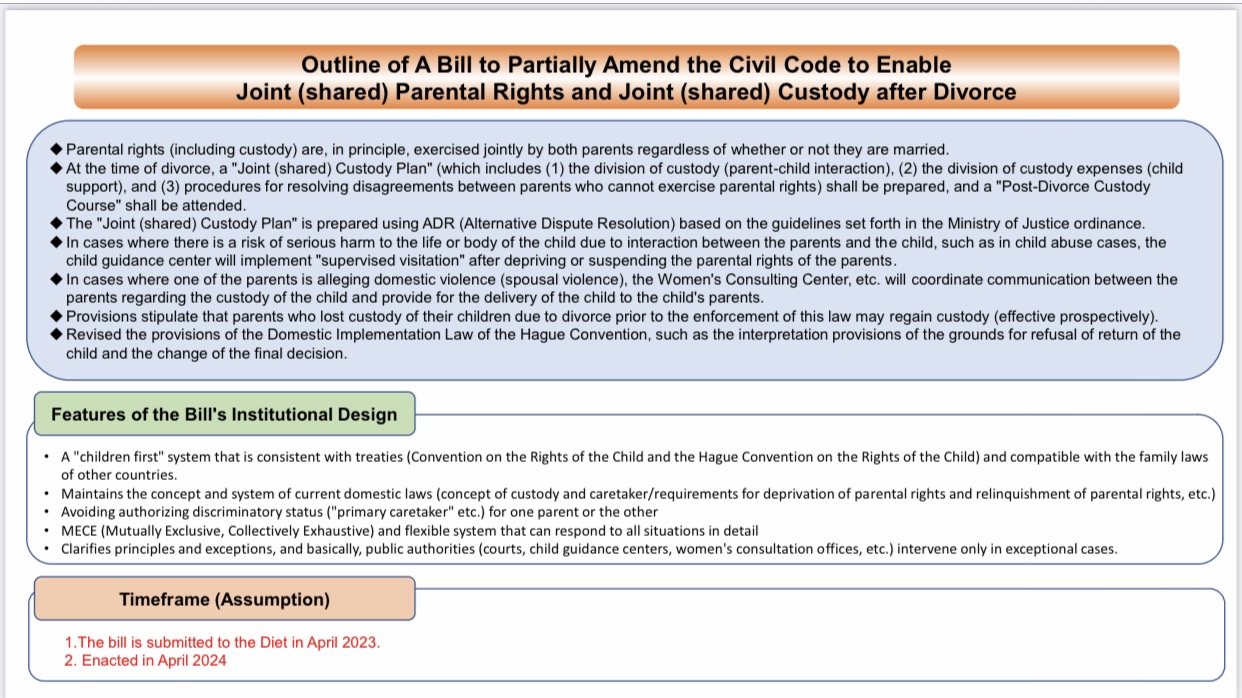
それに対比するのが民間法制審議会中間試案(以下、民間法制審案)だ。
*民間法制審案の概要詳細リンクは参考動画上に貼付け
法務省法制審議会が発表した中間試案に危機感を抱いた北村晴男弁護士等を中心として構成され試案された民間法制審案は、一部を除いて先進各国とほぼ同等な共同親権案である。この試案はこれまでの様な実子を連れ去る行為も速やかに解決し、離婚後の親子交流の断絶も解決出来る。更に親子を引き離す行為にはペナルティが課せられ、子の意思に関係無く一方の親が親子断絶を行う行為は禁止となり、現在の様に大きな社会問題となっている親子断絶も解決出来る。DV問題にしても、これまでの様な虚偽DV問題も解決でき、更に本当のDV行為や養育費不払い問題にも対応し、DVを行なった者への親権停止措置、養育費不払い行為にもペナルティが課せられるといった、世界基準の共同親権法案である。
現在、改正家族法は公布され、2026年には“見せかけだけの共同親権制度“が施行される。だが、依然として、子供を奪われた各国の親や各国政府からの批判はおさまらず、各先進国は日本の改正家族法が“偽りである“と認識している。日本政府は、日本国民や日本人の配偶者に子供を奪われた在日外国人被害者の訴えでは行動を起こさないが、諸外国からの批判や勧告、それに足して私たち当事者がもっと声を上げ、行動に移していき、『諦める事なく訴えていかなければならない』と思っています。その為には原則共同親権制度を求め、日本の民法に照らし合わせ、非常に合理性のある民間法制審議会案をベースに、「先進国基準の原則共同親権制度」を今後も強く訴えかけていきたい。
(リンクを貼り付けてある民間法制審議会案の概要を読んで頂ければ、外国政府に提出しても納得でき、すぐにでも採用出来る案になっています。)
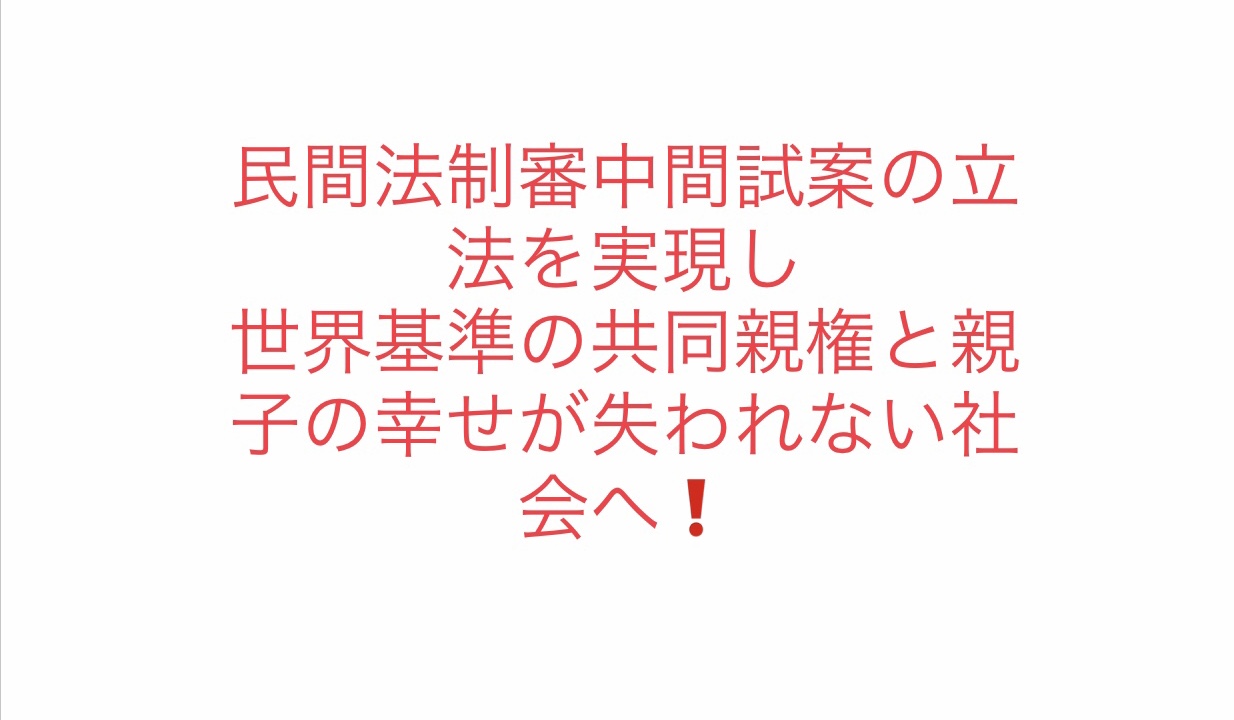
この「世界基準の共同親権法の立法を求める」賛同署名は、海外の政府や国内の然るべき管轄庁へ提出し実現を目指す。
是非、日本の子供達、私達の子供達の未来をより良くする社会の実現と、家族間の争いが起きず、皆が幸せになる為に、子供が幸せになる為にご賛同を頂きたいと思っています。子供の人権を大切にし、子を尊重し愛おしみ、親子が引き離される悲しみが無い平和な社会へ。何卒賛同を宜しくお願い致します。
On May 17, 2024. Japan passed a revised family law (Parental Rights Act, Reiwa 6, Act No. 33), which was enacted by the Diet for the first time in approximately 77 years and promulgated on May 24.
For many years, Japan maintained a sole custody system. However, with the rapid globalization and changes in public consciousness, the principle of sole custody after divorce, where only one parent takes on child-rearing responsibilities, has become outdated. The fundamental problem with the sole custody system is that after divorce, one parent is primarily responsible for child-rearing, which imposes financial and physical burdens. For the child, it means losing one parent who would have otherwise provided unconditional love. The parent who loses custody and is forced to live apart from the child often suffers severe psychological trauma, and some even resort to suicide due to the inability to see their children. Furthermore, the responses of some NPOs, lawyers, and courts have been criticized, making the current sole custody system lacking in rationality and causing significant issues from both moral and human rights perspectives. In today’s globalized society, countries with a sole custody system are very few. Advanced nations and the UN have repeatedly urged or criticized the Japanese government to reform to a joint custody system. Under international pressure, the Japanese government legislated the revised family law, including provisions that allow for the possibility of joint custody after divorce.
However, this revised law is far from a joint custody system (including child-rearing rights) and has been designed in such a way that it actually strengthens the sole custody system, effectively tearing parents and children further apart. The revised family law could encourage the unjust separation of children from their parents and is very difficult to understand. It is a so-called "pseudo joint custody law" in name only. The government’s parental rights law is a “selective joint custody system” that requires the mutual consent of the couple, unlike the principle of joint custody adopted by most advanced countries.
The legislative intent and philosophy behind this are very ambiguous, and when considering the overall draft and the actual situation upon enforcement, it effectively becomes a sole custody law or a law very close to sole custody. For example, separating the parental rights holder from the child-rearing rights holder means that even if one is a parental rights holder, they cannot be primarily involved in the child’s upbringing. Furthermore, if neither spouse designates a child-rearing rights holder or parental rights holder after divorce, it should theoretically lead to joint custody. However, the revised family law incorporates the concept of a “primary custodian” (in overseas terms, this only designates the main residence of the child, which does not prevent the non-custodial parent from meeting the child) under the guise of international norms, and modifies the interpretation of guardianship to easily facilitate parent-child separation, even without giving the primary custodian excessive authority. This is evident in the fact that the Ministry of Justice’s intermediate proposals link the new DV law to the parental rights law.
In contrast, the Private Legislative Council’s interim proposal (hereafter referred to as the Private Legislative Council Proposal) has been drafted by a group led by lawyer Haruo Kitamura, who felt a sense of crisis over the Ministry of Justice’s interim proposal. This proposal is almost equivalent to the joint custody systems of advanced countries. This proposal can swiftly resolve actions like the previous abductions of biological children and the post-divorce severance of parent-child relationships. Furthermore, penalties are imposed for actions that separate parents and children, prohibiting unilateral parent-child separation actions, and resolving the significant social issue of parent-child separation. It also addresses false DV issues and unpaid child support, with measures such as suspending parental rights for actual DV perpetrators and imposing penalties for non-payment of child support, making it a world-standard joint custody bill.
The revised family law has been promulgated, and the “pseudo joint custody system” will be enforced in 2026. However, criticism from parents whose children have been taken and foreign governments has not subsided. Advanced countries recognize Japan’s revised family law as false. The Japanese government does not act on the appeals of Japanese citizens or foreign residents whose children have been taken by their Japanese spouses. Still, it must respond to foreign criticism and recommendations. We, the affected parties, must continue to raise our voices and act, never giving up on our appeals. Therefore, we strongly advocate for a “principle of joint custody system” based on the Private Legislative Council’s proposal, which is highly rational under Japanese civil law, and continue to strive for the “principle of joint custody system” by international standards.
This petition for legislation for a “world-standard joint custody law” aims to be submitted to relevant domestic authorities and foreign governments to achieve this. We seek your support to realize a society that improves the future of Japanese children and our children, where family disputes do not occur, and everyone can be happy, ensuring children’s happiness. We aim for a peaceful society that values children’s human rights, respects and cherishes children, and eliminates the sorrow of parent-child separation. We kindly ask for your support.

3,661
署名活動の主旨
2024年5月17日、日本は約77年ぶりの改正となる家族法(親権制度・令和6年法律第33号)が国会で成立し、同月24日に公布された。
日本は、長年に渡り単独親権制度を堅持していたが、近代の急速な国際化社会の流れや、国民意識の変化によって、夫婦の離婚後にどちらか一方の親が子供の養育をする原則単独親権制度が、時代と相違していた。
単独親権制度が時代とそぐわない理由として基本的な問題は、子を持つ夫婦の離婚後、子を養育する親が基本的には父母のどちらか1人になる事で、親は養育の主となる、金銭的、体力的にも不利益を生じ、子供にとっては、本来なら無償の愛情を惜しみなく注いでくれる筈の一方の親を失ってしまう。また、親権を失い子供とも別居せざるを得なくなった一方の親は、夫婦の離婚後にわが子と殆ど会えなくなってしまい、心理的外傷を深く負ってしまい、中には子供と会えない事を苦に自死を選ぶ親も少なくない。そして一部のNPO団体や一部の弁護士、裁判所の対応も問題視されており、親と子供にとって現在の単独親権制度は、合理性に欠如し、道徳的にも人権的観点からも非常に支障をきたす制度になっている。国際化している現在の社会でも単独親権制度の国は非常に少数で、先進国や国連が日本政府に対して度々、共同親権制度に改正するように勧告、あるいは非難している。国際社会からの圧力で日本政府は改正家族法を立法し、夫婦の離婚後に“共同親権“になり得る可能性のある条文を規定した。
しかしこの改正法は、共同親権(監護権を含む)とは程遠い法であり、見せかけだけの共同親権法改正を企てる法務省法制審議会委員達の思惑により、これまでと何ら変わりないどころか更に親子を引き裂く実質的な単独親権制度となる様に制度設計がされている。
この改正家族法では日本の単独親権制の諸問題である"実子誘拐"や親子の不当な引き離しを助長しかねない法であり、尚且つ非常に理解しにくい立法で、共同親権とは名ばかりの、いわゆる"似て非なる"親権法である。
政府が交付した親権法は、夫婦の合意が基本的な条件となる“選択制の共同親権制度“であり、各先進国の原則共同親権制度とは全く異なる「選択制共同親権」である。
そして、その立法趣旨や理念は非常に曖昧なものであり、全体の案を読み解き実際に法施行された場合の状況を考えると実質的に単独親権となる、あるいは単独親権制に近い立法となる。
例えば、分かりやすいのは親権者と監護権者を分別し、親権者であっても子の主たる養育に関われない事態になる。更に夫婦の互いが離婚後の監護権者や親権者指定をしない場合であれば実質的に共同親権となり得る筈であるが、改正家族法にはこれを実現させない様に"主たる監護者"の指定(海外の観念では主たる監護者を指定したとしても主な子の居住地を子、又は子が決定出来ない場合は親が決定するだけであり、それにより別居親が会えなくなる事は無い)を海外の観念と見せかけて取り入れ、主たる監護者がこれまでの様に多大な権限を持たなくても養育権に絡めた法解釈を変更し親子断絶を容易に出来るシステムとなっている。これは新DV法の成立と絡めて親権法に新DV法を反映させる等の工作をしているのも法務省中間試案を深く読込み解釈をすれば良く分かる。
それに対比するのが民間法制審議会中間試案(以下、民間法制審案)だ。
*民間法制審案の概要詳細リンクは参考動画上に貼付け
法務省法制審議会が発表した中間試案に危機感を抱いた北村晴男弁護士等を中心として構成され試案された民間法制審案は、一部を除いて先進各国とほぼ同等な共同親権案である。この試案はこれまでの様な実子を連れ去る行為も速やかに解決し、離婚後の親子交流の断絶も解決出来る。更に親子を引き離す行為にはペナルティが課せられ、子の意思に関係無く一方の親が親子断絶を行う行為は禁止となり、現在の様に大きな社会問題となっている親子断絶も解決出来る。DV問題にしても、これまでの様な虚偽DV問題も解決でき、更に本当のDV行為や養育費不払い問題にも対応し、DVを行なった者への親権停止措置、養育費不払い行為にもペナルティが課せられるといった、世界基準の共同親権法案である。
現在、改正家族法は公布され、2026年には“見せかけだけの共同親権制度“が施行される。だが、依然として、子供を奪われた各国の親や各国政府からの批判はおさまらず、各先進国は日本の改正家族法が“偽りである“と認識している。日本政府は、日本国民や日本人の配偶者に子供を奪われた在日外国人被害者の訴えでは行動を起こさないが、諸外国からの批判や勧告、それに足して私たち当事者がもっと声を上げ、行動に移していき、『諦める事なく訴えていかなければならない』と思っています。その為には原則共同親権制度を求め、日本の民法に照らし合わせ、非常に合理性のある民間法制審議会案をベースに、「先進国基準の原則共同親権制度」を今後も強く訴えかけていきたい。
(リンクを貼り付けてある民間法制審議会案の概要を読んで頂ければ、外国政府に提出しても納得でき、すぐにでも採用出来る案になっています。)
この「世界基準の共同親権法の立法を求める」賛同署名は、海外の政府や国内の然るべき管轄庁へ提出し実現を目指す。
是非、日本の子供達、私達の子供達の未来をより良くする社会の実現と、家族間の争いが起きず、皆が幸せになる為に、子供が幸せになる為にご賛同を頂きたいと思っています。子供の人権を大切にし、子を尊重し愛おしみ、親子が引き離される悲しみが無い平和な社会へ。何卒賛同を宜しくお願い致します。
On May 17, 2024. Japan passed a revised family law (Parental Rights Act, Reiwa 6, Act No. 33), which was enacted by the Diet for the first time in approximately 77 years and promulgated on May 24.
For many years, Japan maintained a sole custody system. However, with the rapid globalization and changes in public consciousness, the principle of sole custody after divorce, where only one parent takes on child-rearing responsibilities, has become outdated. The fundamental problem with the sole custody system is that after divorce, one parent is primarily responsible for child-rearing, which imposes financial and physical burdens. For the child, it means losing one parent who would have otherwise provided unconditional love. The parent who loses custody and is forced to live apart from the child often suffers severe psychological trauma, and some even resort to suicide due to the inability to see their children. Furthermore, the responses of some NPOs, lawyers, and courts have been criticized, making the current sole custody system lacking in rationality and causing significant issues from both moral and human rights perspectives. In today’s globalized society, countries with a sole custody system are very few. Advanced nations and the UN have repeatedly urged or criticized the Japanese government to reform to a joint custody system. Under international pressure, the Japanese government legislated the revised family law, including provisions that allow for the possibility of joint custody after divorce.
However, this revised law is far from a joint custody system (including child-rearing rights) and has been designed in such a way that it actually strengthens the sole custody system, effectively tearing parents and children further apart. The revised family law could encourage the unjust separation of children from their parents and is very difficult to understand. It is a so-called "pseudo joint custody law" in name only. The government’s parental rights law is a “selective joint custody system” that requires the mutual consent of the couple, unlike the principle of joint custody adopted by most advanced countries.
The legislative intent and philosophy behind this are very ambiguous, and when considering the overall draft and the actual situation upon enforcement, it effectively becomes a sole custody law or a law very close to sole custody. For example, separating the parental rights holder from the child-rearing rights holder means that even if one is a parental rights holder, they cannot be primarily involved in the child’s upbringing. Furthermore, if neither spouse designates a child-rearing rights holder or parental rights holder after divorce, it should theoretically lead to joint custody. However, the revised family law incorporates the concept of a “primary custodian” (in overseas terms, this only designates the main residence of the child, which does not prevent the non-custodial parent from meeting the child) under the guise of international norms, and modifies the interpretation of guardianship to easily facilitate parent-child separation, even without giving the primary custodian excessive authority. This is evident in the fact that the Ministry of Justice’s intermediate proposals link the new DV law to the parental rights law.
In contrast, the Private Legislative Council’s interim proposal (hereafter referred to as the Private Legislative Council Proposal) has been drafted by a group led by lawyer Haruo Kitamura, who felt a sense of crisis over the Ministry of Justice’s interim proposal. This proposal is almost equivalent to the joint custody systems of advanced countries. This proposal can swiftly resolve actions like the previous abductions of biological children and the post-divorce severance of parent-child relationships. Furthermore, penalties are imposed for actions that separate parents and children, prohibiting unilateral parent-child separation actions, and resolving the significant social issue of parent-child separation. It also addresses false DV issues and unpaid child support, with measures such as suspending parental rights for actual DV perpetrators and imposing penalties for non-payment of child support, making it a world-standard joint custody bill.
The revised family law has been promulgated, and the “pseudo joint custody system” will be enforced in 2026. However, criticism from parents whose children have been taken and foreign governments has not subsided. Advanced countries recognize Japan’s revised family law as false. The Japanese government does not act on the appeals of Japanese citizens or foreign residents whose children have been taken by their Japanese spouses. Still, it must respond to foreign criticism and recommendations. We, the affected parties, must continue to raise our voices and act, never giving up on our appeals. Therefore, we strongly advocate for a “principle of joint custody system” based on the Private Legislative Council’s proposal, which is highly rational under Japanese civil law, and continue to strive for the “principle of joint custody system” by international standards.
This petition for legislation for a “world-standard joint custody law” aims to be submitted to relevant domestic authorities and foreign governments to achieve this. We seek your support to realize a society that improves the future of Japanese children and our children, where family disputes do not occur, and everyone can be happy, ensuring children’s happiness. We aim for a peaceful society that values children’s human rights, respects and cherishes children, and eliminates the sorrow of parent-child separation. We kindly ask for your support.
3,661
意思決定者

賛同者からのコメント
2022年12月31日に作成されたオンライン署名