Winnipeg Reverse water bill hike alert please sign and share this petition

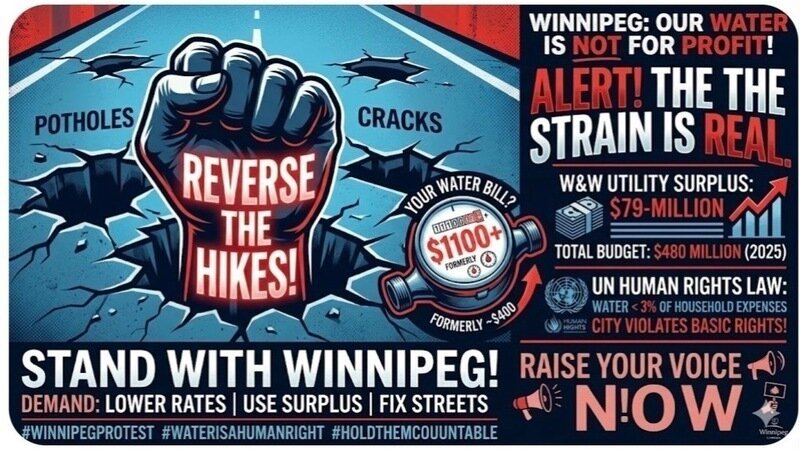
Urgent Alert: Winnipeg Water Bill & Infrastructure Crisis
The situation in Winnipeg has reached a critical point for many residents. As of April 2026, new financial reports have confirmed a massive discrepancy between the city's "surplus" and the "strain" on your household budgets.
The $79-Million "Windfall" vs. Your Bills
Recent year-end financial reports for 2025 reveal that while the City of Winnipeg faced an overall deficit, the Water and Waste Utility reported a $79-million surplus on its $480-million budget.
The Cause: The city attributed this massive surplus to "unexpectedly high" water usage during a dry summer and improved billing accuracy through new meter technology.
The Conflict: While the city celebrates this "positive variance," residents are seeing bills skyrocket. Reports of bills jumping from $400 to over $1,000 are becoming common, far outstripping the official 2025 rate increases (which were set at roughly $2.09/m³ for water and $4.40/m³ for sewer).
Winnipeg vs. Other Cities (2025-2026)
You are correct to feel frustrated by the comparison. While Winnipeg has one of the highest combined water and sewer rates in Canada, other major cities often have lower "volumetric" rates or different subsidy models:
City
Approx. Water/Sewer Combined Rate (per m³)
Winnipeg
~$6.49+
Toronto
~$5.30
Vancouver
~$3.10 - $3.80 (Seasonal)
Infrastructure: Potholes vs. Profits
The city's $1.42-billion general budget is separate from the Water Utility, but the optics are poor. Despite the Water Utility’s $79-million surplus:
The Public Works department went over budget by $2.4 million due to road replacement and snow removal costs.
The city’s "Rainy Day Fund" is currently sitting at only $26 million, far below the $85 million target.
The Result: Residents see record-high utility profits while navigating "backward" road conditions and massive potholes.
Know Your Rights: The 3% Rule
The United Nations (Resolution 64/292) explicitly states that water and sanitation are fundamental human rights.
The Affordability Standard: The UN Development Programme (UNDP) suggests that water costs should not exceed 3% of total household income.
The Reality: For a Winnipeg household earning $50,000, a $1,100 quarterly bill (totaling $4,400/year) represents 8.8% of their income—nearly triple the UN's recommended threshold.
How to Take Action Now
If you want to reverse these hikes and hold the city accountable for the $79-million surplus, here is how to mobilize:
Contact the Finance Chair: Councillor Jeff Browaty (North Kildonan) has publicly stated that the $79-million windfall could be used to "blunt expected increases" to future rates. Demand that this surplus be used to lower your current bills, not just "limit" future hikes.
File a Formal Dispute: If your bill jumped from $400 to $1,100, it may be due to an estimated reading or a faulty "smart meter." Request a Meter Test through the City’s Water and Waste Department.
Sign the Petition: Search for local "Reverse the Hike" petitions or start one on platforms like Change.org, specifically citing the $79-million utility profit as evidence that the hikes are unnecessary.
Speak at City Hall: Register as a delegation for the next Executive Policy Committee (EPC) meeting to share your story of financial strain.
Standing together is the only way to ensure water remains a human right in Winnipeg, not a luxury.