

Urgent upgrade of the MBBS curriculum to MD
The Issue
We, the undersigned, are concerned citizens, medical professionals, students, and advocates for quality healthcare in Nepal. We are writing to you to advocate for the urgent upgrade of the MBBS (Bachelor of Medicine, Bachelor of Surgery) curriculum to MD (Doctor of Medicine). This upgrade is critical to align our medical education with international standards, improve the quality of healthcare services, and address the existing challenges within our healthcare system.
Background:
The MBBS program has been foundational in training Nepal's medical doctors. However, the rapidly evolving field of medicine and increasing complexity of healthcare needs demand a more advanced and comprehensive education framework. Upgrading the MBBS curriculum to MD will equip our graduates to meet these demands and provide high-quality care. This approach follows successful models from other countries where the focus on comprehensive pre-medical education and direct MD programs has yielded significant benefits.
Recent efforts highlight the joint initiative of six government health science institutes in Nepal to prepare a unified MBBS curriculum.
These institutes are:
- National Academy of Medical Sciences (NAMS)
- Rapti Health Science Academy
- Madhesh Health Science Academy
- Pokhara Health Science Academy
- Madan Bhandari Health Science Academy
- Ram Raja Prasad Singh Health Science Academy
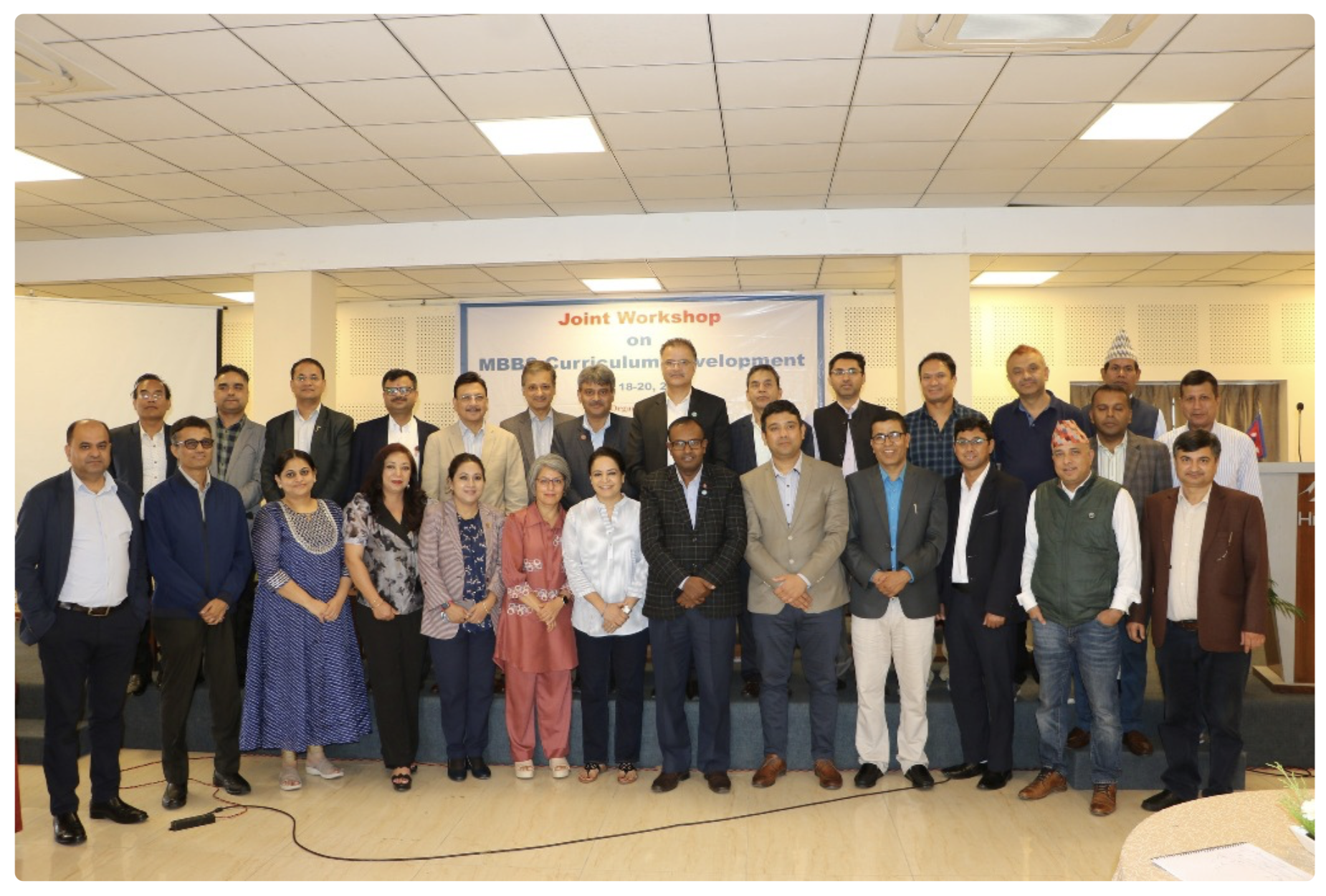
Photo credit: swasthyakhabar.com
Despite these efforts, MBBS graduates in Nepal face significant challenges:
- Limited Job Opportunities:
There are fewer job openings compared to the number of graduates, leading to high competition for available positions. A 2015 study by the Nepal Medical Council (NMC) indicated that approximately 36% of doctors were working abroad, with the actual proportion likely much higher today. The demand for Good Standing Certificates (GSCs), required for practicing abroad, has surged, highlighting the trend of medical professionals leaving the country due to insufficient local opportunities (Nepali Times) (Medchrome). - Scarcity of MD Seats: Limited opportunities for further specialization within Nepal force many graduates to seek education and training abroad. The Medical Education Commission reports that there are only around 2,000 postgraduate seats available annually, a number insufficient to meet the needs of the growing number of MBBS graduates. This shortage of postgraduate opportunities exacerbates the brain drain, as graduates seek advanced training elsewhere (Medchrome).
- Inadequate Infrastructure: Many medical facilities in Nepal lack modern equipment and sufficient resources, hindering practical training and professional growth. This inadequate infrastructure not only affects the quality of education but also impacts the healthcare services provided to patients. A significant proportion of doctors in specialized fields report challenges due to insufficient facilities and equipment (Nepali Times).
- Low Pay and Benefits: Medical professionals in Nepal often face low remuneration and lack insurance, retirement plans, and other benefits. Despite spending significant amounts on education (often up to half a crore), they are offered salaries as low as NPR 30,000-40,000 per month. This discrepancy between investment and return demotivates many professionals, driving them to seek better opportunities abroad (Nepali Times) (Medchrome).
- High Patient Load: Overcrowded hospitals and high patient-to-doctor ratios can lead to burnout and reduce the quality of care. In remote districts, the doctor-to-population ratio is as low as 1 per 150,000, compared to 1 per 850 in Kathmandu Valley. This disparity highlights the need for a more robust and well-distributed healthcare workforce (Nepali Times).
Adding more MBBS seats and schools can exacerbate these issues if the curriculum remains outdated. Upgrading to a direct MD program would ensure a higher standard of education, better prepare graduates for the complexities of modern medicine, and improve healthcare outcomes. It is crucial for experts and policymakers to consider this transition to address current inefficiencies and elevate the quality of medical education in Nepal.
In today's healthcare landscape, patients increasingly expect specialized and focused care from medical professionals. When someone introduces themselves as a "doctor," the public often inquires about their specific area of expertise, be it cardiology, neurology, orthopedics, dermatology, or any other medical specialty. This shift in public awareness and demand for specialized care underscores the need for a comprehensive medical education that prepares graduates for advanced training and specialization opportunities.
By upgrading to an MD program, Nepal can produce medical professionals who possess a strong foundation in core medical sciences, coupled with exposure to various specialties during their training. This approach would better align our healthcare workforce with public expectations and ensure that patients receive care from doctors who have undergone rigorous, focused education in their respective fields.
Current Challenges:
Outdated Curriculum: The existing MBBS curriculum is not fully aligned with the latest medical advancements and global standards.
Limited Practical Training: Students often lack sufficient hands-on experience, which is crucial for their professional development.
Quality Disparities: There are significant disparities in the quality of education across different medical institutions.
Global Recognition: An MD degree is more widely recognized Clinical Degree and respected internationally, facilitating better opportunities for our graduates.
Proposed Solutions:
- Curriculum Overhaul: Develop a curriculum that integrates modern medical practices, technologies, and research-based education. This should include enhanced clinical exposure, problem-based learning, and interdisciplinary training.
- Standardized Accreditation: Establish a robust accreditation system to ensure uniform quality across all medical colleges.
- Faculty Development: Invest in the continuous professional development of faculty members to maintain high teaching standards.
- International Collaboration: Partner with international medical institutions and organizations to adopt best practices and innovative teaching methodologies.
Benefits of Upgrading to MD:
- Enhanced Competence: Graduates will possess a deeper and broader knowledge base, improving their diagnostic and treatment capabilities.
- Global Opportunities: An MD degree will open doors for international job opportunities, further education, and collaborative research.
- Improved Healthcare: A more advanced medical education will directly contribute to higher quality healthcare services, benefiting the entire nation.
- Attracting Talent: Upgrading to an MD program will attract more talented and dedicated individuals to the medical profession.
Call to Action:
We respectfully request the Ministry of Education, Science, and Technology; the Ministry of Health and Population; the Nepal Medical Council; and all concerned stakeholders to take immediate action to upgrade the MBBS curriculum to MD. This initiative will require a collaborative effort, including input from educational institutions, healthcare providers, policy makers, and the community at large.
References:
Nepali Times. Grass is greener overseas for Nepal's doctors. Retrieved from: https://nepalitimes.com/here-now/grass-is-greener-overseas-for-nepals-doctors
Common Entrance Exam Nepal. Exploring Career Opportunities: Post-MBBS Benefits in Nepal and Abroad. Retrieved from: https://www.commonentranceexamnepal.com
Dixit, H., & Marahatta, S. B. (2008). Medical education and training in Nepal: SWOT analysis. Kathmandu University Medical Journal, Vol. 6, No. 3, Issue 23, 412-420. Retrieved from ResearchGate: www.researchgate.net/publication/41013171_Medical_education_and_training_in_Nepal_SWOT_analysis
Nepal Medical Council (NMC). (2023). Medical Education System in Nepal: Historical Context and Modern Developments. Retrieved from Nepal Medical Council: www.nmc.org.np
Ministry of Health and Population, Nepal. (2023). Evolution of Health System in Nepal. Retrieved from Ministry of Health and Population: www.mohp.gov.np
World Health Organization (WHO). (2023). Comparative Analysis of Global Medical Education Standards. Retrieved from WHO: www.who.int
Nepal Medical Education Council. (2023). Accreditation and Standardization in Medical Education. Retrieved from NMEC: www.nmec.gov.np
Medchrome. Post Graduation (PG) after MBBS – Top Destinations. Retrieved from: https://medchrome.com

86
The Issue
We, the undersigned, are concerned citizens, medical professionals, students, and advocates for quality healthcare in Nepal. We are writing to you to advocate for the urgent upgrade of the MBBS (Bachelor of Medicine, Bachelor of Surgery) curriculum to MD (Doctor of Medicine). This upgrade is critical to align our medical education with international standards, improve the quality of healthcare services, and address the existing challenges within our healthcare system.
Background:
The MBBS program has been foundational in training Nepal's medical doctors. However, the rapidly evolving field of medicine and increasing complexity of healthcare needs demand a more advanced and comprehensive education framework. Upgrading the MBBS curriculum to MD will equip our graduates to meet these demands and provide high-quality care. This approach follows successful models from other countries where the focus on comprehensive pre-medical education and direct MD programs has yielded significant benefits.
Recent efforts highlight the joint initiative of six government health science institutes in Nepal to prepare a unified MBBS curriculum.
These institutes are:
- National Academy of Medical Sciences (NAMS)
- Rapti Health Science Academy
- Madhesh Health Science Academy
- Pokhara Health Science Academy
- Madan Bhandari Health Science Academy
- Ram Raja Prasad Singh Health Science Academy
Photo credit: swasthyakhabar.com
Despite these efforts, MBBS graduates in Nepal face significant challenges:
- Limited Job Opportunities:
There are fewer job openings compared to the number of graduates, leading to high competition for available positions. A 2015 study by the Nepal Medical Council (NMC) indicated that approximately 36% of doctors were working abroad, with the actual proportion likely much higher today. The demand for Good Standing Certificates (GSCs), required for practicing abroad, has surged, highlighting the trend of medical professionals leaving the country due to insufficient local opportunities (Nepali Times) (Medchrome). - Scarcity of MD Seats: Limited opportunities for further specialization within Nepal force many graduates to seek education and training abroad. The Medical Education Commission reports that there are only around 2,000 postgraduate seats available annually, a number insufficient to meet the needs of the growing number of MBBS graduates. This shortage of postgraduate opportunities exacerbates the brain drain, as graduates seek advanced training elsewhere (Medchrome).
- Inadequate Infrastructure: Many medical facilities in Nepal lack modern equipment and sufficient resources, hindering practical training and professional growth. This inadequate infrastructure not only affects the quality of education but also impacts the healthcare services provided to patients. A significant proportion of doctors in specialized fields report challenges due to insufficient facilities and equipment (Nepali Times).
- Low Pay and Benefits: Medical professionals in Nepal often face low remuneration and lack insurance, retirement plans, and other benefits. Despite spending significant amounts on education (often up to half a crore), they are offered salaries as low as NPR 30,000-40,000 per month. This discrepancy between investment and return demotivates many professionals, driving them to seek better opportunities abroad (Nepali Times) (Medchrome).
- High Patient Load: Overcrowded hospitals and high patient-to-doctor ratios can lead to burnout and reduce the quality of care. In remote districts, the doctor-to-population ratio is as low as 1 per 150,000, compared to 1 per 850 in Kathmandu Valley. This disparity highlights the need for a more robust and well-distributed healthcare workforce (Nepali Times).
Adding more MBBS seats and schools can exacerbate these issues if the curriculum remains outdated. Upgrading to a direct MD program would ensure a higher standard of education, better prepare graduates for the complexities of modern medicine, and improve healthcare outcomes. It is crucial for experts and policymakers to consider this transition to address current inefficiencies and elevate the quality of medical education in Nepal.
In today's healthcare landscape, patients increasingly expect specialized and focused care from medical professionals. When someone introduces themselves as a "doctor," the public often inquires about their specific area of expertise, be it cardiology, neurology, orthopedics, dermatology, or any other medical specialty. This shift in public awareness and demand for specialized care underscores the need for a comprehensive medical education that prepares graduates for advanced training and specialization opportunities.
By upgrading to an MD program, Nepal can produce medical professionals who possess a strong foundation in core medical sciences, coupled with exposure to various specialties during their training. This approach would better align our healthcare workforce with public expectations and ensure that patients receive care from doctors who have undergone rigorous, focused education in their respective fields.
Current Challenges:
Outdated Curriculum: The existing MBBS curriculum is not fully aligned with the latest medical advancements and global standards.
Limited Practical Training: Students often lack sufficient hands-on experience, which is crucial for their professional development.
Quality Disparities: There are significant disparities in the quality of education across different medical institutions.
Global Recognition: An MD degree is more widely recognized Clinical Degree and respected internationally, facilitating better opportunities for our graduates.
Proposed Solutions:
- Curriculum Overhaul: Develop a curriculum that integrates modern medical practices, technologies, and research-based education. This should include enhanced clinical exposure, problem-based learning, and interdisciplinary training.
- Standardized Accreditation: Establish a robust accreditation system to ensure uniform quality across all medical colleges.
- Faculty Development: Invest in the continuous professional development of faculty members to maintain high teaching standards.
- International Collaboration: Partner with international medical institutions and organizations to adopt best practices and innovative teaching methodologies.
Benefits of Upgrading to MD:
- Enhanced Competence: Graduates will possess a deeper and broader knowledge base, improving their diagnostic and treatment capabilities.
- Global Opportunities: An MD degree will open doors for international job opportunities, further education, and collaborative research.
- Improved Healthcare: A more advanced medical education will directly contribute to higher quality healthcare services, benefiting the entire nation.
- Attracting Talent: Upgrading to an MD program will attract more talented and dedicated individuals to the medical profession.
Call to Action:
We respectfully request the Ministry of Education, Science, and Technology; the Ministry of Health and Population; the Nepal Medical Council; and all concerned stakeholders to take immediate action to upgrade the MBBS curriculum to MD. This initiative will require a collaborative effort, including input from educational institutions, healthcare providers, policy makers, and the community at large.
References:
Nepali Times. Grass is greener overseas for Nepal's doctors. Retrieved from: https://nepalitimes.com/here-now/grass-is-greener-overseas-for-nepals-doctors
Common Entrance Exam Nepal. Exploring Career Opportunities: Post-MBBS Benefits in Nepal and Abroad. Retrieved from: https://www.commonentranceexamnepal.com
Dixit, H., & Marahatta, S. B. (2008). Medical education and training in Nepal: SWOT analysis. Kathmandu University Medical Journal, Vol. 6, No. 3, Issue 23, 412-420. Retrieved from ResearchGate: www.researchgate.net/publication/41013171_Medical_education_and_training_in_Nepal_SWOT_analysis
Nepal Medical Council (NMC). (2023). Medical Education System in Nepal: Historical Context and Modern Developments. Retrieved from Nepal Medical Council: www.nmc.org.np
Ministry of Health and Population, Nepal. (2023). Evolution of Health System in Nepal. Retrieved from Ministry of Health and Population: www.mohp.gov.np
World Health Organization (WHO). (2023). Comparative Analysis of Global Medical Education Standards. Retrieved from WHO: www.who.int
Nepal Medical Education Council. (2023). Accreditation and Standardization in Medical Education. Retrieved from NMEC: www.nmec.gov.np
Medchrome. Post Graduation (PG) after MBBS – Top Destinations. Retrieved from: https://medchrome.com
Petition Updates
Share this petition
Petition created on May 20, 2024