
Ban Single Use Plastics at URI
The Issue
We are moving quickly towards a plastic-filled future. Roughly 44% of all plastic ever manufactured was produced in just the last two decades, and production is expected to increase exponentially. In 14 years, Rhode Island landfills will reach capacity. After that we will have to export our trash, but that doesn’t mean it will go away. In 30 years, there will be more plastic in the ocean than fish. And in 450 years, the Dunkin’ cup you bought and threw into the trash today might have finally broken down.
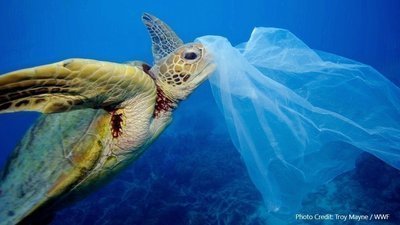
Plastic pollution has become a prominent threat to the majority of marine life, which means that it hurts us, too. The oceans are the “lungs of the planet,” producing more than half of the oxygen we breath and absorbing a quarter of our carbon emissions. Yet we continue to fill the Earth’s lungs with plastic clumps twice the size of Texas that float around in ocean gyres. Fishermen are pulling up as much plastic as they are fish, and those fish consume plastic particles that enter our bodies when we enjoy our tuna sandwiches or fish and chips.
At URI, recycling is encouraged and the university has invested in reusable water refilling stations throughout campus. On average only about 10% of plastics are actually recycled in the United States, so most of it ends up in the landfill or makes its way to the sea. URI recycles about 35% of its waste. However, there is still more that we can do to reduce our plastic consumption. Think about all of the takeout containers, plastic utensils, straws, bottles, wrappers, and bags that we use one time and throw away. Another little known fact is that some of the plastics in our oceans come from our clothes.
Dr. Elizabeth Mendenhall, an Assistant Professor of Marine Affairs, wishes that students were more aware “that synthetic fabrics are a major source of micro-plastic fibers - fleece, polyester, 'performance fabrics,' and stretchy leggings,” for example. She suggests “buying natural fibers, and higher quality clothes that you keep longer,” to reduce the amount of plastic that enters the environment, and can even be found in the air that we breathe.
One thing that we can all do is to increase our awareness and decrease our consumption of all forms of plastic. Did you know that URI has at least 35 academic programs with a sustainability theme? Consider taking a class to learn more. You can also join one of the many student clubs on campus that are active in protecting our natural resources.
While she was an undergraduate student at UC San Diego, Eliya Baron Lopez worked on a campaign to ban the sale and distribution of plastic bottles. Now a Master’s student at URI, she wishes that students would use their voice and power to push for change. “While it is the university's responsibility to formulate service contracts to limit or ban the distribution of single-use plastics, students need to organize and communicate with administration that they find the issue of single-use plastics as a serious problem,” she commented.
In 2018, Duke University banned disposable plastics from its 34 dining halls. Now that alternative options which are recyclable and compostable are more accessible and affordable than ever, the university was able to take this important step in becoming more sustainable. When the University of Vermont prohibited the sale of bottled water, the effort initially backfired. Students bought soda and other less healthy alternatives when water was not available. They found out that focusing on one specific product was not enough, they needed to change the culture on campus. Promoting reusable alternatives, composting, reducing the university’s energy use and lowering our carbon emissions will have a much bigger impact.
Banning single use plastics at URI would be a start, but we all need to do more than that to keep ourselves and our Blue Planet safe. If you would like to join the effort to reduce the use of plastic at URI, please consider signing this petition.
Petition Closed
The Issue
We are moving quickly towards a plastic-filled future. Roughly 44% of all plastic ever manufactured was produced in just the last two decades, and production is expected to increase exponentially. In 14 years, Rhode Island landfills will reach capacity. After that we will have to export our trash, but that doesn’t mean it will go away. In 30 years, there will be more plastic in the ocean than fish. And in 450 years, the Dunkin’ cup you bought and threw into the trash today might have finally broken down.
Plastic pollution has become a prominent threat to the majority of marine life, which means that it hurts us, too. The oceans are the “lungs of the planet,” producing more than half of the oxygen we breath and absorbing a quarter of our carbon emissions. Yet we continue to fill the Earth’s lungs with plastic clumps twice the size of Texas that float around in ocean gyres. Fishermen are pulling up as much plastic as they are fish, and those fish consume plastic particles that enter our bodies when we enjoy our tuna sandwiches or fish and chips.
At URI, recycling is encouraged and the university has invested in reusable water refilling stations throughout campus. On average only about 10% of plastics are actually recycled in the United States, so most of it ends up in the landfill or makes its way to the sea. URI recycles about 35% of its waste. However, there is still more that we can do to reduce our plastic consumption. Think about all of the takeout containers, plastic utensils, straws, bottles, wrappers, and bags that we use one time and throw away. Another little known fact is that some of the plastics in our oceans come from our clothes.
Dr. Elizabeth Mendenhall, an Assistant Professor of Marine Affairs, wishes that students were more aware “that synthetic fabrics are a major source of micro-plastic fibers - fleece, polyester, 'performance fabrics,' and stretchy leggings,” for example. She suggests “buying natural fibers, and higher quality clothes that you keep longer,” to reduce the amount of plastic that enters the environment, and can even be found in the air that we breathe.
One thing that we can all do is to increase our awareness and decrease our consumption of all forms of plastic. Did you know that URI has at least 35 academic programs with a sustainability theme? Consider taking a class to learn more. You can also join one of the many student clubs on campus that are active in protecting our natural resources.
While she was an undergraduate student at UC San Diego, Eliya Baron Lopez worked on a campaign to ban the sale and distribution of plastic bottles. Now a Master’s student at URI, she wishes that students would use their voice and power to push for change. “While it is the university's responsibility to formulate service contracts to limit or ban the distribution of single-use plastics, students need to organize and communicate with administration that they find the issue of single-use plastics as a serious problem,” she commented.
In 2018, Duke University banned disposable plastics from its 34 dining halls. Now that alternative options which are recyclable and compostable are more accessible and affordable than ever, the university was able to take this important step in becoming more sustainable. When the University of Vermont prohibited the sale of bottled water, the effort initially backfired. Students bought soda and other less healthy alternatives when water was not available. They found out that focusing on one specific product was not enough, they needed to change the culture on campus. Promoting reusable alternatives, composting, reducing the university’s energy use and lowering our carbon emissions will have a much bigger impact.
Banning single use plastics at URI would be a start, but we all need to do more than that to keep ourselves and our Blue Planet safe. If you would like to join the effort to reduce the use of plastic at URI, please consider signing this petition.
The Decision Makers
Petition Updates
Share this petition
Petition created on May 1, 2020