
XXXXXX
XXXXXX
XXXXXX
XXXXXX
Our Ref: YorExit/UK9
16 September 2022
Mrs Kemi Badenoch
Secretary of State for International Trade
President of the Board of Trade
Department of Trade
London
Dear Mrs Badenoch
We at IlanaUK congratulate you on your appointment as Secretary of State for International Trade and President of the Board of Trade.
We know that yours is a specialised department upon which the success or otherwise of Brexit depends. Your department is responsible for developing, coordinating, and detailing a new trade policy for the UK. Your department is responsible for preparing for and then negotiating free trade agreements and market access deals with foreign countries. Your department is responsible for striking and extending trade agreements between the United Kingdom and foreign countries.
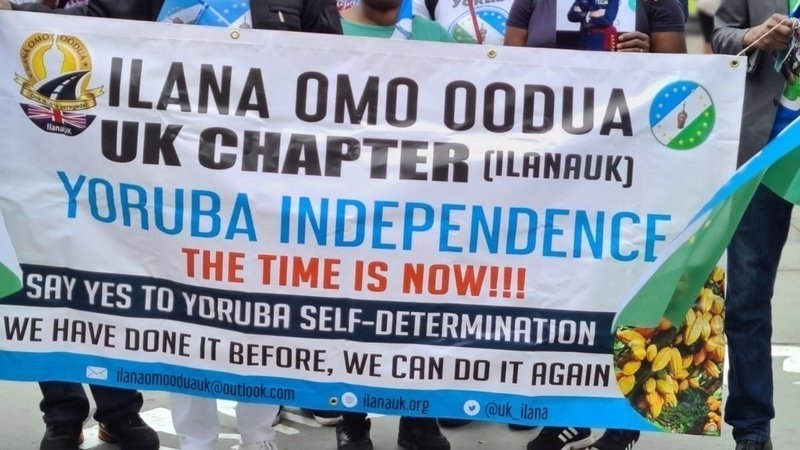
IlanaUK is a welfare organisation dedicated to achieving self-determination for the Yoruba people of Nigeria through lawful and non-violent means. We here make the case for specific, preferential trade agreements with the Yoruba Homeland located in the Southwestern region of the country that the British named Nigeria in 1914.
First, a Britain-Yorubaland trade agreement is nothing new. The first such agreement was included in the treaty of friendship signed in 1888 by Queen Victoria and the Alaafin of Oyo. In 1913, the volume of trade with Yorubaland was about £8.5 million out of a total of £13.5 million for the British Empire as a whole. In 1917, it was about £12 million out of a total of £14.5 million.
Second, the volume of trade with the Nigeria area currently is paltry at only about 0.3%. Import from Nigeria was worth £1.2 billion. Crude oil accounted for 85%. Export to Nigeria was worth $1.9 billion. Refined petroleum and petroleum products accounted for 40%. There is potential for a much larger volume of trade, of much more diverse content, but a significant uplift in trade will only occur if Nigeria was dissolved into its constituent ethnic nations. The Nigeria construct is the biggest obstacle to greater trade with the UK.
Third, the Yoruba Homeland, when it was the self-governing Western Region of Nigeria, was remarkably successful in establishing and running partnerships with foreign companies. Interested companies were provided with Pioneer Certificates, which enabled the foreign company to enjoy a variety of concessions including tax breaks, assistance with loans and guarantees, acquisition of land for their ventures and repatriation of capital and profit as wished. Between 1954 and 1959, there were 30 or so such ventures established with success between the Western Nigeria Development Corporation and foreign companies from the USA, UK, Italy, France, Germany, and Israel. Yorubaland in those heady days of the Awolowo era offered itself as ‘test grounds’ where giants of industry could experiment and participate unfettered by politics.
Fourth, Yorubaland has natural resources which made it a worthy trade partner to the UK. Yorubaland has arable and fertile land in abundance, suitable for growing almost any crop. Mineral resources yet to be exploited include bitumen, marble, gold, and oil. There are limitless opportunities in the Yoruba landscape to harness renewable energy from sun, water, and wind. There are tourism opportunities with many historical sites and sites of natural beauty.
Fifth, Yorubaland has human capital in abundance which too made it a worthy trade partner to the UK. Many native-born Yoruba practice their professions in different parts of the world. The success of the Yoruba Diaspora attests to the fact that we have a culture of adaptability. We Yoruba are undaunted by advances and complexities in artificial intelligence, robotics, science, and technology. Preferential trade agreement would energise the Yoruba Diaspora and enable us to have global economic and political impact. Our universally accepted Omoluabi principles has made us a cultured people, civil, congenial, generous, and hospitable.
Sixth, in the short period of self-government from 1954 to 1959, financed with money from cocoa sales, Awolowo introduced into Yorubaland free universal primary education and free healthcare for all children. ‘First in Africa’, a television station, was established and Cocoa House, a skyscraper, was built in Ibadan, the capital city. The Liberty Stadium, the first stadium in Nigeria, was built to Olympic standards. A minimum wage was introduced for workers, and then raised. Private sector industries were enabled with government funding to shore up their working capital. A thriving middle class was created on a sound economic footing. The Yoruba were at that time competing head-to-head with peoples of the emerging nations of southeast Asia that have today become very successful nations indeed. We can do it again.
Your late grandfather, Reverend Adubifa, was one of the pioneers that made the development of Yorubaland possible during the 1954-59 Awolowo era. He would expect no less of you.
We are not asking you to get involved in Nigeria’s politics. Far from it. What we respectfully and responsibly ask for is that when writing the new trade policy for the UK, you highlighted the fact that the volume of trade with the Nigeria area could substantially increase, but could not increase from the present 0.3% whilst the country is as it is.
Respectfully yours
Baasegun (Dr) Olusola Oni
Coordinator, IlanaUK