Proudly Yoruba - Baasegun at Seoyekoribe 19.05.22

Of all the peoples of Africa, the Yoruba are the most unique. No matter in what the situation they have found themselves, the Yoruba are the only peoples indigenous to Africa that throughout history have retained their Africanness, the ‘Ogo Adulawo’.
This came home to me the other day as I watched a Netflix documentary on the Yoruba people. All Yoruba must watch that Netflix documentary called ‘Bigger than Africa’.
Thousands and thousands of investigations, thousands and thousands of articles and books, have been written about the Yoruba. Why? Because the Yoruba is a unique and fascinating ancient civilisation.
3 years ago I went to Dakar Senegal for a conference of the West African College of Surgeons of which I am a honorary fellow. At Dakar, we visited the port from where Yoruba people were forcibly, cruelly and inhumanely transported as slaves to the Americas, a strange land. There was a part of the port called the ‘point of no return’. Once you got there, and got on the boat, there was no coming back.
It was the fact though that the Yoruba in reality never left home. On the journey and on arrival in the Americas, the European slavers were determined to break the spirits of their Yoruba slaves, but they failed. What they had not realised was that all Yoruba have tattooed in their brain the philosophy of ‘Ile labo simi oko’. The ‘Ile’ means not just Yorubaland, a physical place, but also the spirit of being Yoruba.
In Brazil, the slaves were forcibly baptised and converted to the catholic religion. What did the Yoruba do? They gave Yoruba names to the catholic saints which allowed them to continue to worship their Orisa through the European’s churches. I visited Brazil some years ago at Christmas time. Symbols of the Orisa were present everywhere. At the dawn of the New Year, the Brazilians took to the sea to worship Yemoja. The spectacle of white dresses and of candle flames was awesome.
In Haiti, the Yoruba retained their devotion to Ifa and to Yoruba deities, which today is referred to as voodoo. Their determination to remain Yoruba caused them several times to rebel and fight for freedom from their European slavers.
In Cuba, the Yoruba used their talking drums to keep alive their Yorubaness, their ‘Ogo adulawo’. They used their drums to transmit Yoruba culture to one another, and from one generation to the next. They sang songs that reminded them of where they came from. It brought tears to one’s eyes to hear the word ‘Ibadan’ in one of the songs. The Yoruba were an integral part of Castro’s revolution to liberate the oppressed masses.
In Trinidad and Tobago, the Yoruba slaves were prohibited from using their talking drums, which the Europeans had discovered was the means of communication amongst the slaves. So what did the Yoruba do? They created lengths of bamboo sticks to beat to talk to each other. They made musical instruments out of pieces of steel, like the steel drum. As in Brazil, the Yoruba of Trinidad used the ‘Egungun’ festival to remind themselves of home.
In all these strange lands to where they were forcibly and inhumanely transported as slaves, the Yoruba never forgot that ‘Ile labo simi oko’. They were determined to retain their identity, their culture and their tradition.
And so it has been for the Yoruba people of Nigeria too. In 1914, the British used the fraud of amalgamation to force the Yoruba to cohabit in the same country with total strangers. But, almost as soon as they sought to colonise us, we Yoruba sought to show the British that we are their equals. We went to their schools and excelled. We went into their professions and excelled. By the 1800s, we have a Yoruba Bishop, Yoruba missionaries, Yoruba doctors, Yoruba lawyers and other Yoruba professionals. We wrote our history. We translated the Bible.
Because we are the superior people in Nigeria, the British in 1953 rigged the census, and in 1959 they rigged the elections to supress the Yoruba people.
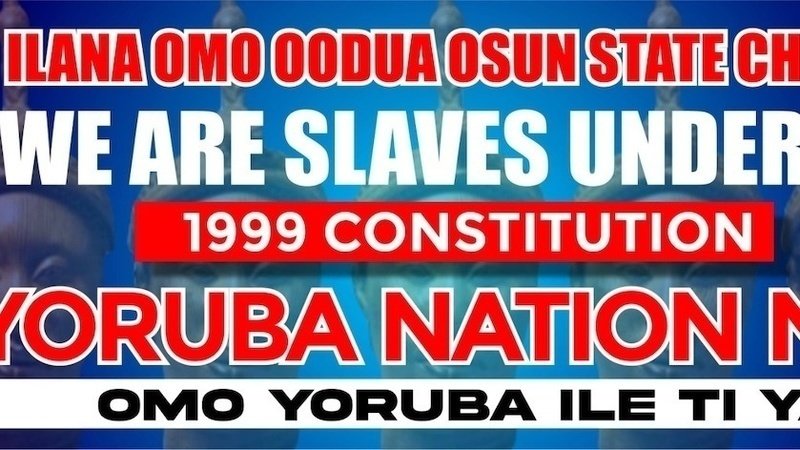
Since 1963, and, in particular since 1999, the Fulani have used the fraud of constitution, as the British had taught them, to keep us Yoruba as slaves in Nigeria. Our task is to expose this fraud. That is why we went to court at Ado Ekiti. That is why we were in court yesterday at Osogbo.
The remarkable thing about the Yoruba since our enslavement began is that we are not a people to rely on leaders to fight for us. We fight for ourselves. True, on occasions people like Moremi, Obafemi Awolowo and Sunday Igboho have emerged, but even they would be the first to admit that they were mere messengers, not leaders.
The Yoruba do not tolerate leaders. That is why our monarchy system is unique in the world. The Yoruba Oba was not a ruler but the mouthpiece of his people’s desires. The people tell the Oba what they want through the council of chiefs (Oloye) and the Oba implemented it. If he does not the people remove him from office.
The Yoruba believe in being led by ideals rather than by people. Reverence of elders. Respect for the rights of others. Giving to make your community better. Benefiting only from the fruits of your labour. These are the essence of Omoluabi, the humanism that you forge for yourself rather than being born with it, as it is frequently and wrongly characterised.
The Yoruba revere heroes (Akoni). The Orisa were Yoruba heroes of yesterday. Who are our heroes today? Certainly the 10 Osun voters and the 6 Ekiti voters are our heroes. They were brave enough to take the federal government of Nigeria to court to stop the 2022 elections. Those who risk their lives and Nigeria’s notorious DSS attention to attend the court hearings at Ado Ekiti and Osogbo are our heroes.