Why Nigeria is bad for the Yoruba - Baasegun @ IlanaUK Clubhouse 31.03.22

Oil and water don’t mix.
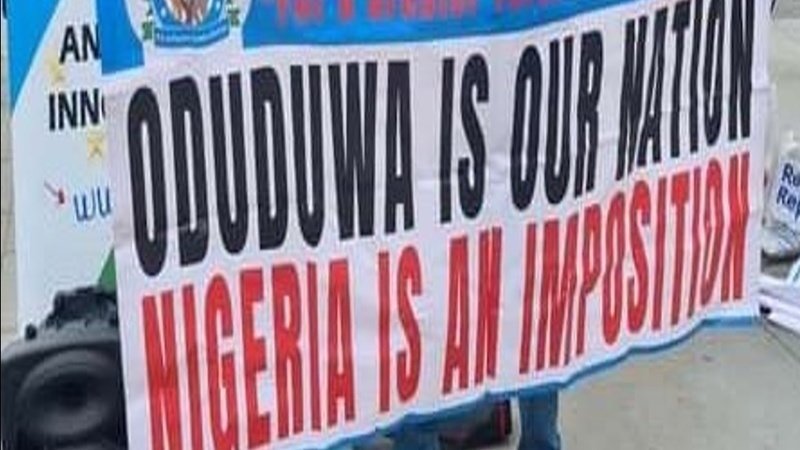
Nigeria is bad for the Yoruba because it is an ethnic mix of incompatibles with a very high incompatibility index. A toxic political and social environment that we know from the experience of 100 years was enduring and permanent. To persist with Nigeria is evidence of a lunacy.
The various ethnic groups of Nigeria were naturally separated by the ‘Y’ of the Niger and Benue Rivers. There was no significant historical interactions between them until the Europeans came.
Bloody confrontations between Nigeria’s ethnic groups have been unrelenting since the 1914 Amalgamation. Indeed, this situation led to a 3-year civil war that started in 1967. Keeping the different peoples of Nigeria under one administrative roof has been a form of inhuman and degrading treatment for the Yoruba.
1. The Yoruba have absolutely nothing in common with the other ethnic groups in Nigeria. The peoples of Nigeria are fundamentally different peoples just like the Italians of Europe are different from the Germans and the French are different from the English etc. The different European ethnic groups have no commonality other than geography, and they spent centuries at war with one another. Nigeria’s ethnic groups also have no shared custom and no common tradition. We look different. We dress different. We talk different. And they hate us for it. The barbarity of the Fulani in deliberately orphaning Yoruba children, raping their mothers and sisters, and wantonly destroying Yoruba farms and communities attest to the Fulani deep-seated hatred for the Yoruba. That Fulani hatred has not changed or diminished despite over 100 years of sharing a country. The history of Cyprus, another British colony, tells us that ethnic hatred never changes.
The British knew that putting Nigeria together was wrong. Governor Hugh Clifford (29/12/20, Nigerian Council Debates): ‘The people of British West African colonies and protectorates have no more pretensions to a common nationality than have, for example, the people of Europe.’
2. The Yoruba governance culture is antithetic to theirs. There is a clash of opposing cultures. The Hausa/Fulani have a liege culture, feudal culture. They coalesce under one leadership no matter how inept or mediocre. The Yoruba have an anti-liege culture. Leadership if given, is fettered and never 100%. The Hausa/Fulani perceive ‘country’ in jihadist terms, and they act accordingly and follow their leadership in that pursuit. The Yoruba perceive ‘country’ as a commonwealth, affording participation for each and every citizen. The Hausa/Fulani see the ruler as protector of a faith. The Yoruba see the ruler as a sacral figure. The Fulani view subjugation of others as their God-given mission and will stop at nothing to achieve it. The Yoruba view the Fulani as slavers and oppressors; uncivilised barbarians.
3. The Yoruba governance tradition is antithetic to theirs. In the Hausa/Fulani north, in the 1700s, centuries old indigenous Hausa sultanates were being violently sacked by Fulani Islamic jihadists. By 1807, the Sokoto Caliphate, with its Islamic culture and law, had been established centralising the system of government. The political structure was the Sultan of Sokoto ruling via emirate leaders that he had personally appointed, and who pledged allegiance to him. The Emir in turn controlled all local land, merely allocating pieces of it to families at his pleasure. The Emir was a mere interpreter and enforcer of the law whilst the Sultan was the embodiment of the state.
In Yorubaland, the ‘city state’ (Ilu) was the autonomous, independent unit of the political structure. There were many such ‘city states’, affiliated in a true confederation. The apparatus of government in each was monarchical. Each ‘city state’ was ruled by one person (Oba), although not governed by him. The Oba was not a supreme ruler. His rule was subject to veto by an institutionalised council of spokespersons (the Council of Oloye) representing different institutions such as age groups, craft guilds and religious sects. The council operated in two functional groups; namely, Otun (‘to the right’), that looked after the interests and wellbeing of the monarchy institution and Osi (‘to the left’), that looked after the interests and wellbeing of the ordinary citizen. The Yoruba monarchical system encouraged the Oba to rule in the interest of his people.
4. The Yoruba vision for the future is antithetic to theirs. They do not see the world through the same lens as us. Whilst we Yoruba are concerned and engrossed with cake-making, the Hausa/Fulani are concerned and engrossed with cake-stealing.
The Fulani have no interest in their children’s future. They kidnap their own children for ransom. They deny education to their own children, and prefer for them to be cattle herders travelling hundreds of miles by foot. They desire their girls to marry before they reached puberty. The elites desire their people to live in the 16thcentury.
The period between 1952 and 1959 reveals the vision that the Yoruba had for their future. Financed with money from cocoa sales, Awolowo introduced into Yorubaland free universal primary education and free healthcare for all children. First in Africa, a television station was established. Cocoa House, a skyscraper, was built in Ibadan, the capital city. The Liberty Stadium, the first stadium in Nigeria, was built to Olympic standards. A minimum wage was introduced for workers, and then raised. Private sector industries were enabled with government funding to shore up their working capital. A thriving middle class was created on a sound economic footing. The Yoruba were at that time competing head-to-head with peoples of the emerging nations of southeast Asia, such as South Korea and Singapore, that have today become very successful nations indeed.
That very rapid advancement of the Yoruba nation was brought to an abrupt halt from the very day that Nigeria independence was proclaimed. The other ethnic groups did not share the progressive vision of the Yoruba. Instead, they strove, and have continued to strive, to destroy the Yoruba dream.
5. Fulanisation or internal colonisation is their agenda for Nigeria. On October 12, 1960, Ahmadu Bello, the Sardauna of Sokoto confirmed the Fulani attitude towards other ethnic groups when he said this: ‘The new nation called Nigeria should be an estate of our grandfather, Othman Danfodio. We must ruthlessly prevent a change of power. We must use the minorities in the North as willing tools and the South as conquered territories and never allow their future.’
The Fulani have relentlessly pursued their Sardauna’s mission. In 1962, the Fulani-led Federal government used emergency powers to take over the administration of the Yorubaland. In 1963, Awolowo, the Yoruba leader, was imprisoned for 10 years. In 1964, the Midwest was hived off to diminish the economic and political power of the Yoruba. In 1979, Awolowo was denied a runoff of the presidential election. More recently in 1992, the election of Mosood Abiola, a Yoruba, as president of Nigeria was annulled by a Fulani-led military fiat. Several Yoruba political activists have been assassinated, for example, Bola Ige, or attempts made to assassinate them, for example, Mrs Ransome Kuti and Sunday Igboho.
Nigeria has had 13 rulers since independence in 1960, 9 of them have been Hausa/Fulani. Nigeria has had 8 military coups since 1966, 7 of them have been staged by Fulani army officers. The Fulani have governed Nigeria for 45 out of 62 years since independence. All of Nigeria’s post-independence constitutions have been written by Fulani army officers with the intention of making the Yoruba their slaves. Today, one ethnic group, the Fulani, and Muslims, have put themselves in charge of everything. Can anyone say that all this is good for the Yoruba?
Some pretentious Yoruba intellectuals and political opportunists, the Nigerianistas, rail against ethnic identity. They preach ‘ethnic blindness’ as the solution to Nigeria’s problems. They seem ignorant to the fact that Nigeria since 1966 has practiced ‘ethnic blindness’ in the form of the so-called ‘federal character’. A device that allows the Fulani to take resources from Yorubaland to impoverish the Yoruba. A device that has all but destroyed the education system in Yorubaland. A device that elevated the unqualified Fulani mediocre to head government departments. ‘Ethnic blindness’ breeds corruption, conflict, insecurity and internal colonialism, and is the main obstacle to peaceful coexistence and progress in Nigeria.
Ethnic identity makes a man. Without his ethnic identity man is nothing, a person without a soul. The Ukrainians are fighting for their ethnic identity. The Soviet Union broke up in 1991 because the constituent nations asserted their ethnic identities. Why should we Yoruba be different?
You left, escaped from, Nigeria because Nigeria was bad for you. There is no alternative but to exit from Nigeria, if you young people ever want to return home. You are not as helpless as they want you to believe. The Ekiti/Osun court case, to stop the 2022 governorship elections under the fraudulent 1999 constitution, has the potential to liberate Yorubaland. Be a part of the fight. Support the court case. Donate to the court case via www.ilanauk.org or http://PayPal.Me/ilanaUK or Lloyds Bank a/c no: 69579562 sort code: 309897. Oodua a gbewa. Oluwa a fun se.