Invitation to America’s Black people to support establishment of the Oduduwa Republic

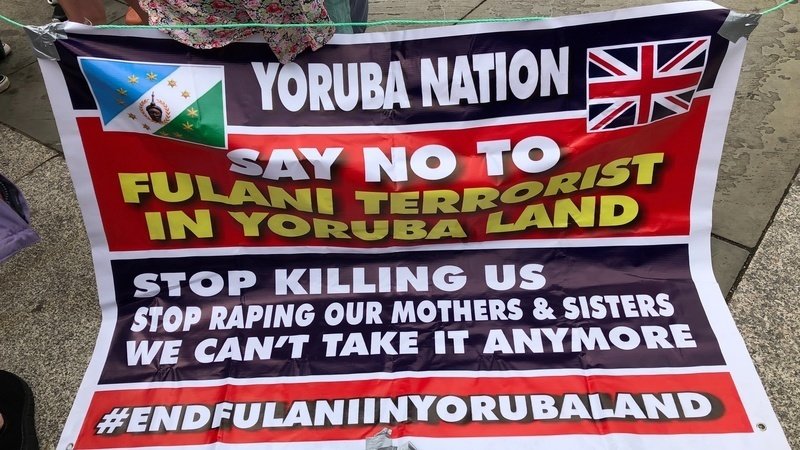
We, the indigenous Yoruba people of Nigeria, invite America’s Black peoples to march with us in New York, at the United Nations, for 3 days from 30 September to 2 October 2021. The purpose of our march is to convince the UN member nations, and the Biden administration, to support our desire to exist as an independent nation to be called Oduduwa Republic. As indigenous people, the UN Charter guarantees the Yoruba their own independent homeland. The same guarantee of independence is enshrined in the Charter of the African Union and in the domestic laws of Nigeria.
Most of America’s Black peoples are descendants of 10 million Yoruba forcibly and inhumanely transported to the Americas as slaves between 1400 and 1800. America’s Black peoples are Yoruba Diaspora. Freedom for Yorubaland is important because all Yoruba history happened there. The Yoruba have occupied their land continuously since time immemorial. The Creator gave us this land. Hence, all people with Yoruba blood are entitled to settle in Yorubaland, and that includes America’s Black peoples too; Yorubaland is your homeland.
Britain, Nigeria’s colonial masters, incorporated Yorubaland into Nigeria by fraud. Firstly in 1888, the British Queen entered into a treaty with the Alafin of Oyo and Head of Yorubaland, which preserved for eternity the sovereignty of the Yoruba nation. Secondly in 1914, Britain did not have jurisdiction over Yorubaland, and therefore did not have the legal right to incorporate Yorubaland into Nigeria as she did. We now have the opportunity to right the wrong that the British did to our forefathers, and we must seize that opportunity. We seek to reclaim our homeland from Nigeria and exist as an independent Oduduwa Republic.
In the 1950s, Yorubaland was the most developed territory in the whole of Africa. The Yoruba leader, Awolowo established free universal primary education and free healthcare for all children. First in Africa, a television station was established and Cocoa House, a skyscraper, was built in Ibadan, the capital city. The Liberty Stadium, the first stadium in Nigeria, was built to Olympic standards. A minimum wage was introduced for workers, and then raised. Private sector industries were enabled with government funding to shore up their working capital. A thriving middle class was created on a sound economic footing. The Yoruba were at that time competing head-to-head with peoples of the emerging nations of southeast Asia that have today become economic giants.
The very rapid advancement of the Yoruba nation was brought to an abrupt halt in 1966 when the Nigeria army sacked the Akintola government in a bloody coup. Thereafter, Yoruba advancement was put into reverse by a deliberate policy of the Nigerian Federal government. In the guise of the ‘Federal Character’, the Federal government took resources from Yorubaland (and the south generally) to give to the north, put unqualified northerners in charge of everything and limited opportunities for the Yoruba (and other southerners) in all spheres of Nigerian life. Because of Nigeria’s policy, several industries that had been established in Yorubaland through the Western Nigeria Development Corporation were killed off, made redundant or abandoned. The following were amongst the industries that were disappeared one-by-one from Yorubaland from 1966: textile production, glass manufacturing, canning industries, tyre manufacturing, battery manufacturing, cocoa and palm kernel processing, farm settlements, hydroelectric power stations and dams for water supply and fish farming.
The Taliban government of Nigeria use their jihadist, Islamic terrorist proxies, that they imported from north and Sahelian Africa, and called Fulani herdsmen, to commit human rights abuses in Yorubaland. Fulani herdsmen open graze their herds to destroy Yoruba farmers’ crops. They use AK47 rifles and swords that they carry to kill unarmed innocent Yoruba men, women, and children. Thereafter they dismember the dead and display the severed heads as trophies. The Fulani herdsmen rape Yoruba women and girls, and make spouses, parents and children watch as they do so. They use horsewhipping and multiple skin cuts to torture school children that they have kidnapped. They burn down Yoruba villages. And where the local people were brave enough to apprehend these killers, they hand them over to the Nigeria police who in turn arrest and detain the local people and then let the Fulani killers go. The police are under instructions from Nigeria’s Taliban government not to apprehend the herdsmen. In other words, the government permits Fulani killer herdsmen to roam free unchallenged. Fulani killer herdsmen have made farming impossible in most areas of Yorubaland, thereby causing food shortages.
Nigeria has badly damaged the Yoruba. There is need for urgent rescue, but this cannot be done if the Yoruba remain trapped in the Nigeria construct. Independence is the only viable solution. It is in the long-term interest, and health, of the indigenous Yoruba people to have a homeland of their own. There is much for the Yoruba to gain from independence from Nigeria. There is no doubt that Yorubaland can become a successful nation in the mould of Israel and Singapore. The Yoruba like the peoples of these successful countries have a culture of entrepreneurship. In the 1950s, the Yoruba played to their natural advantage of being the first educated Africans providing justices and medical and other professionals to other African countries. Yorubaland in those heady days of Awolowo leadership offered itself as ‘test grounds’ where giants of industry could experiment and participate unfettered by politics.
Yorubaland was remarkably successful in establishing and running partnerships with foreign companies. Any companies interested in working in Yorubaland were provided with Pioneer Certificates, which enabled the foreign company to enjoy a variety of concessions including tax breaks, assistance with loans and guarantees, acquisition of land for their ventures and repatriation of capital and profit as wished. Between 1954 and 1959, there were 30 or so such ventures established with success between the Western Nigeria Development Corporation and foreign companies from the USA, UK, Italy, France, Germany, and Israel. The companies were allowed to be managed principally by the expatriates, and assets and liabilities were shared proportionately.
Yorubaland has human capital in abundance; many native-born Yoruba practice their professions in different parts of the world. The success of the Yoruba outside of Nigeria attests also to their possession of a culture of adaptability. The Yoruba are undaunted by advances and complexities in artificial intelligence, robotics, science and technology. Yorubaland has arable and fertile land in abundance, suitable for growing almost any crop. Mineral resources yet untapped include bitumen, marble, gold and oil. There are limitless opportunities in the Yoruba landscape to harness renewable energy from sun, water and wind. Modernisation of the ancient Yoruba Osomalo system of commerce could enable significant economic activity to take place amongst the poorest of society. Their universally accepted Omoluabi upbringing has made the Yoruba a cultured people, civil, congenial, generous and hospitable.
Independence will enable the Yoruba to play a more visible, and constructive, role on the global stage. The Yoruba have some 30 millions of their people living in the Diaspora. Indeed, many peoples of the South American continent, especially Brazil and Cuba, have remained loyal to the Yoruba culture. Independence would enable the Yoruba to have global economic and political influence as well as tourism opportunities. There are many historical sites and sites of natural beauty to visit in Yorubaland. A modernised Egungun festival would provide the world with insight into the origins of carnivals staged yearly particularly in Brazil and the Caribbean. Other cultural imprints would be led by the arts, literature (Wole Soyinka is a Nobel laurate) and music (Fela Kuti was an international music icon).
Social and physical sciences perfected by the ancient Yoruba would establish their global influence too. The Ifa oracle is a probability system available to be scientifically exploited. Gbere intradermal techniques used for delivery of therapeutic agents, analgesia, boost to the body defenses, contraception, and vaccination (introduced to America in 1776 by Onesimus, a Yoruba slave) would take their place in modern medicine. Principles underpinning the ancient Yoruba medicine, which is more observational science than the conceptual medicine of India (Ayurveda) and China, would finally attract western scrutiny. The Yoruba system of participatory democracy would give other African nations and their political leaders food for thought.
To become the society that we aspire to be, we the Yoruba people of Nigeria seek the approval of members of the United Nations to join their ranks of independent nations as the Oduduwa Republic. The support of America’s Black peoples will go a long way to achieving our aim. Thank you.
Yours sincerely
Chief (Dr) Olusola Oni
MBBS, MSc, MD, LLM, GDL, FRCSEd, FWACS, FMCS, FRCSEng
(Baasegun Alabe of Ijebu-Jesa, Osun State, Nigeria)
For and on Behalf of Yoruba Descendants