How to develop our Oduduwa Republic

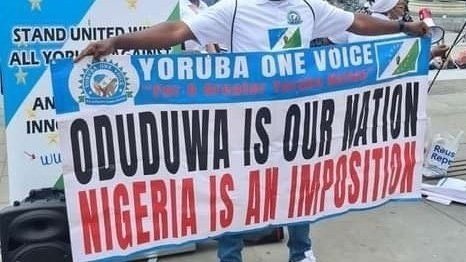
Africa emerged from a more or less cooperative and egalitarian society into one in which ‘winner takes all’. ‘Winner takes all’ works in a wealthy society or one capable of generating wealth which the state then could use to pacify the disadvantaged. Africa at present is neither wealthy nor capable of generating the requisite wealth to satisfy its citizenry. Therefore, we need a fundamental rethink about our own journey forward after independence. Our starting point is the existing situation of scarcity, and ‘rationing’ by the ruling elites, of resources that are inadequate to meet known requirements, let alone to meet the unknown.
The Nigeria situation has laid bare two basic problems – institutional mismatch and unemployment. In regard to the institutional mismatch, the political institution is based on loyalty to the political party rather than to the state. Nigeria's economic institutions serve money rather than the person. The service institutions cater for the haves rather than for the needing. The legal institutions favour the articulate over justice. The institutional mismatch has caused the flight by many into an urban jungle which promised a lot but has delivered very little.
To reverse our perpetual state of impoverishment needs fundamental rethinking. The Nigeria situation tells us that we must build from the bottom up. This means redistributing the little that we have more widely, concentrating on basic provisions for all individuals, which would then free up potential thinkers and innovators to engage in thinking and innovating rather than all the time hustling for their daily bread. The success of China was built on this principle.
How do we build from bottom up? First, we invest massively, above everything else, yes above everything else, in infrastructure by which I mean electricity, water and communication technology. Every community should be proximate to, and have access to, a borehole. Electricity should be provided locally via wind-turbines and solar farms and then supplied directly to adjoining homes and businesses. The national grid system, which is as inefficient as it is expensive, should be totally abandoned and replaced with community by community generators. Communication technology should be mandated by law, which would increase the potential to work from home, which in turn would yield more employment opportunities. The local ‘elites’ would then not just comprise, as they are now, of pastors and politicians but also of scientists, engineers, planners, computer programmers and business executives.
Second, we organise production and market to favour the rural economy and deurbanise. Wealth can be created without urbanisation. Purchase of local produce is the only way by which local wealth can be boosted, aside of course from governmental allocation. Awolowo recognised this when he instituted the cocoa marketing strategy. That strategy should be revived and extended to include food crops (the local ‘cash crops’) such as wheat, groundnuts, plantain, yam and cassava etc. However, instead of building expensive silos, we should build food-processing plants close to the farmer, which would further incentivise. The link that would be established between farmers and food-processors (horizontal link) likely would loosen the grip on society of those in power and encourage cooperation within the farming ‘community’. Instead of being ordered from above there, would be transition from capitalism to the cooperativeness, practiced by our forefathers. This is devolution of economic power and authority to the rural folks. A boosted rural economy would revivify our long forgotten traditional family life and re-establish ‘government’ through the family.
Third, we have to be smart international traders. International trade is a fact of life. We are dependent on copying technology and products already established in the ‘advanced’ economies. We do not need our intellectuals to waste resources on reinventing what already has been invented elsewhere. We are reliant on multinationals to do some of the producing for us. Capital is mobile whilst labour is not. Dependency is further fuelled by our people aspiring to the western way of life, but aspiration is also the mother of progress.
What therefore can we, or must we, do? We must demand that the country of origin of a product declared the amount of subsidy that they have incurred on that product (ie actual price). Thereafter, we must demand that such subsidy be removed to create a level playing field between their producers and ours, even if ours was only a potential producer. This strategy would have the effect of protecting our agricultural sector and our small sized manufacturers. We cmust keep foreign trade to the minimum required to obtain essentials and buy only what we can immediately pay for in full. Buying on the tick unnecessarily inflates the price of the product as well as assists the exporting producer against the home producer. Import restrictions would incentivise local production.
But most important of all, we must make clear to the world what we are good at. Despite the obvious advantages, manufacturing has not shifted to Africa on a large scale. Why? The reason is that we have not made clear what we are good at. Claiming a unique or distinctive position and standing out from the competitors is of the utmost importance. In my view, our most outstanding skill to sell is adaptable entrepreneurship; the ability to change approach to doing things in order to suit a new situation - smoothly and timeously. The Yoruba are flexible and have the ability to adapt to changing work conditions. They do not fold under pressure and are able to come up with the appropriate solution when there is a problem.
Nearly 5000 have signed our UN petition http://chng.it/QJp8yJ6hPs If you like what you have just read, share it and sign and support our petition http://chng.it/QJp8yJ6hPs to get us to the 5000 signatures. Thank you.