

The Vatican and Portugal Must Apologize for the Goa Inquisition
The Issue
To be clear about what this petition is not: it is a demand for historical accountability from the Vatican and Portugal. It is not a statement about Christians in India today. Goan Catholics and other Indian Christians are fellow inheritors of this history, not its villains, and this history must never be used to justify hatred against any community.
I recently learned about Truth and Reconciliation Day and what it truly signifies. I learned that in 2022, the Church apologized for its role in Canada’s residential school system. But then I realized the Church was behind something similar in India, and it has never apologized for that. That doesn’t sit well with me.
I am an Indian living in Canada. Every September 30, this country pauses: people wear orange shirts, share survivors’ stories, and confront a painful history. Canada received its apology. India is still waiting.
What is Truth and Reconciliation Day? (For readers in India)
If you are reading this from India, you may never have heard of it. From the 1870s to 1996, Canada ran residential schools for Indigenous children. More than 150,000 children were taken from their families and placed in 139 church- and state-run schools built to erase their languages and cultures. Many suffered abuse. Many never came home.
In 2008, Canada created a Truth and Reconciliation Commission. It collected more than 6,750 survivor statements and concluded the system amounted to “cultural genocide.” Its final report issued 94 Calls to Action. One of them asked the Pope to come to Canada and apologize.
September 30 is now Canada’s National Day for Truth and Reconciliation. It grew from Orange Shirt Day, begun in 2013, which honors Phyllis Webstad. At age six, she arrived at St. Joseph’s Mission residential school wearing a brand-new orange shirt her grandmother had bought her. It was taken from her that first day and never returned. The orange shirt now stands for every Indigenous child whose identity, culture, and freedom were taken. Its motto: Every Child Matters.

On July 25, 2022, Pope Francis stood at Maskwacis, Alberta, and apologized for the Catholic Church’s role. He had already apologized in Bolivia in 2015 for the Church’s crimes against the Indigenous peoples of the Americas.
What happened in Goa: the evidence
From 1560 to 1812, Portugal’s Church and Crown ran a system of religious persecution on India’s western coast: a Church tribunal, the Goa Inquisition, worked alongside royal decrees. Temples were demolished. Hindu rituals and festivals were banned. The Konkani language was suppressed. Families faced discriminatory laws that punished them for their faith and pressured them into conversion. This was not a brief episode. It lasted over 250 years.
First, what does “Inquisition” actually mean? It was a religious court run by the Catholic Church, created to hunt down “heresy,” anyone the Church believed was betraying the Christian faith. In Goa that mostly meant Indians who had converted to Christianity, willingly or under pressure, but were suspected of secretly keeping their old ways: Hindu families quietly praying at home, observing their festivals, or simply being denounced by a neighbor. The tribunal’s real power was fear, and that fear touched everyone.
And what did it mean to be “tried”? It did not mean a fair hearing. It meant arrest on a secret denunciation you were never allowed to see. Then months or years locked in the Inquisition’s prison in Old Goa, cut off from family, never told the charges. Then interrogation, and torture was a formal, documented part of the process, used to force confessions. Then sentencing at a grand public spectacle called an auto-da-fé, an “act of faith,” where the condemned were paraded in penitential robes before a crowd. Punishments ranged from public flogging and the seizure of everything a family owned, to years enslaved rowing the king’s galleys, to being burned alive at the stake. Those who had died or fled were burned “in effigy,” as straw dummies, so the spectacle was complete either way.
The Goa tribunal was the first Inquisition court established outside Europe. Ordered in March 1560, with its first inquisitors arriving that December, it ran until its abolition in 1812: a span of over 250 years.
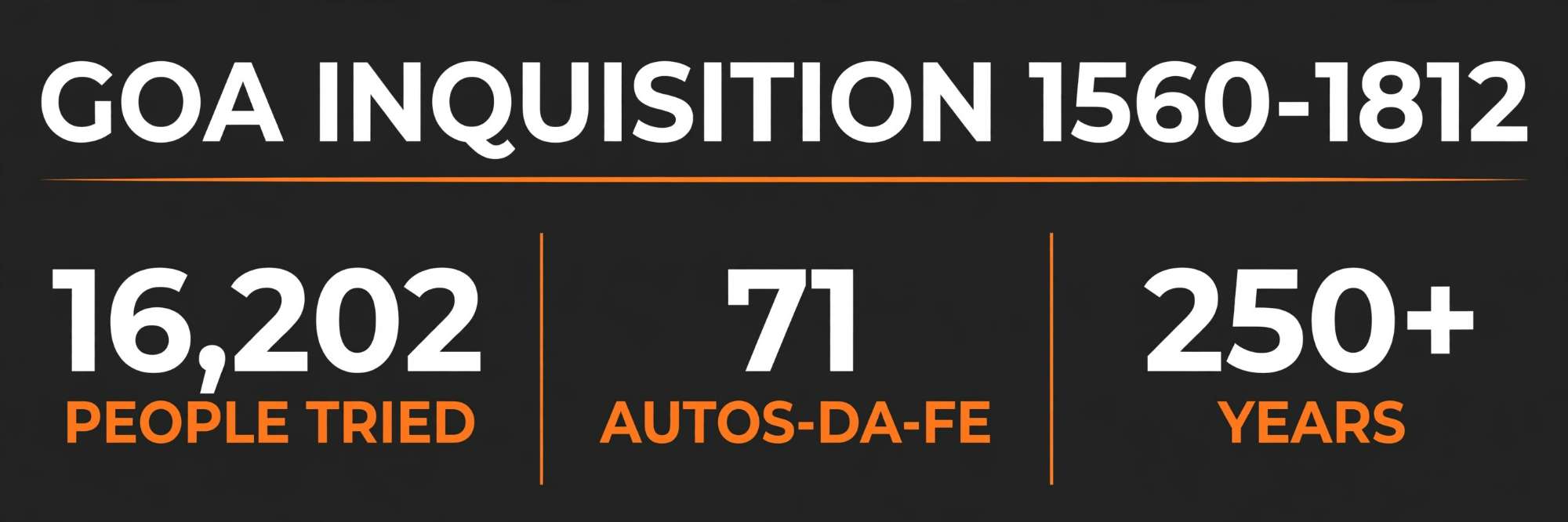
The scale, from surviving records, which historians have reconstructed. Executions were few; the tribunal’s true power was terror, denunciation, and the seizure of family wealth:
- From 1561 to 1774, a published reconstruction records 16,202 people tried. 57 were executed in person; 64 were burned in effigy. (Salomon and Sassoon, in The Marrano Factory, 2001)
- In 1561-1623 alone there were 3,800 cases, in a Goa of roughly 60,000 people. (Lauren Benton, Law and Colonial Cultures, 2002)
- A royal law of 4 December 1567 expelled Hindu priests, banned Hindu marriage rites, the sacred thread ceremony and cremation, and forced everyone over 15 to attend Christian preaching. (A.K. Priolkar, The Goa Inquisition, 1961)
- In 1684 the administration banned the Konkani language, confirmed by the king in 1687. (Luís Filipe Thomaz, 2016)
- 71 autos-da-fé are on record. At the 1580 ceremony the remains of the great physician Garcia da Orta were dug up and burned.
- We have an eyewitness. Charles Dellon, a French physician arrested in 1674, spent some 18 months in the Inquisition’s Goa prison before being sentenced to the galleys. His Relation de l’Inquisition de Goa (Paris, 1687) remains the only inside account by a contemporary witness.
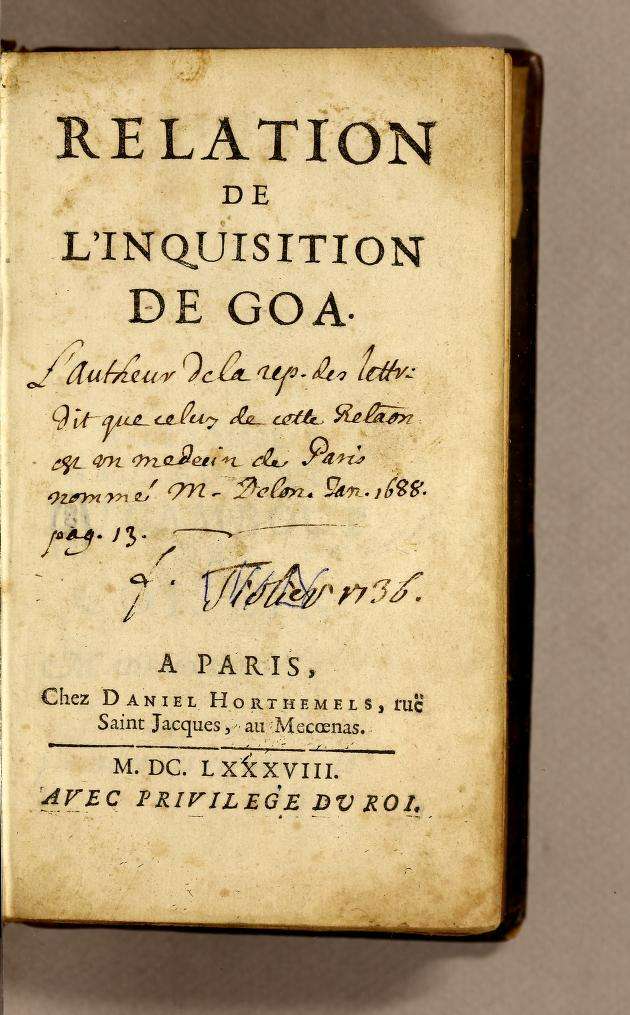
Most of the tribunal’s own files were destroyed. What survives sits in Lisbon’s Torre do Tombo archive and Rio de Janeiro’s National Library. It is enough.
What the trials were really like: an eyewitness
We do not have to imagine what the Goa Inquisition did to people. We have the testimony of a man who lived through it. Charles Dellon was arrested in 1674 and spent about eighteen months in the tribunal’s secret prison, never told the charges against him. In 1687 he published his account in Paris. The historian Donald Lach called it the only inside description of the tribunal by a contemporary who saw it from the inside.
Here is what Dellon records:
On the prison: inmates never saw fire or lamplight, only daylight. No books were allowed. The cells swarmed with mosquitoes. Those who died inside were buried without ceremony, and if the tribunal later judged them deserving of death, their bodies were dug up so their bones could be burned at the next public sentencing.
On starvation: in a cell separated from his only by a wall, prisoners were so starved they were reduced to eating their own excrement. He learned that some years earlier, about fifty Malabar prisoners locked in that same room had been driven by famine to such despair that more than forty strangled themselves with the linen of their turbans.
On the “justice”: the tribunal accepted any witnesses, however unworthy, and the accused could never object to them. Men were racked until they confessed to crimes they never committed, because confession was the only way to save their own lives. Dellon writes that the judges “desire not so much their Lives as their Goods,” since a signed confession meant nobody could question the seizure of everything the prisoner owned.
On the burnings: at the auto-da-fé, the condemned were tied to posts on the pyre. Those who submitted were strangled first; those who held to their faith were burned alive. The day after, their portraits were hung in Dominican churches, with their name, their father’s name, their country, and their “crimes” written beneath, as a warning to all.
Dellon summed up the tribunal’s logic in one devastating sentence: “We will rather cause you to be burnt as guilty, than let the World believe that we have Imprisoned you innocent.”
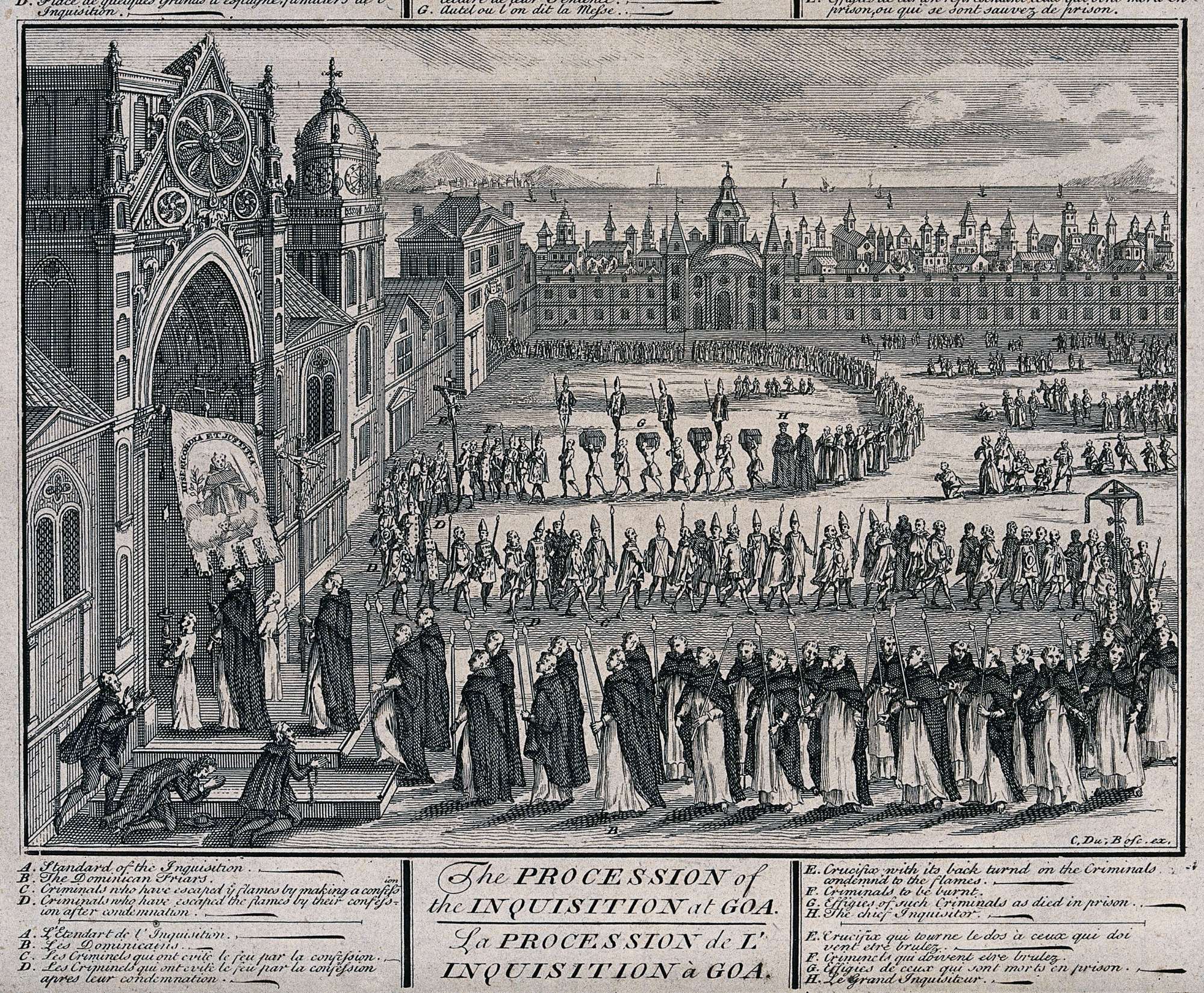
This engraving shows what Dellon himself marched in: the procession of the Inquisition at Goa, in an eighteenth-century depiction. The condemned in penitential robes. The effigies of those who died in prison. The Grand Inquisitor. These are the ceremonies that filled the streets of Goa.
India has never received an equivalent apology. When the demand was raised during Pope John Paul II’s 1999 visit to India, it was dismissed as “not on the Pope’s agenda.” The Vatican’s 2023 repudiation of the Doctrine of Discovery spoke in general terms but said nothing specific about Goa, forced conversions, or the persecution of the people of Goa. Portugal, whose empire ran the Inquisition, has issued no formal apology for the religious persecution in its former Indian territories either. The conversation is shifting, though: in 2023 and 2024, Portugal's president said the country must take responsibility for its colonial-era crimes. A formal apology for Goa would be a concrete place to start.
An apology does not rewrite history. But Canada showed what one can do: it validated survivors, opened honest conversation, and began the long work of reconciliation. India’s survivors and their descendants deserve the same acknowledgment.
We call on:
- The Vatican to issue a formal apology for the Goa Inquisition, forced conversions, and the persecution of the people of Goa.
- The Government of Portugal to formally apologize for colonial-era religious persecution and forced conversions in its former Indian territories.
If you believe reconciliation should not stop at one country’s border, please sign and share. Reconciliation starts with the truth.

18
The Issue
To be clear about what this petition is not: it is a demand for historical accountability from the Vatican and Portugal. It is not a statement about Christians in India today. Goan Catholics and other Indian Christians are fellow inheritors of this history, not its villains, and this history must never be used to justify hatred against any community.
I recently learned about Truth and Reconciliation Day and what it truly signifies. I learned that in 2022, the Church apologized for its role in Canada’s residential school system. But then I realized the Church was behind something similar in India, and it has never apologized for that. That doesn’t sit well with me.
I am an Indian living in Canada. Every September 30, this country pauses: people wear orange shirts, share survivors’ stories, and confront a painful history. Canada received its apology. India is still waiting.
What is Truth and Reconciliation Day? (For readers in India)
If you are reading this from India, you may never have heard of it. From the 1870s to 1996, Canada ran residential schools for Indigenous children. More than 150,000 children were taken from their families and placed in 139 church- and state-run schools built to erase their languages and cultures. Many suffered abuse. Many never came home.
In 2008, Canada created a Truth and Reconciliation Commission. It collected more than 6,750 survivor statements and concluded the system amounted to “cultural genocide.” Its final report issued 94 Calls to Action. One of them asked the Pope to come to Canada and apologize.
September 30 is now Canada’s National Day for Truth and Reconciliation. It grew from Orange Shirt Day, begun in 2013, which honors Phyllis Webstad. At age six, she arrived at St. Joseph’s Mission residential school wearing a brand-new orange shirt her grandmother had bought her. It was taken from her that first day and never returned. The orange shirt now stands for every Indigenous child whose identity, culture, and freedom were taken. Its motto: Every Child Matters.
On July 25, 2022, Pope Francis stood at Maskwacis, Alberta, and apologized for the Catholic Church’s role. He had already apologized in Bolivia in 2015 for the Church’s crimes against the Indigenous peoples of the Americas.
What happened in Goa: the evidence
From 1560 to 1812, Portugal’s Church and Crown ran a system of religious persecution on India’s western coast: a Church tribunal, the Goa Inquisition, worked alongside royal decrees. Temples were demolished. Hindu rituals and festivals were banned. The Konkani language was suppressed. Families faced discriminatory laws that punished them for their faith and pressured them into conversion. This was not a brief episode. It lasted over 250 years.
First, what does “Inquisition” actually mean? It was a religious court run by the Catholic Church, created to hunt down “heresy,” anyone the Church believed was betraying the Christian faith. In Goa that mostly meant Indians who had converted to Christianity, willingly or under pressure, but were suspected of secretly keeping their old ways: Hindu families quietly praying at home, observing their festivals, or simply being denounced by a neighbor. The tribunal’s real power was fear, and that fear touched everyone.
And what did it mean to be “tried”? It did not mean a fair hearing. It meant arrest on a secret denunciation you were never allowed to see. Then months or years locked in the Inquisition’s prison in Old Goa, cut off from family, never told the charges. Then interrogation, and torture was a formal, documented part of the process, used to force confessions. Then sentencing at a grand public spectacle called an auto-da-fé, an “act of faith,” where the condemned were paraded in penitential robes before a crowd. Punishments ranged from public flogging and the seizure of everything a family owned, to years enslaved rowing the king’s galleys, to being burned alive at the stake. Those who had died or fled were burned “in effigy,” as straw dummies, so the spectacle was complete either way.
The Goa tribunal was the first Inquisition court established outside Europe. Ordered in March 1560, with its first inquisitors arriving that December, it ran until its abolition in 1812: a span of over 250 years.
The scale, from surviving records, which historians have reconstructed. Executions were few; the tribunal’s true power was terror, denunciation, and the seizure of family wealth:
- From 1561 to 1774, a published reconstruction records 16,202 people tried. 57 were executed in person; 64 were burned in effigy. (Salomon and Sassoon, in The Marrano Factory, 2001)
- In 1561-1623 alone there were 3,800 cases, in a Goa of roughly 60,000 people. (Lauren Benton, Law and Colonial Cultures, 2002)
- A royal law of 4 December 1567 expelled Hindu priests, banned Hindu marriage rites, the sacred thread ceremony and cremation, and forced everyone over 15 to attend Christian preaching. (A.K. Priolkar, The Goa Inquisition, 1961)
- In 1684 the administration banned the Konkani language, confirmed by the king in 1687. (Luís Filipe Thomaz, 2016)
- 71 autos-da-fé are on record. At the 1580 ceremony the remains of the great physician Garcia da Orta were dug up and burned.
- We have an eyewitness. Charles Dellon, a French physician arrested in 1674, spent some 18 months in the Inquisition’s Goa prison before being sentenced to the galleys. His Relation de l’Inquisition de Goa (Paris, 1687) remains the only inside account by a contemporary witness.
Most of the tribunal’s own files were destroyed. What survives sits in Lisbon’s Torre do Tombo archive and Rio de Janeiro’s National Library. It is enough.
What the trials were really like: an eyewitness
We do not have to imagine what the Goa Inquisition did to people. We have the testimony of a man who lived through it. Charles Dellon was arrested in 1674 and spent about eighteen months in the tribunal’s secret prison, never told the charges against him. In 1687 he published his account in Paris. The historian Donald Lach called it the only inside description of the tribunal by a contemporary who saw it from the inside.
Here is what Dellon records:
On the prison: inmates never saw fire or lamplight, only daylight. No books were allowed. The cells swarmed with mosquitoes. Those who died inside were buried without ceremony, and if the tribunal later judged them deserving of death, their bodies were dug up so their bones could be burned at the next public sentencing.
On starvation: in a cell separated from his only by a wall, prisoners were so starved they were reduced to eating their own excrement. He learned that some years earlier, about fifty Malabar prisoners locked in that same room had been driven by famine to such despair that more than forty strangled themselves with the linen of their turbans.
On the “justice”: the tribunal accepted any witnesses, however unworthy, and the accused could never object to them. Men were racked until they confessed to crimes they never committed, because confession was the only way to save their own lives. Dellon writes that the judges “desire not so much their Lives as their Goods,” since a signed confession meant nobody could question the seizure of everything the prisoner owned.
On the burnings: at the auto-da-fé, the condemned were tied to posts on the pyre. Those who submitted were strangled first; those who held to their faith were burned alive. The day after, their portraits were hung in Dominican churches, with their name, their father’s name, their country, and their “crimes” written beneath, as a warning to all.
Dellon summed up the tribunal’s logic in one devastating sentence: “We will rather cause you to be burnt as guilty, than let the World believe that we have Imprisoned you innocent.”
This engraving shows what Dellon himself marched in: the procession of the Inquisition at Goa, in an eighteenth-century depiction. The condemned in penitential robes. The effigies of those who died in prison. The Grand Inquisitor. These are the ceremonies that filled the streets of Goa.
India has never received an equivalent apology. When the demand was raised during Pope John Paul II’s 1999 visit to India, it was dismissed as “not on the Pope’s agenda.” The Vatican’s 2023 repudiation of the Doctrine of Discovery spoke in general terms but said nothing specific about Goa, forced conversions, or the persecution of the people of Goa. Portugal, whose empire ran the Inquisition, has issued no formal apology for the religious persecution in its former Indian territories either. The conversation is shifting, though: in 2023 and 2024, Portugal's president said the country must take responsibility for its colonial-era crimes. A formal apology for Goa would be a concrete place to start.
An apology does not rewrite history. But Canada showed what one can do: it validated survivors, opened honest conversation, and began the long work of reconciliation. India’s survivors and their descendants deserve the same acknowledgment.
We call on:
- The Vatican to issue a formal apology for the Goa Inquisition, forced conversions, and the persecution of the people of Goa.
- The Government of Portugal to formally apologize for colonial-era religious persecution and forced conversions in its former Indian territories.
If you believe reconciliation should not stop at one country’s border, please sign and share. Reconciliation starts with the truth.
The Decision Makers

Petition Updates
Share this petition
Petition created on 29 September 2026