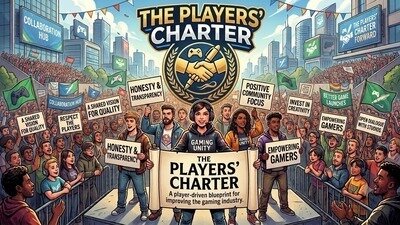

THE PLAYERS' CHARTER: a player-driven blueprint for improving the gaming industry
Il problema
TL:DR here
https://sharpdressedviking.github.io/players-charter/en/creators/
Disclaimer:
In the following content, we will try to avoid using real names of games and companies, but we will try to make who/what we're talking about clear enough.
Please, enjoy the edited names, and try to catch them all :D
Despite the whole text being written by hand, it has been reviewed by an AI. The review process roughly added 10 rows of content, over 270+ that have been written by a human. This has been done to fix readability, coherence and language issues (english is not the writer's first language)
The cover image has been created with AI for time and convenience, but we will be more than happy to evaluate any actual art that will be proposed to take its place.
---
INTRO
If there's ONE single thing the whole gaming community agrees upon, is that there are several issues plaguing our beloved hobby.
The problem, is that we cannot agree on how to solve them - or even what those issues are.
This petition is to give our whole community something really worth fighting for. No stupid console wars. No demand for some useless pieces of plastic. No.
This is serious and will cover several points in which the gaming market can actually improve for us: the players - the ones that actually keep the market alive.
This petition will try to guide the community's efforts towards meaningful demands that will actually give us some value, compared to unpractical (and unapplicable) requests that are just asking corporates to stop behaving like corporates.
In writing this, we hope to have a list that any of us gamers can go through and find at least a couple points to strongly agree upon.
Again: this is to unite us all in the goal to make the market better for us.
We all know that this is a business, and that decisions are made with the only goal to make revenue, so this is not going to be one of those naive petitions that ask the tech giants to go against their own interests - no: our intention here is to give suggestions that will most probably help them gain even more, and do that without making gamers hate them. The opposite, actually.
The list of suggestions will be long and diverse, but most probably not comprehensive of everything that can be done.
In this petition we will highlight many important issues, give descriptions about them, analyze them and give some suggestions about how to solve them.
Chapters WILL NOT be put in order of importance.
Who is this petition for?
It is addressed to game publishers and platform holders first: you are the ones who can implement most of what follows. A few points also concern rating boards and consumer protection authorities, and we'll say so where that's the case.
And it is addressed to you, fellow player. By signing, you're telling the industry that these requests have a market behind them. Nothing more is asked of you - no boycotts, no harassment, no console wars. Just a number that grows.
What does success look like? Every publisher or platform that publicly adopts even ONE of these suggestions is a win. We're not asking for everything at once - we're drawing a map.
Chapter one: About physical media
Let's start with the most recent drama:
The big blue giant announced they will stop producing physical media for games in 2028.
This decision has been made after thorough analysis of the market and shocked most of the community, with a lot of us moving to ask the big blue to not do that.
Let's be real about this though:
Physical media IS dying, and it was already written in stone that this day would've come sooner or later - we could do nothing about that then, and we can do nothing about that now: they're not changing their idea.
The decision is data-backed, and we only need a couple minutes to find it:
More than 80% of the videogames sold on consoles in 2023 were digital.
If we take all platforms in account, the percentage goes up to about 95%.
United Kingdom reports, in 2024, a 35-ish% drop in physical sales compared to 2023.
Also, they already took in account the losses that this will bring to them, and they're more than compensated by the money they will save by doing so.
This automatically makes meaningless every single demand to keep that portion of market on.
What can be done, then?
Ask for rights and improved digital marketplaces, as per the next chapter.
Chapter two: About digital marketplaces
This point is very easy, really.
Most of the digital marketplaces, on ANY platform, fall short. Badly.
Bad pricing, no consumer rights, little to no services and so on...
There is one single marketplace that is incredibly better than the others, though, and we all know who we're talking about. Our favourite PC's marketplace gives a good example of what can be done - and it too is still far from perfect - it's merely a good starting point from where big corps can take example.
Suggestion 1: right of withdrawal
Most digital marketplaces give little to no option about this. You bought your digital licence? It's yours, and you cannot do anything about it. Specially if you already installed it or worse, played even only a few minutes.
The best market we're taking as example gives us two hours of playtime, within 14 days of purchase, to test the game - and if we don't like it, we can refund it 100%.
Every corp should implement this if they want to give us a good marketplace.
Yes, two hours is not that much - but we can work with that, and improve it later.
Suggestion 2: the used market
Removing physical media will 100% kill the market for used games, since there will be none.
This is a really heartfelt issue for some of us, since it helps keep the prices low and get some money back for games we don't want to keep any more.
The solution?
Our example already has a very great internal market to sell game assets and collectibles - extending it to the resale of used games would be a natural next step. We won't pretend this is legally or commercially simple - digital resale is a battlefield of its own - but consider what a small fee on every transaction means: for the first time in history, the publisher earns money from second-hand copies. That's a deal physical retail never offered them.
Alternative solution:
Implement a "reduced percentage refund" for games used more than the time allotted for full withdrawal.
Issue: the marketplace could get full of sh**ty game keys with solution 1. This can be avoided by making unsellable any key that has been paid less than a certain value - 5€, for example.
Solution 2 just won't suffer from this issue at all.
Suggestion 3: family/friend share
We all agree that it's nice to be able to lend games to our friends and family.
As for the other points, here too our example gives us a great service, allowing us to build a small community of up to 5 people that can share their libraries - limiting only the amount of people that can concurrently play on the same GAME ONLINE: one per key in the family; no other limit is included, as every member could play games from the same library.
Nothing to really say here: every platform and every marketplace should implement this in some extent. We must have the right to share with our friends our possessions - even if it's only a licence to reproduce the content.
Suggestion 4: about prices
A lot of people we see complaining, also fear prices not going down EVER once the physical market is closed.
This too is not an issue for our paragon: frequent sales give people the ability to buy games at a discount, allowing less privileged people to access games all the same.
Every market should have this. Every game should go on sale every now and then, or implement a strategy that automatically lowers prices as time passes - just like it already happens for physical media.
On the other hand, cutting off the whole physical retail market will save A LOT of money to the publishers:
about 30% of the cost is in producing the media, distributing, and final retailer's cut.
The whole gaming community would greatly appreciate it if even a small part of these savings were to be redistributed onto us in the form of lower average game prices.
More realistically, as some of us know very well that game pricetags did not follow inflation and would've been already higher than they are now if they did, we would probably accept a guarantee that they will always keep not growing at inflation's rate as they did until now.
Examples like Popstar's sixth chapter of their Bitty Larceny Bycicle franchise has its pricetag in a hard to accept range for a lot of us.
Suggestion 5: ownership
Another very talked-about topic is game ownership.
With the loss of physical media, some of us fear it will be possible for us to lose access over the content we paid for.
What we ask for is to give those who fear this some sort of guarantee that it will never happen.
A DRM-free model like the polish guys already do would be great, but there may be other solutions to the issue. This solution would also serve as a tie-in for games that get delisted due to licensing issues.
Chapter two: conclusion
These suggestions, together, will give us players much fairer places to buy our games, making us happier - directly bringing up the number of sales and, as a result, revenue.
Chapter three: about game quality
Another point on which a big part of the gaming community agrees is that games are getting released incomplete or in a bad state more and more often.
The fact that updates have been made a lot easier thanks to the internet infrastructure improvements we had in the last years, made videogame development sloppy and cut its corners.
At the same time, the infrastructure allows for pieces of content to be cut-off and sold lately as DLC, and while we have some pieces of very good example (like the "plasma and vodka" dlc for that famous polish game) some other are definitely... terrible (we're looking at you, publishers who sell the true ending separately)
Suggestion 1: it gets released when it's ready.
Simply stop releasing games in need of an enormous day-one update. Simple as that.
Sure, probably removing the physical media from the equation will improve the situation, but nobody believes it will automatically fix the issue.
It takes time to print and distribute, and that is time stolen to the development, but it's not realistic to say that it's the only reason why some games get such big D1 updates...
And let's be clear about the incentive: broken launches aren't just bad for us.
Refunds, review bombing and "apology patches" cost real money, and a franchise's reputation, once spent, is expensive to buy back. A delayed game costs you a quarter; a broken launch can cost you the sequel.
This takes us to...
Suggestion 2: not enough testing
Let's be real here, many gamers feel like they're being used as beta-testers for the first couple weeks after a game is on the market, and that is clearly a sign of not enough testing.
Most games could benefit from more testing programs, both private and open.
Investing a little more on the QA phase will counter the movements that try to boycott D1 sales and increase revenue.
This could also be done with more early accesses - games like Galdur's Bastion 3 demonstrate how a long early access period can be very good for the final result.
Suggestion 3: DLCs are okay, but...
...but not if you use them to monetize on cut content.
It's crystal-clear that some games are released with missing pieces, that are then sold as DLCs - and games that get downloadable content released in the first two weeks are proof of this.
And let's not enter the "true ending missing" territory - or the "additional characters that break the game" one.
It's getting really unnerving for some gamers - please, review your "DLC policy".
Suggestion 4: periodic releases
We don't need a new TextMessage from Responsibility every single year - and this is true for every franchise that releases on a fixed schedule.
We know annual releases are a proven revenue machine, so we won't pretend that asking you to stop is realistic. What we will point out is that the machine wears out: every rushed installment spends a little of the franchise's reputation, and fatigue eventually shows up in the sales numbers - it always does. Meanwhile, the series that took an extra year and came back stronger, critically AND commercially, keep proving the alternative works.
Take more time, at least every few installments. The games deserve it. The players deserve it. The sales, historically, reward it.
Suggestion 5: the "Express Ticket" pre-order trap
Another recent trend is to lock the launch date of a game behind a paywall. Publishers charge an extra fee (often $20 or $30) for a "Deluxe" or "Premium" edition that allows players to play the game three to seven days early.
Let's be clear: this is not "early access" – this is artificially delaying the standard release of the game to squeeze more money from the most eager fans. Even worse, it turns these paying fans into day-negative-five bug testers who pay a premium to experience the launch-week issues before the first day-one patch is even released.
Stop artificially delaying standard editions. If you want to charge a premium for deluxe versions, include actual content (soundtracks, artbooks, expansions) rather than capitalizing on artificial time gates that divide the community.
Chapter four: about remasters, remakes, and new IPs
The last couple of years have been full of remasters and remakes of older games - and this is not a bad thing per-se.
The problem is that this is a trend that's becoming more and more abused, and while there are some games that really deserved a revision and got a great service out of it, like the reimagined Terminal Imagination 7, there have been a lot others that got "remastered" editions that were definitely unneeded (did a game released less than 7 years before really need a graphical revamp? REALLY?)
Suggestion 1: about remakes
Give the gamers the remaster/remakes they actually ask for.
Give us Chevaliers of the new Democracy's remake.
Give us PlasmaDead's remake.
Keep to yourself games like BaggableBeasts Sparkly Gemstone.
Suggestion 2: about new IPs and budgeting
Concurrently to giving us less remakes - please stop trying to squeeze every last ounce of life from old IPs.
It's okay to let go, if you don't know what to do in the next Killer's Ideology - just don't. Let it go. Think about something new.
Stop ballooning budget on AAA titles that have been milked to death for decades and invest it in something new. Not everything needs to be AAA or more (talking about you, Cranium and Tibias) simple mid-budget AA games are very well received and, if the publisher trusts the developer enough, can result in a great profit for the studio - and games like Light'n'Darkness: Shipment 33 clearly prove this.
Chapter five: about online requirements and preservation
This is definitely one of the most talked-about topics in the community, and has already been slightly touched by suggestion 5 in chapter two.
With the increasing trend of making games completely dependent on an internet connection to run, even for single player content, we can't help but worry about the long-term availability of the games we buy.
The previous suggestion already covers a small part of this, but we need to add more: not all servers are forever, and with time, many games (even multiplayer ones) end up having their servers shut down for good.
Suggestion 1: what is SINGLE PLAYER, stays single player.
Simple. Clear. Obvious.
If a game is single player, it should not need an internet connection to run after it's installed or downloaded. Not at launch. Not five years later. NEVER.
If there are "optional" online modes, they should actually be that: optional. They should not even be needed for any achievement, blocking players from obtaining 100%, let alone required for the game to run.
This includes additional launchers and/or accounts needed to play the game. If a game requires opening another launcher and/or another account to run, it breaks the "not online" part.
Suggestion 2: about multiplayer games
For multiplayer games, we can't expect official servers to stay online forever. We know that, and we don't ask for the servers to be kept running for all eternity.
It's okay for devs and publishers to close support to online servers if a game is not profitable anymore - but we, the players, should not suffer from this decision.
Wanna take down the server? Make public announcements about that a couple months before, and give us a way to keep playing the game on our own terms.
Offline modes, p2p hosting, private servers, dedicated toolkits - anything that allows us to keep playing the game is a step in the right direction.
The best option for the players would be for the publishers to release the netcode and allow the community to host the servers themselves, but we know that's not always possible.
What we demand is a guarantee that something serious will be done about that - and that you'll work with communities to find the best solution possible.
Chapter six: localization
We'll make it quick: many gamers outside the anglo-sphere want to play games in their own language. And while there are some (very good) examples of games that are fully localized, there are many more that are not.
This translates (pun intended) into gamers being unable or unwilling to enjoy many titles - which is a loss for both the players and the developers.
Suggestion: kickstarter-like campaigns for localization
We understand that many publishers, especially the smaller ones, can't afford to localize every game they publish - or maybe they think it would not be profitable enough to have a good translation. A kickstarter-like campaign could help publishers to gauge the interest of the community in a specific language, and if the campaign is successful, the publisher can then invest in the localization of the game.
What we suggest, is to open preorders with a "requested language" optional field.
If a game reaches a certain number of preorders for a specific language, the publisher commits to localizing it in that language - at release or in a post-launch update.
One important note: these preorders must stay refundable like any other purchase. We're not going to contradict the right of withdrawal we asked for in chapter two, and in many countries it couldn't be waived anyway. The value for the publisher isn't locking players' money in - it's the signal. Preorder counts, corrected by the cancellation rates the industry already knows how to estimate, are a far more reliable measure of demand than any survey or wishlist.
This would allow publishers to minimize the risks associated with the localization of a game and reach a wider audience, and it would also give the community a say in which games get localized.
Chapter seven: other relevant issues
1: predatory monetization
Microtransactions, lootboxes, gambling mechanics and such are completely anti-consumer, and need addressing.
Some countries have already banned or restricted some of these mechanics, and this is one of the few points in this petition where our ask goes to regulators and rating boards more than to publishers.
We are not asking to completely remove them - but we ask for more transparency, more regulation, and less abuse.
A good start would be increasing PEGI and similar rating systems evalutation to 18 or equivalent for games that include them.
This somehow applies to battle pass systems and other mechanics that rely on FOMO or artificially time-gated content, that also rely on psychological vulnerability, bypassing the normal inhibitory brakes related to conscious spending.
2: Kernel-level anticheats and DRM
Performance degradation, privacy concerns, security risks, broken compatibility... the costs of kernel-level anticheat are paid entirely by the player.
We know cheating is a real problem that costs you players and money, so we're not asking you to just drop protection and hope for the best. We're asking you to invest in server-side detection and behavioral analysis instead of reaching ever deeper into our machines. The arms race on our hardware is being lost anyway - the server is the one battlefield you fully control.
3: modding support
Many games benefit from community-developed mods, whether it's to fix bugs, add new features, or create new content entirely. However, many publishers and developers actively work against modding, making it difficult or impossible for players to mod their games.
We ask for developers and publishers to be more supportive of modding, whether it's by providing official tools, documentation, or support for the modding community. This would allow players to enjoy games in new and creative ways, and it would also help to extend the lifespan of games.
Also: more moddability on consoles please. We know it's possible.
4: AI-generated content
With the recent rise of AI image and text generation, some developers have started to use AI to generate content for their games. While this can be a useful tool for some purposes, it can also be used to create low-quality, generic content that detracts from the overall experience.
We demand for developers and publishers to be more transparent about their use of AI-generated content, describing exactly what the AI was used for, and in what amount.
5: exclusives, and bad porting
We understand exclusives: they're how platforms differentiate, and they do sell hardware. We won't pretend otherwise.
But understand our side too: exclusives split friend groups apart and breed exactly the console-war resentment this petition is trying to put to rest.
So here's a middle ground: make all exclusivity TIMED, not permanent.
Keep the launch window that sells your consoles, then bring the game everywhere. The recent wave of former console exclusives landing on PC has already proven the point: a second launch on a second platform is not lost hardware sales - it's found money.
And when you DO port: a port sold at full price is a full product.
Things like the PC porting of that 2017's game where a redhead hunts mechanical beasts left PC players fighting performance issues for months after release.
We know you can do better - we've seen it. Budget the port like a launch, because for that audience, it is one.
---
EPILOGUE
This is not a declaration of war against the game industry.
It's a business proposal from your customers - the ones who actually keep the market alive.
We are not asking for the impossible, and we are not asking for free games, or for publishers to stop making money. We just want a say in the future of the industry we love - an industry we feel is slowly forgetting its players in favor of the quick buck.
To the publishers and platform holders reading this: every suggestion in this document is designed to be profitable, or at worst cost-neutral, when done right. Happier players buy more games, refund fewer, review better, and stay loyal longer. You don't need to adopt all of it. Pick one point and prove us right.
To the players reading this: sign it, share it, and reward with your wallet the companies that listen. That's the whole strategy - and it's enough, because we are the ones the revenue numbers are made of.
We want to be heard. We want to be respected. We want to be part of the conversation.
So please, listen to us. Consider our words. Evaluate our suggestions and improve on them.
Let's work together to make the game industry a better place for everyone.
And remember: this is not a complete list - there certainly are other issues that at least some players want solved - but it is a place to start.
Thank you for reading this petition.

41
Il problema
TL:DR here
https://sharpdressedviking.github.io/players-charter/en/creators/
Disclaimer:
In the following content, we will try to avoid using real names of games and companies, but we will try to make who/what we're talking about clear enough.
Please, enjoy the edited names, and try to catch them all :D
Despite the whole text being written by hand, it has been reviewed by an AI. The review process roughly added 10 rows of content, over 270+ that have been written by a human. This has been done to fix readability, coherence and language issues (english is not the writer's first language)
The cover image has been created with AI for time and convenience, but we will be more than happy to evaluate any actual art that will be proposed to take its place.
---
INTRO
If there's ONE single thing the whole gaming community agrees upon, is that there are several issues plaguing our beloved hobby.
The problem, is that we cannot agree on how to solve them - or even what those issues are.
This petition is to give our whole community something really worth fighting for. No stupid console wars. No demand for some useless pieces of plastic. No.
This is serious and will cover several points in which the gaming market can actually improve for us: the players - the ones that actually keep the market alive.
This petition will try to guide the community's efforts towards meaningful demands that will actually give us some value, compared to unpractical (and unapplicable) requests that are just asking corporates to stop behaving like corporates.
In writing this, we hope to have a list that any of us gamers can go through and find at least a couple points to strongly agree upon.
Again: this is to unite us all in the goal to make the market better for us.
We all know that this is a business, and that decisions are made with the only goal to make revenue, so this is not going to be one of those naive petitions that ask the tech giants to go against their own interests - no: our intention here is to give suggestions that will most probably help them gain even more, and do that without making gamers hate them. The opposite, actually.
The list of suggestions will be long and diverse, but most probably not comprehensive of everything that can be done.
In this petition we will highlight many important issues, give descriptions about them, analyze them and give some suggestions about how to solve them.
Chapters WILL NOT be put in order of importance.
Who is this petition for?
It is addressed to game publishers and platform holders first: you are the ones who can implement most of what follows. A few points also concern rating boards and consumer protection authorities, and we'll say so where that's the case.
And it is addressed to you, fellow player. By signing, you're telling the industry that these requests have a market behind them. Nothing more is asked of you - no boycotts, no harassment, no console wars. Just a number that grows.
What does success look like? Every publisher or platform that publicly adopts even ONE of these suggestions is a win. We're not asking for everything at once - we're drawing a map.
Chapter one: About physical media
Let's start with the most recent drama:
The big blue giant announced they will stop producing physical media for games in 2028.
This decision has been made after thorough analysis of the market and shocked most of the community, with a lot of us moving to ask the big blue to not do that.
Let's be real about this though:
Physical media IS dying, and it was already written in stone that this day would've come sooner or later - we could do nothing about that then, and we can do nothing about that now: they're not changing their idea.
The decision is data-backed, and we only need a couple minutes to find it:
More than 80% of the videogames sold on consoles in 2023 were digital.
If we take all platforms in account, the percentage goes up to about 95%.
United Kingdom reports, in 2024, a 35-ish% drop in physical sales compared to 2023.
Also, they already took in account the losses that this will bring to them, and they're more than compensated by the money they will save by doing so.
This automatically makes meaningless every single demand to keep that portion of market on.
What can be done, then?
Ask for rights and improved digital marketplaces, as per the next chapter.
Chapter two: About digital marketplaces
This point is very easy, really.
Most of the digital marketplaces, on ANY platform, fall short. Badly.
Bad pricing, no consumer rights, little to no services and so on...
There is one single marketplace that is incredibly better than the others, though, and we all know who we're talking about. Our favourite PC's marketplace gives a good example of what can be done - and it too is still far from perfect - it's merely a good starting point from where big corps can take example.
Suggestion 1: right of withdrawal
Most digital marketplaces give little to no option about this. You bought your digital licence? It's yours, and you cannot do anything about it. Specially if you already installed it or worse, played even only a few minutes.
The best market we're taking as example gives us two hours of playtime, within 14 days of purchase, to test the game - and if we don't like it, we can refund it 100%.
Every corp should implement this if they want to give us a good marketplace.
Yes, two hours is not that much - but we can work with that, and improve it later.
Suggestion 2: the used market
Removing physical media will 100% kill the market for used games, since there will be none.
This is a really heartfelt issue for some of us, since it helps keep the prices low and get some money back for games we don't want to keep any more.
The solution?
Our example already has a very great internal market to sell game assets and collectibles - extending it to the resale of used games would be a natural next step. We won't pretend this is legally or commercially simple - digital resale is a battlefield of its own - but consider what a small fee on every transaction means: for the first time in history, the publisher earns money from second-hand copies. That's a deal physical retail never offered them.
Alternative solution:
Implement a "reduced percentage refund" for games used more than the time allotted for full withdrawal.
Issue: the marketplace could get full of sh**ty game keys with solution 1. This can be avoided by making unsellable any key that has been paid less than a certain value - 5€, for example.
Solution 2 just won't suffer from this issue at all.
Suggestion 3: family/friend share
We all agree that it's nice to be able to lend games to our friends and family.
As for the other points, here too our example gives us a great service, allowing us to build a small community of up to 5 people that can share their libraries - limiting only the amount of people that can concurrently play on the same GAME ONLINE: one per key in the family; no other limit is included, as every member could play games from the same library.
Nothing to really say here: every platform and every marketplace should implement this in some extent. We must have the right to share with our friends our possessions - even if it's only a licence to reproduce the content.
Suggestion 4: about prices
A lot of people we see complaining, also fear prices not going down EVER once the physical market is closed.
This too is not an issue for our paragon: frequent sales give people the ability to buy games at a discount, allowing less privileged people to access games all the same.
Every market should have this. Every game should go on sale every now and then, or implement a strategy that automatically lowers prices as time passes - just like it already happens for physical media.
On the other hand, cutting off the whole physical retail market will save A LOT of money to the publishers:
about 30% of the cost is in producing the media, distributing, and final retailer's cut.
The whole gaming community would greatly appreciate it if even a small part of these savings were to be redistributed onto us in the form of lower average game prices.
More realistically, as some of us know very well that game pricetags did not follow inflation and would've been already higher than they are now if they did, we would probably accept a guarantee that they will always keep not growing at inflation's rate as they did until now.
Examples like Popstar's sixth chapter of their Bitty Larceny Bycicle franchise has its pricetag in a hard to accept range for a lot of us.
Suggestion 5: ownership
Another very talked-about topic is game ownership.
With the loss of physical media, some of us fear it will be possible for us to lose access over the content we paid for.
What we ask for is to give those who fear this some sort of guarantee that it will never happen.
A DRM-free model like the polish guys already do would be great, but there may be other solutions to the issue. This solution would also serve as a tie-in for games that get delisted due to licensing issues.
Chapter two: conclusion
These suggestions, together, will give us players much fairer places to buy our games, making us happier - directly bringing up the number of sales and, as a result, revenue.
Chapter three: about game quality
Another point on which a big part of the gaming community agrees is that games are getting released incomplete or in a bad state more and more often.
The fact that updates have been made a lot easier thanks to the internet infrastructure improvements we had in the last years, made videogame development sloppy and cut its corners.
At the same time, the infrastructure allows for pieces of content to be cut-off and sold lately as DLC, and while we have some pieces of very good example (like the "plasma and vodka" dlc for that famous polish game) some other are definitely... terrible (we're looking at you, publishers who sell the true ending separately)
Suggestion 1: it gets released when it's ready.
Simply stop releasing games in need of an enormous day-one update. Simple as that.
Sure, probably removing the physical media from the equation will improve the situation, but nobody believes it will automatically fix the issue.
It takes time to print and distribute, and that is time stolen to the development, but it's not realistic to say that it's the only reason why some games get such big D1 updates...
And let's be clear about the incentive: broken launches aren't just bad for us.
Refunds, review bombing and "apology patches" cost real money, and a franchise's reputation, once spent, is expensive to buy back. A delayed game costs you a quarter; a broken launch can cost you the sequel.
This takes us to...
Suggestion 2: not enough testing
Let's be real here, many gamers feel like they're being used as beta-testers for the first couple weeks after a game is on the market, and that is clearly a sign of not enough testing.
Most games could benefit from more testing programs, both private and open.
Investing a little more on the QA phase will counter the movements that try to boycott D1 sales and increase revenue.
This could also be done with more early accesses - games like Galdur's Bastion 3 demonstrate how a long early access period can be very good for the final result.
Suggestion 3: DLCs are okay, but...
...but not if you use them to monetize on cut content.
It's crystal-clear that some games are released with missing pieces, that are then sold as DLCs - and games that get downloadable content released in the first two weeks are proof of this.
And let's not enter the "true ending missing" territory - or the "additional characters that break the game" one.
It's getting really unnerving for some gamers - please, review your "DLC policy".
Suggestion 4: periodic releases
We don't need a new TextMessage from Responsibility every single year - and this is true for every franchise that releases on a fixed schedule.
We know annual releases are a proven revenue machine, so we won't pretend that asking you to stop is realistic. What we will point out is that the machine wears out: every rushed installment spends a little of the franchise's reputation, and fatigue eventually shows up in the sales numbers - it always does. Meanwhile, the series that took an extra year and came back stronger, critically AND commercially, keep proving the alternative works.
Take more time, at least every few installments. The games deserve it. The players deserve it. The sales, historically, reward it.
Suggestion 5: the "Express Ticket" pre-order trap
Another recent trend is to lock the launch date of a game behind a paywall. Publishers charge an extra fee (often $20 or $30) for a "Deluxe" or "Premium" edition that allows players to play the game three to seven days early.
Let's be clear: this is not "early access" – this is artificially delaying the standard release of the game to squeeze more money from the most eager fans. Even worse, it turns these paying fans into day-negative-five bug testers who pay a premium to experience the launch-week issues before the first day-one patch is even released.
Stop artificially delaying standard editions. If you want to charge a premium for deluxe versions, include actual content (soundtracks, artbooks, expansions) rather than capitalizing on artificial time gates that divide the community.
Chapter four: about remasters, remakes, and new IPs
The last couple of years have been full of remasters and remakes of older games - and this is not a bad thing per-se.
The problem is that this is a trend that's becoming more and more abused, and while there are some games that really deserved a revision and got a great service out of it, like the reimagined Terminal Imagination 7, there have been a lot others that got "remastered" editions that were definitely unneeded (did a game released less than 7 years before really need a graphical revamp? REALLY?)
Suggestion 1: about remakes
Give the gamers the remaster/remakes they actually ask for.
Give us Chevaliers of the new Democracy's remake.
Give us PlasmaDead's remake.
Keep to yourself games like BaggableBeasts Sparkly Gemstone.
Suggestion 2: about new IPs and budgeting
Concurrently to giving us less remakes - please stop trying to squeeze every last ounce of life from old IPs.
It's okay to let go, if you don't know what to do in the next Killer's Ideology - just don't. Let it go. Think about something new.
Stop ballooning budget on AAA titles that have been milked to death for decades and invest it in something new. Not everything needs to be AAA or more (talking about you, Cranium and Tibias) simple mid-budget AA games are very well received and, if the publisher trusts the developer enough, can result in a great profit for the studio - and games like Light'n'Darkness: Shipment 33 clearly prove this.
Chapter five: about online requirements and preservation
This is definitely one of the most talked-about topics in the community, and has already been slightly touched by suggestion 5 in chapter two.
With the increasing trend of making games completely dependent on an internet connection to run, even for single player content, we can't help but worry about the long-term availability of the games we buy.
The previous suggestion already covers a small part of this, but we need to add more: not all servers are forever, and with time, many games (even multiplayer ones) end up having their servers shut down for good.
Suggestion 1: what is SINGLE PLAYER, stays single player.
Simple. Clear. Obvious.
If a game is single player, it should not need an internet connection to run after it's installed or downloaded. Not at launch. Not five years later. NEVER.
If there are "optional" online modes, they should actually be that: optional. They should not even be needed for any achievement, blocking players from obtaining 100%, let alone required for the game to run.
This includes additional launchers and/or accounts needed to play the game. If a game requires opening another launcher and/or another account to run, it breaks the "not online" part.
Suggestion 2: about multiplayer games
For multiplayer games, we can't expect official servers to stay online forever. We know that, and we don't ask for the servers to be kept running for all eternity.
It's okay for devs and publishers to close support to online servers if a game is not profitable anymore - but we, the players, should not suffer from this decision.
Wanna take down the server? Make public announcements about that a couple months before, and give us a way to keep playing the game on our own terms.
Offline modes, p2p hosting, private servers, dedicated toolkits - anything that allows us to keep playing the game is a step in the right direction.
The best option for the players would be for the publishers to release the netcode and allow the community to host the servers themselves, but we know that's not always possible.
What we demand is a guarantee that something serious will be done about that - and that you'll work with communities to find the best solution possible.
Chapter six: localization
We'll make it quick: many gamers outside the anglo-sphere want to play games in their own language. And while there are some (very good) examples of games that are fully localized, there are many more that are not.
This translates (pun intended) into gamers being unable or unwilling to enjoy many titles - which is a loss for both the players and the developers.
Suggestion: kickstarter-like campaigns for localization
We understand that many publishers, especially the smaller ones, can't afford to localize every game they publish - or maybe they think it would not be profitable enough to have a good translation. A kickstarter-like campaign could help publishers to gauge the interest of the community in a specific language, and if the campaign is successful, the publisher can then invest in the localization of the game.
What we suggest, is to open preorders with a "requested language" optional field.
If a game reaches a certain number of preorders for a specific language, the publisher commits to localizing it in that language - at release or in a post-launch update.
One important note: these preorders must stay refundable like any other purchase. We're not going to contradict the right of withdrawal we asked for in chapter two, and in many countries it couldn't be waived anyway. The value for the publisher isn't locking players' money in - it's the signal. Preorder counts, corrected by the cancellation rates the industry already knows how to estimate, are a far more reliable measure of demand than any survey or wishlist.
This would allow publishers to minimize the risks associated with the localization of a game and reach a wider audience, and it would also give the community a say in which games get localized.
Chapter seven: other relevant issues
1: predatory monetization
Microtransactions, lootboxes, gambling mechanics and such are completely anti-consumer, and need addressing.
Some countries have already banned or restricted some of these mechanics, and this is one of the few points in this petition where our ask goes to regulators and rating boards more than to publishers.
We are not asking to completely remove them - but we ask for more transparency, more regulation, and less abuse.
A good start would be increasing PEGI and similar rating systems evalutation to 18 or equivalent for games that include them.
This somehow applies to battle pass systems and other mechanics that rely on FOMO or artificially time-gated content, that also rely on psychological vulnerability, bypassing the normal inhibitory brakes related to conscious spending.
2: Kernel-level anticheats and DRM
Performance degradation, privacy concerns, security risks, broken compatibility... the costs of kernel-level anticheat are paid entirely by the player.
We know cheating is a real problem that costs you players and money, so we're not asking you to just drop protection and hope for the best. We're asking you to invest in server-side detection and behavioral analysis instead of reaching ever deeper into our machines. The arms race on our hardware is being lost anyway - the server is the one battlefield you fully control.
3: modding support
Many games benefit from community-developed mods, whether it's to fix bugs, add new features, or create new content entirely. However, many publishers and developers actively work against modding, making it difficult or impossible for players to mod their games.
We ask for developers and publishers to be more supportive of modding, whether it's by providing official tools, documentation, or support for the modding community. This would allow players to enjoy games in new and creative ways, and it would also help to extend the lifespan of games.
Also: more moddability on consoles please. We know it's possible.
4: AI-generated content
With the recent rise of AI image and text generation, some developers have started to use AI to generate content for their games. While this can be a useful tool for some purposes, it can also be used to create low-quality, generic content that detracts from the overall experience.
We demand for developers and publishers to be more transparent about their use of AI-generated content, describing exactly what the AI was used for, and in what amount.
5: exclusives, and bad porting
We understand exclusives: they're how platforms differentiate, and they do sell hardware. We won't pretend otherwise.
But understand our side too: exclusives split friend groups apart and breed exactly the console-war resentment this petition is trying to put to rest.
So here's a middle ground: make all exclusivity TIMED, not permanent.
Keep the launch window that sells your consoles, then bring the game everywhere. The recent wave of former console exclusives landing on PC has already proven the point: a second launch on a second platform is not lost hardware sales - it's found money.
And when you DO port: a port sold at full price is a full product.
Things like the PC porting of that 2017's game where a redhead hunts mechanical beasts left PC players fighting performance issues for months after release.
We know you can do better - we've seen it. Budget the port like a launch, because for that audience, it is one.
---
EPILOGUE
This is not a declaration of war against the game industry.
It's a business proposal from your customers - the ones who actually keep the market alive.
We are not asking for the impossible, and we are not asking for free games, or for publishers to stop making money. We just want a say in the future of the industry we love - an industry we feel is slowly forgetting its players in favor of the quick buck.
To the publishers and platform holders reading this: every suggestion in this document is designed to be profitable, or at worst cost-neutral, when done right. Happier players buy more games, refund fewer, review better, and stay loyal longer. You don't need to adopt all of it. Pick one point and prove us right.
To the players reading this: sign it, share it, and reward with your wallet the companies that listen. That's the whole strategy - and it's enough, because we are the ones the revenue numbers are made of.
We want to be heard. We want to be respected. We want to be part of the conversation.
So please, listen to us. Consider our words. Evaluate our suggestions and improve on them.
Let's work together to make the game industry a better place for everyone.
And remember: this is not a complete list - there certainly are other issues that at least some players want solved - but it is a place to start.
Thank you for reading this petition.
Voci dei sostenitori
Aggiornamenti sulla petizione
Condividi questa petizione
Petizione creata in data 13 luglio 2026