📣 Tax Petition Update Sooke BC - Update Following the OCP Vote – December 8, 2025

On Monday, December 8, 2025, Sooke Council voted to adopt the Official Community Plan (OCP).
The decision was closely split.
Council vote breakdown
Councillors who voted AGAINST the OCP
✅ Herb Haldane
✅ Kevin Pearson
✅ Megan McGrath
Councillors who voted FOR the OCP
✅ Tony St. Pierre
✅ Al Beddows
✅ Jeff Bateman
With the vote tied, the OCP was adopted through Mayor Maja Tait’s deciding vote.
This update is shared to clarify how the decision was made and to note that the OCP did not pass with unanimous support. The divided vote reflects different perspectives on pace, affordability, implementation, and cost impacts.
What follows focuses only on taxes and everyday costs connected to OCP implementation.
The question residents keep asking:
If each decision sounds modest on its own, why do the final costs feel anything but small?
After reviewing new information tied to the adopted OCP, here is the plain-language explanation.
The OCP and taxes – what changes in real life
The OCP does not set tax rates.
But it does expand what the District must manage, review, enforce, and build.
Anything the District takes on has to be paid for, typically through:
✅ higher property taxes
✅ increased borrowing (which raises future taxes)
✅ higher fees and charges passed directly to residents
Where OCP-related cost pressure comes from:
These are the areas residents should reasonably expect Council to clearly explain and quantify before implementation accelerates:
✅ expanded Development Permit Areas and layered approvals
✅ more planners, administrative staff, bylaw enforcement, and ongoing operating costs
✅ environmental and shoreline mapping, studies, reports, and legal review
✅ trails, parks, and shoreline access design, construction, and long-term maintenance
✅ infrastructure expansion tied to higher growth assumptions
✅ stormwater, drainage, erosion control, and climate adaptation work
✅ increased enforcement, compliance management, and legal costs
✅ ongoing OCP management, reporting, consultants, and policy updates
These are not one-time expenses. They compound year after year.
The costs we see – and the costs we don’t, or, shadow taxes:
What residents see clearly
Property tax increases shown on annual tax notices.
What many residents also experience but don’t see itemized
✅ arborist and hazard-tree reports
✅ Environmental Professional (QEP) reports and on-site supervision
✅ added permits, compliance steps, and reviews
✅ project delays that increase time and cost
✅ higher rents and service prices as costs are passed along
Each requirement may seem reasonable on its own.
Taken together, they can add hundreds or thousands of dollars to routine property maintenance and small projects.
That cost is carried by homeowners, renters, and small businesses alike.
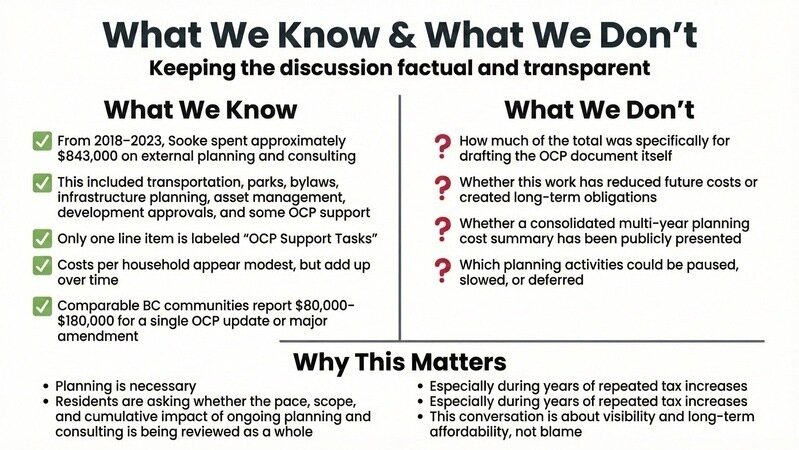
This tax petition is not calling for planning to stop.
Residents are asking for clarity, fairness, and transparency, including:
✅ a clear OCP implementation plan (what happens first, and when)
✅ a staffing plan showing new positions and ongoing operating costs
✅ a realistic 10-year capital and tax impact forecast tied to the OCP
✅ clear explanations of how costs will be funded before they appear on tax notices
In short:
Tell residents what it will cost, when costs will show up, and how the community is expected to pay.
Affordability is not just about the tax rate.
It is about the total cost of decisions, including those that never appear on a tax notice.
Thank you to everyone continuing to read, share, ask questions, and stay engaged.