
STOP McDonald’s MARKETING TV-14 Horror to SMALL CHILDREN with Netflix's Stranger Things
The Issue
Note: This petition is NOT against Stranger Things. I enjoyed the show. But I am an adult.
SMALL CHILDREN are the new TARGET market for horror-themed TV-14 entertainment with frightening themes.
Each Happy Meal has a QR code that enters them into a digital interactive experience with supernatural monsters.
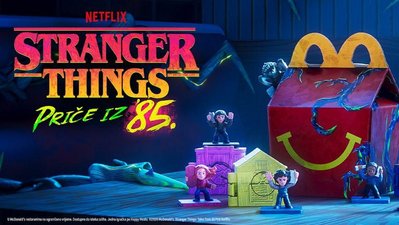
McDonald's and Netflix have entered into an official promotional partnership for Netflix's TV-14 supernatural horror franchise Stranger Things.

On April 23, 2026, Netflix publicly announced this collaboration:
- “Netflix and McDonald’s are joining forces to launch a special Stranger Things: Tales From ‘85 Happy Meal.”
- “What better way to invite a new generation of Stranger Things fans into Hawkins than through one of the most iconic cornerstones of the ‘80s?”
Every Stranger Things themed Happy Meal includes the following:
- a collectible Stranger Things character toy,
- a Stranger Things activity book,
- a "SCAN TO PLAY" QR code unlocking an interactive digital game, where players come face to face with what Netflix calls "the creature.”
YOUNG CHILDREN ARE MORE TECH-SAVVY THAN MANY ADULTS REALIZE
- Research demonstrates that even toddlers and preschoolers can independently access digital entertainment.
- 40% of children have their own tablet by age 2, increasing to 58% by age 4, according to Common Sense Media’s 2025 national research.
- A 2015 study published in Pediatrics found that 28.2% of 2-year-olds could navigate a mobile device without assistance, while another 60.9% needed help only sometimes.
- The same study found that most 3- and 4-year-olds could use mobile devices independently.
RESEARCH STUDIES PROVE THE DANGER
- Decades of scientific research have established that frightening media can have serious and lasting emotional effects on young children, including fear, anxiety, nightmares, emotional distress, and sleep disturbances.
- Research identifies frightening visual imagery—particularly monsters, supernatural threats, and scary fantasy characters—as especially powerful triggers of fear in preschool-aged children.
CUSTERS & VAN DEN BULCK (2012) — FEAR EFFECTS OF MEDIA ON YOUNG CHILDREN
- Published in the European Journal of Pediatrics, this research identifies children ages 3–7 as particularly vulnerable to frightening fantasy characters, transformations, and violence when exposed to such content.
- The resulting fear can persist beyond the initial exposure, contributing to nightmares, sleep disturbances, phobias, and behavioral problems.
CANTOR ET AL. (2010) — MEDIA-INDUCED FEAR IN CHILDREN
- Researchers studied 219 elementary school children, averaging 8.5 years old. 76% recalled a specific frightening media experience, most commonly involving movies or content they had not chosen to watch.
- Additional findings included:
- 71% could not stop thinking about the frightening experience.
59% did not want to sleep alone.
56% experienced nightmares.
52% worried about what they had seen. - Supernatural monsters were the most frequently reported source of fright.
AMERICAN ACADEMY OF PEDIATRICS (2009) — MEDIA VIOLENCE AND CHILDREN'S HEALTH
- In its policy statement published in Pediatrics, the American Academy of Pediatrics warned that exposure to violent media can contribute to fear, anxiety, nightmares, and sleep disturbances in children.
- The Academy emphasized that children younger than 8 are especially vulnerable because of their developing ability to distinguish fantasy from reality. It also urged parents to make informed media choices and called for greater responsibility from entertainment producers.
WALMA VAN DER MOLEN & BUSHMAN (2008) — FEAR AND WORRY CAUSED BY VIOLENT THREATS
- Published in The Journal of Pediatrics, this study examined 572 children ages 8–12.
- Descriptions of violent threats increased children's fear and worry, with younger children experiencing stronger reactions than older children.
- The researchers also found that presenting threats as actual news produced greater fear than presenting them as fiction.
CANTOR (2004) — WHY FRIGHTENING MOVIES CAN LEAVE LASTING FEARS
- Joanne Cantor examined 530 student papers describing frightening media experiences.
- Among 91 papers concerning four frequently mentioned horror films:
- 75% described effects on waking life, including anxiety.
46% reported effects on bedtime behavior, including sleep disturbances.
More than one-third described effects continuing at the time of the study.
The findings illustrate how frightening fictional imagery can remain emotionally disturbing long after exposure.
VALKENBURG, CANTOR & PEETERS (2000) — CHILDREN'S FRIGHT REACTIONS TO TELEVISION
- Researchers surveyed children ages 7–12 about frightening television experiences.
- 31% reported being frightened by television during the preceding year.
- The study examined children's reactions to fantasy characters, interpersonal violence, disasters, and other frightening content. Fear responses and coping strategies differed according to children's ages and developmental stages.
HARRISON & CANTOR (1999) — LASTING EFFECTS OF FRIGHTENING MEDIA
- Researchers surveyed 153 university students about frightening media experiences, most originating in childhood or adolescence.
- 90% recalled a lasting fright reaction, and 26.1% reported residual anxiety years later. More than half reported disturbances in sleeping or eating following their exposure.
CHILDREN’S ADVERTISING STANDARDS
- The Children's Advertising Review Unit (CARU) establishes guidelines protecting children under 13. These standards prohibit advertising that unduly frightens children or provokes anxiety and prohibit knowingly directing children to such content.
- CARU — Official Children’s Advertising Guidelines (PDF)
- The Federal Trade Commission (FTC) also enforces the FTC Rule - Children's Online Privacy Protection Act (COPPA), requiring covered online services to obtain parental consent before collecting personal information from children under 13, subject to limited exceptions.
FIVE IMPORTANT QUESTIONS McDonald's and Netflix must answer:
- Age appropriateness: What independent assessment determined that the game’s supernatural monsters, imagery, themes, and interactive content were appropriate for young children?
- Parental oversight: What information is provided to parents before children scan the QR code, and what parental controls or age-appropriate safeguards are available?
- Content exposure: What additional imagery, gameplay, promotional materials, or links can children encounter after entering the digital experience?
- Advertising practices: Does the experience encourage children to engage further with the Stranger Things franchise, and how clearly is promotional content identified?
- Children’s privacy: Does the experience collect personal information, use tracking technologies, or direct children to third-party services? If so, what safeguards and parental consent mechanisms apply?
WHAT WE DEMAND
We call upon McDonald’s Corporation and Netflix, Inc. to:
- Immediately withdraw any remaining Stranger Things Happy Meal toys and promotional materials.
- Discontinue associated child-directed advertising.
- Suspend the interactive digital promotion pending an independent age-appropriateness review.
- Publicly disclose the age-appropriateness standards used to approve this campaign.
- Establish meaningful safeguards preventing future promotion of age-inappropriate entertainment through children’s meals.
- Cooperate with an independent review of this campaign by the Children’s Advertising Review Unit and any appropriate regulatory authorities.
WHY YOUR SIGNATURE MATTERS
McDonald’s and Netflix are major corporations with substantial influence over the entertainment and products introduced to children.
Both companies participated in this promotional partnership. Both should be held accountable for the decisions made.
Our children deserve thoughtful protection, responsible advertising, and the opportunity to experience childhood without being deliberately introduced to frightening supernatural monsters and horror entertainment through products marketed specifically to them.
AND
Parents already must be hyper-vigilant with safeguarding their children. They should be able to count on a Happy Meal being safe.
SIGN THIS PETITION. DEMAND ACCOUNTABILITY.
THE CHILDREN WE PROTECT TODAY SHAPE THE WORLD OF TOMORROW.

25
The Issue
Note: This petition is NOT against Stranger Things. I enjoyed the show. But I am an adult.
SMALL CHILDREN are the new TARGET market for horror-themed TV-14 entertainment with frightening themes.
Each Happy Meal has a QR code that enters them into a digital interactive experience with supernatural monsters.
McDonald's and Netflix have entered into an official promotional partnership for Netflix's TV-14 supernatural horror franchise Stranger Things.
On April 23, 2026, Netflix publicly announced this collaboration:
- “Netflix and McDonald’s are joining forces to launch a special Stranger Things: Tales From ‘85 Happy Meal.”
- “What better way to invite a new generation of Stranger Things fans into Hawkins than through one of the most iconic cornerstones of the ‘80s?”
Every Stranger Things themed Happy Meal includes the following:
- a collectible Stranger Things character toy,
- a Stranger Things activity book,
- a "SCAN TO PLAY" QR code unlocking an interactive digital game, where players come face to face with what Netflix calls "the creature.”
YOUNG CHILDREN ARE MORE TECH-SAVVY THAN MANY ADULTS REALIZE
- Research demonstrates that even toddlers and preschoolers can independently access digital entertainment.
- 40% of children have their own tablet by age 2, increasing to 58% by age 4, according to Common Sense Media’s 2025 national research.
- A 2015 study published in Pediatrics found that 28.2% of 2-year-olds could navigate a mobile device without assistance, while another 60.9% needed help only sometimes.
- The same study found that most 3- and 4-year-olds could use mobile devices independently.
RESEARCH STUDIES PROVE THE DANGER
- Decades of scientific research have established that frightening media can have serious and lasting emotional effects on young children, including fear, anxiety, nightmares, emotional distress, and sleep disturbances.
- Research identifies frightening visual imagery—particularly monsters, supernatural threats, and scary fantasy characters—as especially powerful triggers of fear in preschool-aged children.
CUSTERS & VAN DEN BULCK (2012) — FEAR EFFECTS OF MEDIA ON YOUNG CHILDREN
- Published in the European Journal of Pediatrics, this research identifies children ages 3–7 as particularly vulnerable to frightening fantasy characters, transformations, and violence when exposed to such content.
- The resulting fear can persist beyond the initial exposure, contributing to nightmares, sleep disturbances, phobias, and behavioral problems.
CANTOR ET AL. (2010) — MEDIA-INDUCED FEAR IN CHILDREN
- Researchers studied 219 elementary school children, averaging 8.5 years old. 76% recalled a specific frightening media experience, most commonly involving movies or content they had not chosen to watch.
- Additional findings included:
- 71% could not stop thinking about the frightening experience.
59% did not want to sleep alone.
56% experienced nightmares.
52% worried about what they had seen. - Supernatural monsters were the most frequently reported source of fright.
AMERICAN ACADEMY OF PEDIATRICS (2009) — MEDIA VIOLENCE AND CHILDREN'S HEALTH
- In its policy statement published in Pediatrics, the American Academy of Pediatrics warned that exposure to violent media can contribute to fear, anxiety, nightmares, and sleep disturbances in children.
- The Academy emphasized that children younger than 8 are especially vulnerable because of their developing ability to distinguish fantasy from reality. It also urged parents to make informed media choices and called for greater responsibility from entertainment producers.
WALMA VAN DER MOLEN & BUSHMAN (2008) — FEAR AND WORRY CAUSED BY VIOLENT THREATS
- Published in The Journal of Pediatrics, this study examined 572 children ages 8–12.
- Descriptions of violent threats increased children's fear and worry, with younger children experiencing stronger reactions than older children.
- The researchers also found that presenting threats as actual news produced greater fear than presenting them as fiction.
CANTOR (2004) — WHY FRIGHTENING MOVIES CAN LEAVE LASTING FEARS
- Joanne Cantor examined 530 student papers describing frightening media experiences.
- Among 91 papers concerning four frequently mentioned horror films:
- 75% described effects on waking life, including anxiety.
46% reported effects on bedtime behavior, including sleep disturbances.
More than one-third described effects continuing at the time of the study.
The findings illustrate how frightening fictional imagery can remain emotionally disturbing long after exposure.
VALKENBURG, CANTOR & PEETERS (2000) — CHILDREN'S FRIGHT REACTIONS TO TELEVISION
- Researchers surveyed children ages 7–12 about frightening television experiences.
- 31% reported being frightened by television during the preceding year.
- The study examined children's reactions to fantasy characters, interpersonal violence, disasters, and other frightening content. Fear responses and coping strategies differed according to children's ages and developmental stages.
HARRISON & CANTOR (1999) — LASTING EFFECTS OF FRIGHTENING MEDIA
- Researchers surveyed 153 university students about frightening media experiences, most originating in childhood or adolescence.
- 90% recalled a lasting fright reaction, and 26.1% reported residual anxiety years later. More than half reported disturbances in sleeping or eating following their exposure.
CHILDREN’S ADVERTISING STANDARDS
- The Children's Advertising Review Unit (CARU) establishes guidelines protecting children under 13. These standards prohibit advertising that unduly frightens children or provokes anxiety and prohibit knowingly directing children to such content.
- CARU — Official Children’s Advertising Guidelines (PDF)
- The Federal Trade Commission (FTC) also enforces the FTC Rule - Children's Online Privacy Protection Act (COPPA), requiring covered online services to obtain parental consent before collecting personal information from children under 13, subject to limited exceptions.
FIVE IMPORTANT QUESTIONS McDonald's and Netflix must answer:
- Age appropriateness: What independent assessment determined that the game’s supernatural monsters, imagery, themes, and interactive content were appropriate for young children?
- Parental oversight: What information is provided to parents before children scan the QR code, and what parental controls or age-appropriate safeguards are available?
- Content exposure: What additional imagery, gameplay, promotional materials, or links can children encounter after entering the digital experience?
- Advertising practices: Does the experience encourage children to engage further with the Stranger Things franchise, and how clearly is promotional content identified?
- Children’s privacy: Does the experience collect personal information, use tracking technologies, or direct children to third-party services? If so, what safeguards and parental consent mechanisms apply?
WHAT WE DEMAND
We call upon McDonald’s Corporation and Netflix, Inc. to:
- Immediately withdraw any remaining Stranger Things Happy Meal toys and promotional materials.
- Discontinue associated child-directed advertising.
- Suspend the interactive digital promotion pending an independent age-appropriateness review.
- Publicly disclose the age-appropriateness standards used to approve this campaign.
- Establish meaningful safeguards preventing future promotion of age-inappropriate entertainment through children’s meals.
- Cooperate with an independent review of this campaign by the Children’s Advertising Review Unit and any appropriate regulatory authorities.
WHY YOUR SIGNATURE MATTERS
McDonald’s and Netflix are major corporations with substantial influence over the entertainment and products introduced to children.
Both companies participated in this promotional partnership. Both should be held accountable for the decisions made.
Our children deserve thoughtful protection, responsible advertising, and the opportunity to experience childhood without being deliberately introduced to frightening supernatural monsters and horror entertainment through products marketed specifically to them.
AND
Parents already must be hyper-vigilant with safeguarding their children. They should be able to count on a Happy Meal being safe.
SIGN THIS PETITION. DEMAND ACCOUNTABILITY.
THE CHILDREN WE PROTECT TODAY SHAPE THE WORLD OF TOMORROW.


Petition Updates
Share this petition
Petition created on November 2, 2026