

Stop Improper ADU Sewer Fees — Demand Fair and Transparent Charges.
The Issue
The Issue
Ojai Valley homeowners report being charged thousands of dollars in sewer capacity fees when they build an accessory dwelling unit (ADU). Some say their ADU connects through the property’s existing private sewer lateral, without a new, separate connection directly to the public sewer system. Homeowners also report that charges were not clearly disclosed before construction, arrived after work began or was completed, or were later placed on property-tax bills.
The comparison below illustrates why homeowners are asking how OVSD calculates these charges.
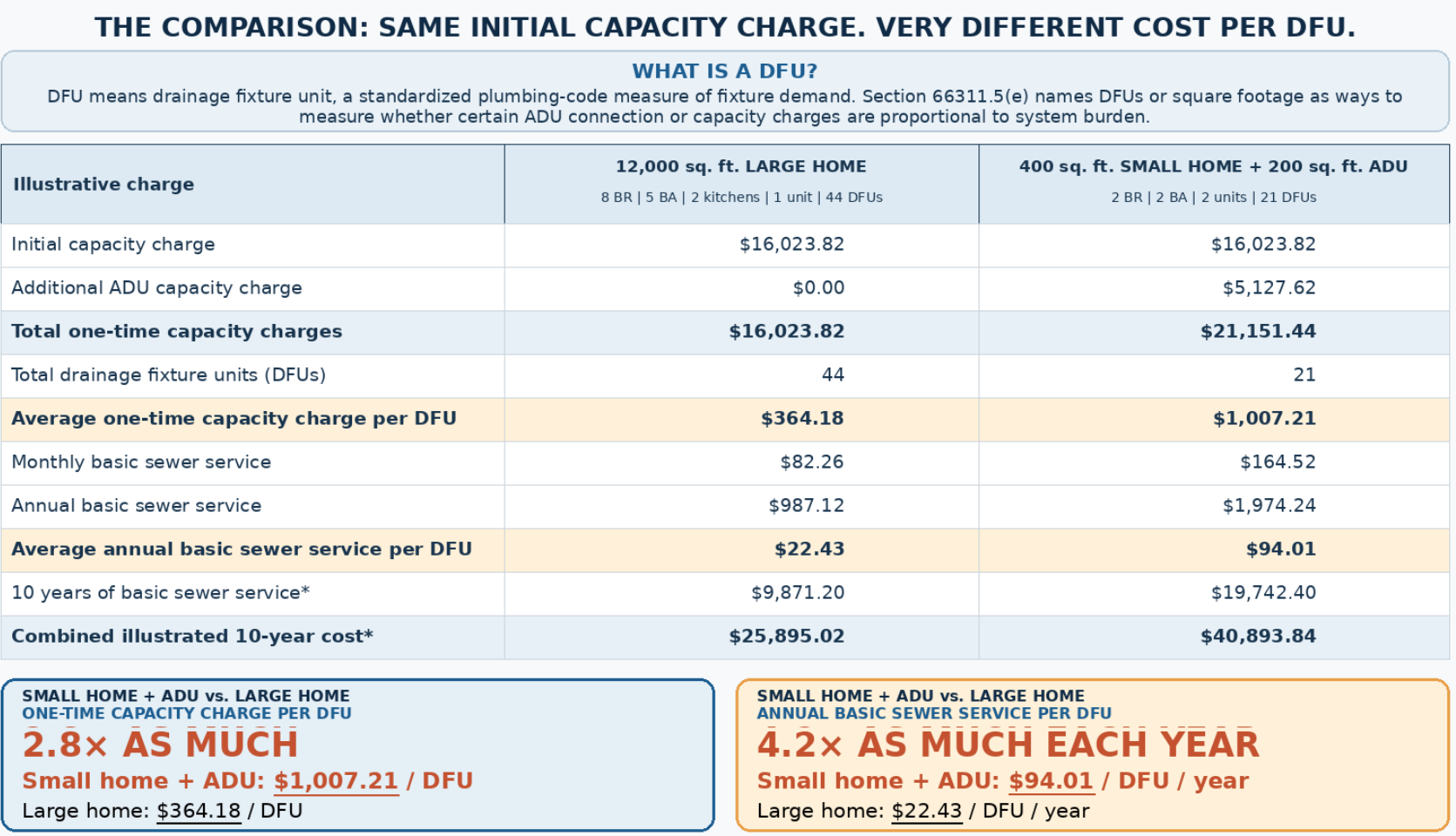
This is an illustrative comparison using the charges and fixture counts shown. The per-DFU figures are averages for comparison; OVSD’s annual sewer-service charges are assessed by service unit. The 10-year figures assume the listed annual rates remain unchanged. The comparison raises questions about the fee method; it is not a judicial finding that a charge is unlawful.
What the Comparison Shows
In the example, a 12,000-square-foot home with 44 drainage fixture units (DFUs) and a 400-square-foot home with a 200-square-foot ADU and 21 DFUs are assigned the same initial capacity charge. The small home and ADU then face an additional ADU capacity charge and a second annual sewer-service charge.
OVSD’s initial residential capacity charge is generally based on a standard charge rather than being individually scaled to the home’s square footage or DFUs. For an added ADU, however, OVSD calculates an additional capacity charge using the ADU’s DFUs.
That difference raises fair questions: What capacity did the original charge assign to the property? How is that previously paid capacity considered when an ADU is added? What evidence shows that the additional charge reflects the ADU’s burden on the sewer system and does not exceed reasonable cost?
A private lateral’s ability to carry more wastewater does not, by itself, establish that the public system has no additional demand. But the existence of additional demand does not, by itself, establish that a particular charge is proportionate or justified. OVSD should be able to explain its method and support it with evidence.
What California Law and HCD Have Said
Government Code § 66311.5 sets different rules for different ADU categories. Subdivision (d) limits when a local agency may require certain qualifying ADUs to install a new or separate direct utility connection or pay a related connection fee or capacity charge. Subdivision (e) addresses other ADUs, for which a new or separate direct connection may be required; a related charge must be proportionate to the ADU’s burden and cannot exceed reasonable cost.
On November 2, 2026, the California Department of Housing and Community Development (HCD) told OVSD that capacity charges may apply to certain ADUs even when they connect through an existing private lateral, if the charges meet the applicable proportionality and reasonable-cost requirements. HCD’s position differs from its June 6, 2026 correspondence and its November 23, 2020 Technical Assistance Letter. HCD described its November interpretation as superseding prior informal guidance.
ADU Rights disagrees with HCD’s revised interpretation and is seeking clarification about how it applies to ADUs using an existing lateral. The November letter does not determine whether OVSD’s calculations in any particular case meet the stated requirements.
Read the correspondence:
November 2, 2026 — HCD letter to OVSD
June 6, 2026 — HCD correspondence regarding direct connections
November 23, 2020 — HCD Technical Assistance Letter
Ongoing Sewer-Service Charges
Annual sewer-service charges are separate from one-time capacity charges. Under OVSD’s rate structure, some ADUs may be assessed an additional full residential service charge. The comparison shows how that can affect a small home with an ADU compared with a much larger home.
Homeowners deserve to know how OVSD determines the number of service units, what costs each charge covers, and how the recurring charge relates to the service provided. These questions require a separate explanation from the one-time capacity-fee calculation.
What We Are Asking
We ask the appropriate state and local authorities to:
Review OVSD’s ADU capacity-charge practices and clarify how the statutory requirements apply to direct and indirect connections.
Require OVSD to publicly explain its capacity-charge method, including how it calculates additional ADU charges and accounts for capacity previously assigned to a property.
Require OVSD to support its calculations with the information needed to evaluate proportionality and reasonable cost.
Review the basis for additional annual sewer-service charges and the service-unit assignments behind them.
Ensure homeowners receive clear, itemized notice of capacity and service charges before committing to construction.
Review disputed assessments and provide corrective action or refunds where particular charges are found to have been improperly imposed.
Establish clear, consistent rules so homeowners can understand expected costs before building an ADU.
ADUs help families house aging parents, provide homes for adult children, create rental housing, and manage rising costs. Homeowners should pay their fair share of public infrastructure costs where authorized. They should also receive charges that are transparently calculated, supported, and disclosed in advance.
Sign this petition. Share it with your neighbors. If you built or proposed an ADU in the Ojai Valley and received an OVSD capacity charge, tell us what happened at adurights.org/contact. We will not publicly share your name or personal story without your permission.
This petition discusses public policy and disputed legal interpretations. Whether an individual charge is permissible depends on the ADU category, applicable law, connection requirements, fee method, and property-specific records. No judicial determination of the challenged OVSD practices is asserted here.

66
The Issue
The Issue
Ojai Valley homeowners report being charged thousands of dollars in sewer capacity fees when they build an accessory dwelling unit (ADU). Some say their ADU connects through the property’s existing private sewer lateral, without a new, separate connection directly to the public sewer system. Homeowners also report that charges were not clearly disclosed before construction, arrived after work began or was completed, or were later placed on property-tax bills.
The comparison below illustrates why homeowners are asking how OVSD calculates these charges.
This is an illustrative comparison using the charges and fixture counts shown. The per-DFU figures are averages for comparison; OVSD’s annual sewer-service charges are assessed by service unit. The 10-year figures assume the listed annual rates remain unchanged. The comparison raises questions about the fee method; it is not a judicial finding that a charge is unlawful.
What the Comparison Shows
In the example, a 12,000-square-foot home with 44 drainage fixture units (DFUs) and a 400-square-foot home with a 200-square-foot ADU and 21 DFUs are assigned the same initial capacity charge. The small home and ADU then face an additional ADU capacity charge and a second annual sewer-service charge.
OVSD’s initial residential capacity charge is generally based on a standard charge rather than being individually scaled to the home’s square footage or DFUs. For an added ADU, however, OVSD calculates an additional capacity charge using the ADU’s DFUs.
That difference raises fair questions: What capacity did the original charge assign to the property? How is that previously paid capacity considered when an ADU is added? What evidence shows that the additional charge reflects the ADU’s burden on the sewer system and does not exceed reasonable cost?
A private lateral’s ability to carry more wastewater does not, by itself, establish that the public system has no additional demand. But the existence of additional demand does not, by itself, establish that a particular charge is proportionate or justified. OVSD should be able to explain its method and support it with evidence.
What California Law and HCD Have Said
Government Code § 66311.5 sets different rules for different ADU categories. Subdivision (d) limits when a local agency may require certain qualifying ADUs to install a new or separate direct utility connection or pay a related connection fee or capacity charge. Subdivision (e) addresses other ADUs, for which a new or separate direct connection may be required; a related charge must be proportionate to the ADU’s burden and cannot exceed reasonable cost.
On November 2, 2026, the California Department of Housing and Community Development (HCD) told OVSD that capacity charges may apply to certain ADUs even when they connect through an existing private lateral, if the charges meet the applicable proportionality and reasonable-cost requirements. HCD’s position differs from its June 6, 2026 correspondence and its November 23, 2020 Technical Assistance Letter. HCD described its November interpretation as superseding prior informal guidance.
ADU Rights disagrees with HCD’s revised interpretation and is seeking clarification about how it applies to ADUs using an existing lateral. The November letter does not determine whether OVSD’s calculations in any particular case meet the stated requirements.
Read the correspondence:
November 2, 2026 — HCD letter to OVSD
June 6, 2026 — HCD correspondence regarding direct connections
November 23, 2020 — HCD Technical Assistance Letter
Ongoing Sewer-Service Charges
Annual sewer-service charges are separate from one-time capacity charges. Under OVSD’s rate structure, some ADUs may be assessed an additional full residential service charge. The comparison shows how that can affect a small home with an ADU compared with a much larger home.
Homeowners deserve to know how OVSD determines the number of service units, what costs each charge covers, and how the recurring charge relates to the service provided. These questions require a separate explanation from the one-time capacity-fee calculation.
What We Are Asking
We ask the appropriate state and local authorities to:
Review OVSD’s ADU capacity-charge practices and clarify how the statutory requirements apply to direct and indirect connections.
Require OVSD to publicly explain its capacity-charge method, including how it calculates additional ADU charges and accounts for capacity previously assigned to a property.
Require OVSD to support its calculations with the information needed to evaluate proportionality and reasonable cost.
Review the basis for additional annual sewer-service charges and the service-unit assignments behind them.
Ensure homeowners receive clear, itemized notice of capacity and service charges before committing to construction.
Review disputed assessments and provide corrective action or refunds where particular charges are found to have been improperly imposed.
Establish clear, consistent rules so homeowners can understand expected costs before building an ADU.
ADUs help families house aging parents, provide homes for adult children, create rental housing, and manage rising costs. Homeowners should pay their fair share of public infrastructure costs where authorized. They should also receive charges that are transparently calculated, supported, and disclosed in advance.
Sign this petition. Share it with your neighbors. If you built or proposed an ADU in the Ojai Valley and received an OVSD capacity charge, tell us what happened at adurights.org/contact. We will not publicly share your name or personal story without your permission.
This petition discusses public policy and disputed legal interpretations. Whether an individual charge is permissible depends on the ADU category, applicable law, connection requirements, fee method, and property-specific records. No judicial determination of the challenged OVSD practices is asserted here.
The Decision Makers


Supporter Voices
Petition Updates
Share this petition
Petition created on September 30, 2024