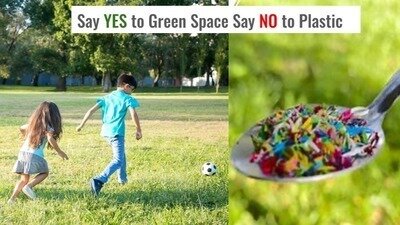

Say NO to Plastic Fields: Demand Real Green Spaces for SFUSD Students
The Issue
To: The SFUSD Board of Education, Superintendent of Schools, and SFUSD Facilities & Capital Planning Department
We, the undersigned students, parents, teachers, staff, and San Francisco community members, call upon SFUSD to immediately halt all planned and future installations of synthetic/artificial turf across our schoolyards and athletic fields. We urge the district to commit instead to non-toxic, sustainable, natural landscaping.
Why This Matters:
Severe Health Risks (PFAS & Toxics): Artificial turf systems and synthetic grass blades frequently contain toxic PFAS ("forever chemicals") and hazardous processing agents. Children are uniquely vulnerable to absorbing these toxic chemicals and microplastics through direct skin contact, open scrapes, and dust inhalation.
Misleading "Low Maintenance" Claims: Manufacturers of artificial turf systems (such as TenCate Pivot) outline rigorous, mandatory maintenance manuals requiring specialized sweeping, weekly high-traffic monitoring, monthly grooming, and chemical weed control. If SFUSD fails to strictly adhere to these mandatory manufacturer rules, the product warranty is automatically voided. Rather than saving resources, these fields place a continuous, expensive operational burden on district facilities teams.
Extreme Surface Heat & Water Waste: Even the most modern artificial turf fields act like heat sinks, reaching dangerous surface temperatures between 120°F and 160°F, posing severe risks of heat exhaustion and contact burns. Products marketed as "cooler" require constant watering to activate their cooling effects. This forces SFUSD to install complex nearby irrigation systems and dedicate staff just to monitor turf temperatures and water the plastic down.
Environmental & Watershed Damage: Artificial turf breaks down over time, shedding thousands of pounds of microplastics directly into San Francisco’s stormwater systems and local waterways. Furthermore, capping the earth in plastic completely destroys living soil ecosystems, eliminating vital urban green spaces and cooling shade.
Irresponsible Financial Lifecycle: Artificial fields are not a one-time purchase—they require total replacement every 8 to 10 years at hundreds of thousands of dollars per site. This creates an endless cycle of heavy spending, diverting scarce educational funds away from classrooms, teachers, and student support services to generate tons of non-recyclable plastic waste.
What the Experts Are Saying:
"We strongly oppose the installation of plastic turf playing fields in San Francisco and enthusiastically encourage support of a more sustainable, health-protective solution that better aligns with the well-being of residents and future generations." –Robert M. Gould MD, San Francisco Bay Area Physicians for Social Responsibility
Tom Brady: “I love grass fields. I hated turf fields. What we’re doing to kids on turf fields in high school, turf fields in college and then ultimately get to the pros, the wear and tear on those bodies over time really takes a toll.”
That’s the real problem: Artificial turf just doesn’t go away. “You’re going to be paying to get rid of it,” says Peaslee, the PFAS expert. “Somebody will have to take it to a dump, where it will sit for a thousand years.”
“There were statistically higher rates of ACL injuries that needed surgery on artificial turf compared to grass. Achilles tendon injuries were the second most common to require surgery – and they, too, were more likely to occur on field turf.” Brian Feeley, an orthopedic surgeon at the University of California-San Francisco
“There is no reason that California’s athletes or anyone else should be exposed to PFAS while playing on the field, especially when there are safer alternatives to these nonessential chemicals,” said CA Assembleymember, Pilar Schiavo
"Perpetuating the use of fossil fuels, especially when there is a safer alternative for playing fields, directly undermines San Francisco’s climate goals." –Robert M. Gould MD, San Francisco Bay Area Physicians for Social Responsibility
Undermines San Francisco Climate Action Plan:
Installing artificial turf directly undermines San Francisco's climate and zero-waste goals in several critical ways. As a petroleum-based product with a finite lifespan of 8 to 10 years, synthetic turf generates massive volumes of non-recyclable plastic waste that ultimately ends up in landfills. It also exacerbates the urban heat island effect by radiating surface temperatures up to 160°F, destroys living soil ecosystems and carbon sinks, and sheds microplastics into local stormwater runoff and the San Francisco Bay. Furthermore, its entire lifecycle—from manufacturing and heavy transport to chemical maintenance and disposal—generates a significantly higher carbon footprint than maintaining natural green spaces.
Huge Climate Impacts
Artificial turf is created by fracking and refining ethane gas, which releases large amounts of greenhouse gases.
Hotter Than a Summer Sidewalk
Plastic turf can heat up 40 - 70 degrees hotter than natural grass.
Creates Urban Heat Island: Plastic off-gases methane and ethylene, creating heat islands larger than the artificial turf surface itself.
Can’t Be Recycled
Despite marketing claims, no artificial turf recycling facilities exist in California
Our Demand:
We urge SFUSD to adopt a health-first facility standard that explicitly bans artificial turf on all district properties and prioritizes natural grass, organic land management, or safe, heat-resilient natural surfacing alternatives.
115
The Issue
To: The SFUSD Board of Education, Superintendent of Schools, and SFUSD Facilities & Capital Planning Department
We, the undersigned students, parents, teachers, staff, and San Francisco community members, call upon SFUSD to immediately halt all planned and future installations of synthetic/artificial turf across our schoolyards and athletic fields. We urge the district to commit instead to non-toxic, sustainable, natural landscaping.
Why This Matters:
Severe Health Risks (PFAS & Toxics): Artificial turf systems and synthetic grass blades frequently contain toxic PFAS ("forever chemicals") and hazardous processing agents. Children are uniquely vulnerable to absorbing these toxic chemicals and microplastics through direct skin contact, open scrapes, and dust inhalation.
Misleading "Low Maintenance" Claims: Manufacturers of artificial turf systems (such as TenCate Pivot) outline rigorous, mandatory maintenance manuals requiring specialized sweeping, weekly high-traffic monitoring, monthly grooming, and chemical weed control. If SFUSD fails to strictly adhere to these mandatory manufacturer rules, the product warranty is automatically voided. Rather than saving resources, these fields place a continuous, expensive operational burden on district facilities teams.
Extreme Surface Heat & Water Waste: Even the most modern artificial turf fields act like heat sinks, reaching dangerous surface temperatures between 120°F and 160°F, posing severe risks of heat exhaustion and contact burns. Products marketed as "cooler" require constant watering to activate their cooling effects. This forces SFUSD to install complex nearby irrigation systems and dedicate staff just to monitor turf temperatures and water the plastic down.
Environmental & Watershed Damage: Artificial turf breaks down over time, shedding thousands of pounds of microplastics directly into San Francisco’s stormwater systems and local waterways. Furthermore, capping the earth in plastic completely destroys living soil ecosystems, eliminating vital urban green spaces and cooling shade.
Irresponsible Financial Lifecycle: Artificial fields are not a one-time purchase—they require total replacement every 8 to 10 years at hundreds of thousands of dollars per site. This creates an endless cycle of heavy spending, diverting scarce educational funds away from classrooms, teachers, and student support services to generate tons of non-recyclable plastic waste.
What the Experts Are Saying:
"We strongly oppose the installation of plastic turf playing fields in San Francisco and enthusiastically encourage support of a more sustainable, health-protective solution that better aligns with the well-being of residents and future generations." –Robert M. Gould MD, San Francisco Bay Area Physicians for Social Responsibility
Tom Brady: “I love grass fields. I hated turf fields. What we’re doing to kids on turf fields in high school, turf fields in college and then ultimately get to the pros, the wear and tear on those bodies over time really takes a toll.”
That’s the real problem: Artificial turf just doesn’t go away. “You’re going to be paying to get rid of it,” says Peaslee, the PFAS expert. “Somebody will have to take it to a dump, where it will sit for a thousand years.”
“There were statistically higher rates of ACL injuries that needed surgery on artificial turf compared to grass. Achilles tendon injuries were the second most common to require surgery – and they, too, were more likely to occur on field turf.” Brian Feeley, an orthopedic surgeon at the University of California-San Francisco
“There is no reason that California’s athletes or anyone else should be exposed to PFAS while playing on the field, especially when there are safer alternatives to these nonessential chemicals,” said CA Assembleymember, Pilar Schiavo
"Perpetuating the use of fossil fuels, especially when there is a safer alternative for playing fields, directly undermines San Francisco’s climate goals." –Robert M. Gould MD, San Francisco Bay Area Physicians for Social Responsibility
Undermines San Francisco Climate Action Plan:
Installing artificial turf directly undermines San Francisco's climate and zero-waste goals in several critical ways. As a petroleum-based product with a finite lifespan of 8 to 10 years, synthetic turf generates massive volumes of non-recyclable plastic waste that ultimately ends up in landfills. It also exacerbates the urban heat island effect by radiating surface temperatures up to 160°F, destroys living soil ecosystems and carbon sinks, and sheds microplastics into local stormwater runoff and the San Francisco Bay. Furthermore, its entire lifecycle—from manufacturing and heavy transport to chemical maintenance and disposal—generates a significantly higher carbon footprint than maintaining natural green spaces.
Huge Climate Impacts
Artificial turf is created by fracking and refining ethane gas, which releases large amounts of greenhouse gases.
Hotter Than a Summer Sidewalk
Plastic turf can heat up 40 - 70 degrees hotter than natural grass.
Creates Urban Heat Island: Plastic off-gases methane and ethylene, creating heat islands larger than the artificial turf surface itself.
Can’t Be Recycled
Despite marketing claims, no artificial turf recycling facilities exist in California
Our Demand:
We urge SFUSD to adopt a health-first facility standard that explicitly bans artificial turf on all district properties and prioritizes natural grass, organic land management, or safe, heat-resilient natural surfacing alternatives.
The Decision Makers
Petition Updates
Share this petition
Petition created on October 20, 2026