
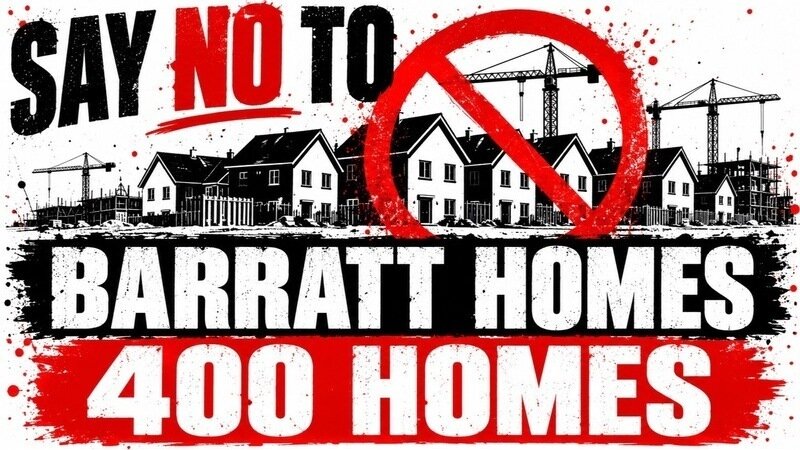
🚨 PETITION UPDATE 2: THE QUESTIONS BARRATT HOMES MUST ANSWER ABOUT BARUGH GREEN
🏡 DO YOU KNOW THE TRUE VALUE OF YOUR HOME?
S75 is already the most expensive postcode in Barnsley to live in. Now ask yourself: what happens to our property values if Barratt Homes gets the go-ahead to build 400 houses?
And what about your council tax? More homes, more pressure on local infrastructure and services - who do you think will end up footing the bill?
YOUR HOME. YOUR MONEY. YOUR COMMUNITY.
Have you really considered what’s at stake?
The proposal to build approximately 400 homes in Barugh Green raises serious questions that deserve clear, evidence-based answers before any planning decision is made.
This is not simply about whether new homes should be built. It is about whether this particular development can be delivered safely and responsibly, without placing an unacceptable burden on the people who already live here.
Promises of contributions, improvements and future arrangements are not enough. Residents deserve to know exactly what is proposed, how it will work in practice, who will pay for it and what safeguards will be put in place.
Here are some more of the questions that need proper answers.
🚌 1. ACCESS FOR BUSES AND EMERGENCY SERVICES
The addition of approximately 400 homes will generate additional vehicle movements and place further demands on the existing road network.
Mary Street and Coronation Road already experience problems with vehicles parked along residential roads, restricting the available carriageway width.
How will buses, ambulances, fire engines and police vehicles safely navigate these roads when parked vehicles restrict the space available?
Residents need more than an assurance that access will be possible. The proposals must be supported by a proper assessment of road widths, parking conditions, vehicle movements and emergency access.
The consequences of inadequate access are too serious to leave unanswered.
🚗 2. WHAT WILL HAPPEN TO EXISTING RESIDENTS’ PARKING?
Barratt has proposed a car park for existing residents, but important questions remain about how this arrangement will work in practice.
How many parking spaces will be provided?
Will there be enough spaces for the residents expected to use it?
How far will residents have to walk from their homes?
How will residents with mobility difficulties be accommodated?
Who will own, maintain and manage the car park?
What happens if the car park becomes full?
Will residents face additional costs to use or maintain it?
Parking is part of everyday life. Any proposal that changes existing parking arrangements must properly consider the practical consequences for the people affected.
Residents deserve clear details, not vague assurances about a car park that has yet to be fully explained.
🔐 3. WHO WILL BE RESPONSIBLE FOR THE CAR PARK’S SECURITY?
If existing residents are expected to use a separate car park, security and long-term management must be addressed.
Will CCTV be installed?
Who will pay for installation, electricity, maintenance and repairs?
Who will monitor the cameras and respond to incidents?
Will the car park have suitable lighting?
Who will be responsible for insurance and liability?
Who will manage the facility in the long term?
What happens if funding or management arrangements change?
These are not minor details. They directly affect residents’ ability to use the proposed facility with confidence.
Barratt must explain how the arrangement will be funded, managed and maintained for the long term - not simply how it will look when first provided.
⚡ 4. WHAT ABOUT RESIDENTS WHO NEED ELECTRIC VEHICLE CHARGING?
For residents who own electric vehicles, changes to parking arrangements raise another important question.
If residents currently rely on charging facilities at or near their homes, moving their vehicles to a separate car park could change how they charge them.
Will suitable charging provision be available? Who would pay for installation, electricity, maintenance and future upgrades? How would the arrangement work for residents who cannot reasonably charge elsewhere?
These details need to be considered before any changes are imposed on existing residents.
🏫 5. BARUGH GREEN HAS ONE PRIMARY SCHOOL
The development will generate additional demand for local school places.
Barugh Green has one primary school, and residents need clear evidence showing how the additional demand will be accommodated.
Barratt has referred to contributions towards education through planning obligations. However, a financial contribution does not, by itself, prove that sufficient school places will be available when they are needed.
Residents deserve answers to the following:
How many additional primary school places will the development require?
Can the existing school accommodate that demand?
If additional capacity is required, what improvements are planned?
Who will fund those improvements, and when will they be delivered?
The question is not simply whether money will be contributed. It is whether the necessary school places will actually be available.
🏥 6. THE PRESSURE ON EVERYDAY SERVICES WILL INCREASE
Approximately 400 additional homes will bring more people into the area. Those residents will need access to healthcare, pharmacies, public transport, recreational facilities and other everyday services.
That additional demand must be considered alongside the needs of the existing community and the cumulative effects of other development in the area.
If Barratt proposes contributions towards local services or facilities, residents should be told:
What specific improvements are proposed?
How much funding will be provided?
Which organisations will receive it?
How will the money be allocated?
When will the improvements be delivered?
How will the council ensure the promised provision meets the additional demand?
A contribution on paper is not the same as a service that has the capacity to meet people’s needs.
7. THE IMPACT ON EXISTING RESIDENTS’ QUALITY OF LIFE
A development of this scale will change the environment in which existing residents live.
If construction proceeds, residents will experience construction activity and associated disruption. Once occupied, the development will bring additional households, vehicle movements and demand for local facilities.
These changes must be assessed in terms of their effects on residential amenity, including noise, privacy, traffic, access and the character of the surrounding area.
The uncertainty surrounding a major development can also place considerable strain on residents who are worried about their homes, their neighbourhood and the future of their community.
Residents’ concerns about their wellbeing and quality of life deserve proper consideration. They should not be dismissed simply because they are difficult to measure in financial terms.
⛏️ 8. THE SITE’S MINING HISTORY MUST BE PROPERLY INVESTIGATED
This is one of the most important issues requiring detailed technical evidence.
Our research has identified historic mining-related records and geological features relevant to the proposed site, including opencast mining, records relating to underground workings and evidence associated with historic surface mining in the wider area.
These records do not automatically mean development is impossible. However, they make it essential that the relevant risks are properly investigated and addressed.
Residents deserve clarity on the following:
What are Barratts findings on historic mining activity? We have evidence of what took place on or near the site and other findings.
What do the available records establish about the coal seams and mine workings?
Have mine entries and their potential zones of influence been investigated?
What ground investigations have been completed?
What do those investigations establish about ground stability?
Has the history of the site, including any historic infilling, been properly assessed?
If material was used to infill any part of the site, what was it, where did it come from and how was its suitability assessed?
What further investigations or mitigation measures are required before development can safely proceed?
Where the site’s history identifies potential risks, those risks must be assessed by appropriately qualified professionals and addressed through suitable measures.
Residents should not be expected to accept assurances about ground conditions when the supporting evidence has not been clearly carried out or explained.
🏗️ 9. WHAT ABOUT SUITABLE BROWNFIELD ALTERNATIVES?
Before greenfield land is developed, residents are entitled to ask what reasonable alternatives have been considered.
Has Barratt demonstrated why this particular site is needed for the proposed development? What suitable previously developed land has been considered? How have the environmental, infrastructure and transport implications of alternative sites been assessed?
Brownfield land is not automatically suitable for every development, and its availability must be assessed realistically. However, that does not remove the need to explain why this site has been selected and how the proposal fits within the wider planning strategy for Barnsley.
The community deserves transparency about the alternatives considered and the reasons this land has been chosen.
📑 10. WE NEED EVIDENCE, NOT JUST PROMISES
Barratt has referred to contributions towards education, recreational facilities and public transport.
Those contributions may form part of a planning agreement, but they do not automatically establish that the development is acceptable in planning terms.
Residents need to understand what is actually being proposed, what evidence supports it, what improvements will be delivered, when they will be delivered and whether those improvements will adequately address the development’s effects.
The relevant planning authority must assess the proposal against the applicable planning policies and the evidence available to it.
A development of this scale must be scrutinised properly. The questions raised by residents deserve clear answers supported by evidence. A leaflet is simply not enough!
‼️WHAT CAN YOU DO TO HELP?‼️
This is why it is important that we continue to make our voices heard.
📢 Please keep signing and sharing the petition. Every share helps bring these questions to more residents and increases awareness of what is being proposed.
✍️ Respond directly to Barratt’s consultation as well. A petition raises collective concerns, but individual consultation responses can set out specific objections and questions that the developer needs to consider.
📩 Contact your local councillors and elected representatives, and ask them to scrutinise the proposal and the evidence supporting it.
We are not asking for special treatment. We are asking for proper investigation, transparency and a planning decision based on evidence, not assumptions or promises.
Barugh Green is already a community. The people who live here deserve to have their concerns taken seriously before decisions are made that will change it.
I will continue to do everything in my power to stand up for our community, ask the difficult questions and make sure our concerns are heard. But one person can only do so much alone. Real change takes people coming together, supporting one another and standing united for something they believe in.
They say it takes a village, and that is exactly what this is about. Every signature, every share and every voice matters. We might not all be able to do the same things, but if we each do what we can, together we can make a much bigger difference.
I will keep fighting for Barugh Green, but I need you to stand alongside me. This isn’t about one person; it’s about all of us, our homes, our community and the future we want to protect.
‼️Please sign. Please share. Please make your voice heard‼️