
SAVE THIRUVANANTHAPURAM ZOO AND MUSEUM COMPLEX: EASY TO DESTROY, IMPOSSIBLE TO RECREATE
The Issue
We, the undersigned citizens of Thiruvananthapuram, urge the Government of Kerala to immediately drop the proposal to relocate our historic zoo to Neyyar or any other forest fringe area. Wildlife veterinarians, conservationists, and zoo management experts have unequivocally recommended retaining the zoo at its present location in the best interests of the animals.
This is not just about a zoological park. This is about a 167-year-old integrated heritage landscape.
Established in 1857 by Maharaja Uthram Thirunal and British Resident General William Cullen on the model of the London Zoo, this 55-acre complex houses Asia's oldest zoo alongside the Napier Museum (1880), Natural History Museum, Sree Chitra Art Gallery, K.C.S. Paniker Gallery and one of India's oldest Botanical Gardens. Together, these institutions form an irreplaceable urban heritage complex that has evolved over 167 years.
We demand protection of this entire complex for the following reasons:
1. Heritage is Irreplaceable
It takes weeks to demolish a park but generations to grow one. This complex is home to 387 rare species of trees and over 400 varieties of flora, including trees nearly 200 years old—some older than the zoo itself. Once this canopy is replaced by concrete, no amount of money can bring it back. Being above 100 years old, the entire area should fall under the protection of the AMASR Act 1958.
2. A Cage in the Forest is Still a Cage
Shifting animals from an enclosure in the city to another enclosure near a forest does not make them free. It subjects more than 1,000 animals belonging to nearly 100 species to severe transport stress, health risks, and mortality. It also exposes wild populations at Neyyar to grave risk of zoonotic disease transmission. True animal welfare means upgrading existing facilities, not forcible eviction.
3. If London Can, Why Can't We?
The renowned London Zoo thrives in the heart of central London on just 36 acres. Its central location ensures greater public accessibility, quicker emergency veterinary care, and stronger research collaboration. If space were the constraint, our zoo's conservation record would not exist.
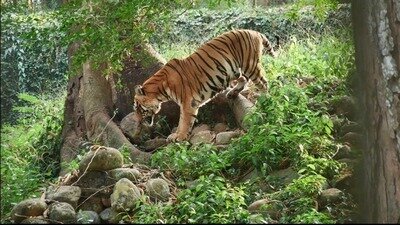
The zoo has a proven track record of successful captive breeding of more than 30 species of animals, birds, and reptiles, including highly endangered and endemic species such as the lion-tailed macaque, Nilgiri langur, Barasingha (swamp deer), Royal Bengal tiger, smooth-coated otter, rhea, etc., besides numerous endangered birds. This success is possible only because of the stable microclimate and undisturbed green cover the present complex provides.
4. Noise is a fallacy.
The claim that urban noise is harming animals at Thiruvananthapuram Zoo is not supported by evidence. The original designers intelligently buffered the zoo on all four sides with an artificial lake fed by one of India's earliest rainwater harvesting systems, the Napier Museum and Botanical Garden, and surrounding art galleries. Inside the campus, traffic noise is inaudible. The only sounds are those of visitors and birds.
5. Our Shield Against Climate Change
There are no credible scientific reports of air pollution or heat stress necessitating relocation. This 55-acre dense green lung significantly lowers ambient temperature, improves air quality, and supports over 100 species of free-ranging birds, 120 species of butterflies, and countless small mammals. Replacing it with a concrete plaza will create an urban heat island and make the city unliveable.
6. Invest in Education, Not Eviction
Instead of spending hundreds of crores on relocation, invest in the current campus. The Central Zoo Authority (CZA)-approved Master Plan itself envisages improvement, modernization and creation of naturalistic enclosures at the present site, not relocation. We demand an improved centre for wildlife research, conservation breeding and accessible wildlife education for over 14 lakh annual visitors, especially school children.
We strongly oppose any attempt to convert our city's most vital green space and heritage precinct into a commercial complex. Sustainable development means utilizing underused spaces elsewhere in the city for new public facilities while protecting existing heritage, tree cover and biodiversity. We refuse to let our city's identity and memory be erased for new construction.
Sign this petition to stand with the citizens of Thiruvananthapuram and protect our green future.

112
The Issue
We, the undersigned citizens of Thiruvananthapuram, urge the Government of Kerala to immediately drop the proposal to relocate our historic zoo to Neyyar or any other forest fringe area. Wildlife veterinarians, conservationists, and zoo management experts have unequivocally recommended retaining the zoo at its present location in the best interests of the animals.
This is not just about a zoological park. This is about a 167-year-old integrated heritage landscape.
Established in 1857 by Maharaja Uthram Thirunal and British Resident General William Cullen on the model of the London Zoo, this 55-acre complex houses Asia's oldest zoo alongside the Napier Museum (1880), Natural History Museum, Sree Chitra Art Gallery, K.C.S. Paniker Gallery and one of India's oldest Botanical Gardens. Together, these institutions form an irreplaceable urban heritage complex that has evolved over 167 years.
We demand protection of this entire complex for the following reasons:
1. Heritage is Irreplaceable
It takes weeks to demolish a park but generations to grow one. This complex is home to 387 rare species of trees and over 400 varieties of flora, including trees nearly 200 years old—some older than the zoo itself. Once this canopy is replaced by concrete, no amount of money can bring it back. Being above 100 years old, the entire area should fall under the protection of the AMASR Act 1958.
2. A Cage in the Forest is Still a Cage
Shifting animals from an enclosure in the city to another enclosure near a forest does not make them free. It subjects more than 1,000 animals belonging to nearly 100 species to severe transport stress, health risks, and mortality. It also exposes wild populations at Neyyar to grave risk of zoonotic disease transmission. True animal welfare means upgrading existing facilities, not forcible eviction.
3. If London Can, Why Can't We?
The renowned London Zoo thrives in the heart of central London on just 36 acres. Its central location ensures greater public accessibility, quicker emergency veterinary care, and stronger research collaboration. If space were the constraint, our zoo's conservation record would not exist.
The zoo has a proven track record of successful captive breeding of more than 30 species of animals, birds, and reptiles, including highly endangered and endemic species such as the lion-tailed macaque, Nilgiri langur, Barasingha (swamp deer), Royal Bengal tiger, smooth-coated otter, rhea, etc., besides numerous endangered birds. This success is possible only because of the stable microclimate and undisturbed green cover the present complex provides.
4. Noise is a fallacy.
The claim that urban noise is harming animals at Thiruvananthapuram Zoo is not supported by evidence. The original designers intelligently buffered the zoo on all four sides with an artificial lake fed by one of India's earliest rainwater harvesting systems, the Napier Museum and Botanical Garden, and surrounding art galleries. Inside the campus, traffic noise is inaudible. The only sounds are those of visitors and birds.
5. Our Shield Against Climate Change
There are no credible scientific reports of air pollution or heat stress necessitating relocation. This 55-acre dense green lung significantly lowers ambient temperature, improves air quality, and supports over 100 species of free-ranging birds, 120 species of butterflies, and countless small mammals. Replacing it with a concrete plaza will create an urban heat island and make the city unliveable.
6. Invest in Education, Not Eviction
Instead of spending hundreds of crores on relocation, invest in the current campus. The Central Zoo Authority (CZA)-approved Master Plan itself envisages improvement, modernization and creation of naturalistic enclosures at the present site, not relocation. We demand an improved centre for wildlife research, conservation breeding and accessible wildlife education for over 14 lakh annual visitors, especially school children.
We strongly oppose any attempt to convert our city's most vital green space and heritage precinct into a commercial complex. Sustainable development means utilizing underused spaces elsewhere in the city for new public facilities while protecting existing heritage, tree cover and biodiversity. We refuse to let our city's identity and memory be erased for new construction.
Sign this petition to stand with the citizens of Thiruvananthapuram and protect our green future.
The Decision Makers
Petition Updates
Share this petition
Petition created on 1 October 2026