Saturday Check-In and OCB Agenda for July 21st, 2026

Good morning everyone. We hope that you have all been staying safe during this week of incredible heat and hazardous air quality. We can only pray that this horrific fire season, both to the north of us and to the west, will soon be relieved by incoming rains.
The Ogle County Board agenda has been posted: OCB Agenda (July 21st, 2026)
The respective packet is available to view here: OCB July 2026 Packet
We hope to see a number of you there this coming Tuesday at 5:30pm on the 3rd Floor of the historic Ogle County courthouse (County Board Room). Please know that if you plan to speak during public comment, the limit is 3 minutes. 180 seconds is not much time to air your concerns or to share your praises, so please be sure to practice/time yourselves.
With respect to the two remaining meetings for this month, there remains the Regional Planning Commission and the Zoning Board of Appeals. The details for both are:
Regional Planning Commission, RPC Agenda
July 23rd, 2026 @ 6pm, Room 100 on the First Floor of the Historic Ogle County Courthouse
Zoning Board of Appeals, Agenda Pending
July 30th, 2026 @ 6pm, Room #317 on the Third Floor of the Historic Ogle County Courthouse
We also wanted to share verbatim public comment made by one of our community members during the Supervisor of Assessments, Planning, and Zoning Committee meeting on the 14th of July as, once again, the minutes are not representative of what was actually shared, further demonstrating the need for accessible and timely documentation (visual and audio) for all committee meetings (e.g. streams to YouTube, much like Lee County).
My name is Towner Reed and I am a resident of Oregon, Illinois. Today, I wanted to share the following as a reminder from the County Board’s Rules of Order, Page 2, item 15: “All meetings of the County Board and County Board committees shall comply with the Illinois Open Meetings Act.”
As a clarifier for everyone in this room’s benefit: from the 104th Illinois General Assembly’s Administrative Code:
Title 2 - GOVERNMENTAL ORGANIZATION
Part 5050 - PUBLIC INFORMATION, RULEMAKING AND ORGANIZATION
Subpart A - PUBLIC INFORMATION
Section 5050.40 - Recording Meetings
(Universal Citation: 2 IL Admin Code § 5050.40)
(https://regulations.justia.com/citations.html
Current through Register Vol. 49, No.26, June 27th, 2025
Subject to the provisions of Section 2.05 of the Open Meetings Act, any person may record the proceedings of any open meeting by tape, film or other means. No equipment used for this purpose shall obstruct the view between any Board members or between any member and the speaker's rostrum. If a power source is necessary for the recording of a meeting, the requestor shall notify the Board Secretary of his or her requirements at least 3 business days prior to the meeting, and the Board will make every reasonable effort to assure that a power source is provided, taking into consider that the Board has no meeting facilities and typically meets at guest sites.”
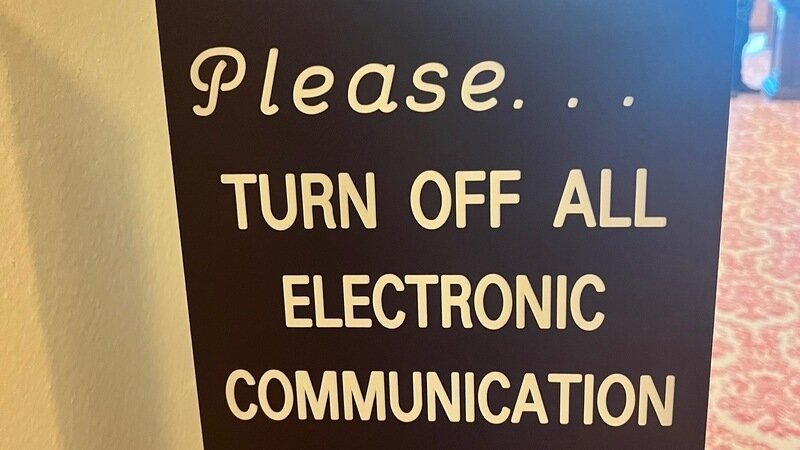
I just wanted to take the time to make this very clear not only to the community members in attendance today, but to some members of the board who seem to think that this is not allowed. Not only is it allowed, but it is also our legal right so long as our doing so does not impede these proceedings. That little sign (referencing the “Please…turn off all electronic communication devices” placard posted at all OCB meetings)….I would politely urge the board to consider revising as it serves only to confuse your constituents. It is a deeply unethical misrepresentation to proclaim public proceedings as “off limits” to being recorded by a peaceful public. Thank you.
Of course it is the County Board’s job to record all proceedings. It is also their job to urge their constituents to peacefully document them. It is, however, not their job to tell community members that it is not allowed.
Similarly, the other public comment (shared by Ms. Ullrich), was not just simply about the duty of the Board to share the contents of their meetings and studies on the subject of data centers. It was specifically regarding the progress of the Board to secure the generation of a 3-Dimensional Ground Water Topography Model as it relates to the proposed data center near the nuclear facility in Byron. (This was met by eye rolling by one board member, in particular.)
To be sure, "3-dimensional (3D) groundwater topography models are superior to traditional 2D water table/aquifer studies in Illinois because they integrate complex, heterogeneous subsurface geology—specifically stacked glacial drift aquifers and confining units—rather than assuming a simple, subdued replica of the surface topography. While 2D water table maps only show the surface of an unconfined aquifer, 3D models (such as those developed by the Illinois State Geological Survey) map multiple aquifer layers, allowing for accurate simulation of 3D flow, vertical leakage, and contaminant transport.”
Furthermore, "Key Advantages of 3D Groundwater Models in Illinois include the following:
Subsurface Geological Accuracy: Unlike 2D models, 3D models map complex, hidden features like buried bedrock valleys and sand/gravel lenses within glacial till, which are critical to identifying aquifer extents in Illinois.
Vertical Flow Simulation: 3D models capture vertical hydraulic gradients, whereas 2D models assume horizontal flow, making 3D superior for analyzing leakage between shallow and deep aquifers (e.g., the Mahomet Aquifer).
High-Capacity Well Planning: 3D models can simulate the impact of high-capacity groundwater withdrawals on multiple depths simultaneously, allowing for the identification of sustainable yield in areas like the southeastern Chicago suburbs.
Contaminant Transport Modeling: 3D modeling allows for predicting how point-source contaminants (e.g., nitrates) move in three dimensions, critical for protecting groundwater quality.
Improved Decision-Making Visualization: 3D geological models, such as those used in Boone County, provide intuitive visualizations for non-technical stakeholders to understand complex subsurface structures and make better land-use decisions.
Application in Illinois
The Prairie Research Institute (PRI) and ISGS have increasingly favored 3D modeling for critical water supply planning in areas such as the Mahomet Aquifer, Kane County, and McHenry County. These 3D models were essential to identify that water levels would be unable to meet future demand by 2030 in certain areas.”
Please know how grateful we are for the continued diligence and attention that our community members have exercised in voicing their concerns regarding the possibility of data centers coming to our river valley in Ogle County. All people deserve to be heard without ridicule, condescension or intimidation from their elected representatives and we sincerely hope that select members of the Ogle County Board will do better to exercise more civility and polity in the future.
See you Tuesday the 21st at 5:30pm!