Save Our Ancestral Land and Community.
The Issue
SAVE OUR MOUNTAINS, ANCESTRAL LANDS & COMMUNITIES
Protect Zambales, Tarlac, Pampanga, Bulacan , Nueva Vizcaya, all in Cagayan Valley, in Rizal to Metro Manila
To: Relevant Philippine national, regional and local government authorities, environmental and Indigenous Peoples' agencies, and other decision-makers with jurisdiction over the affected areas.
OUR APPEAL
We, the undersigned citizens, Indigenous Peoples, community members, environmental advocates, farmers, families and concerned residents, respectfully call for urgent government action to protect our mountains, forests, watersheds, rivers, ancestral lands and communities in Zambales, Tarlac, Pampanga, Bulacan, Nueva Vizcaya to Cagayan Valley, Rizal and to Metro Manila.
Our communities are interconnected.
What happens in upland forests and watersheds can have consequences downstream. Rainfall, runoff, rivers, drainage systems and floodplains cross provincial boundaries. Therefore, environmental decisions affecting one area should not be considered in isolation when they may have consequences for communities downstream.
We are particularly concerned about large-scale development and land conversion in environmentally sensitive and mountainous areas, including proposed or ongoing solar-farm developments and other activities that may involve clearing, excavation, alteration of natural drainage, or conversion of land.
We are not against renewable energy.
We support responsible renewable energy development that respects Indigenous Peoples' rights, environmental laws, watershed protection, community safety and due process.
Our concern is development that may proceed without sufficient protection of the environment and affected communities. Large Dredging in the ocean. It was a massive erosion.
🌳 WHY WE ARE CONCERNED
1. PROTECTION OF ANCESTRAL LANDS
Indigenous Peoples have rights recognized under Republic Act No. 8371, the Indigenous Peoples' Rights Act (IPRA).
Any development affecting ancestral domains must respect applicable Indigenous Peoples' rights and the required legal processes, including Free, Prior and Informed Consent (FPIC) where applicable.
We call for transparent verification of the legal status of affected ancestral lands and compliance with all applicable NCIP requirements.
2. PROTECTION OF MOUNTAINS AND FORESTS
Mountain forests and watersheds are essential natural systems.
They help regulate water, reduce erosion, support biodiversity and sustain communities.
We therefore ask authorities to carefully examine whether proposed land clearing, excavation, road construction, solar installations or other development could adversely affect these functions.
3. FLOODING AND DOWNSTREAM COMMUNITIES
Flooding does not recognize political boundaries.
Communities in Pampanga, Bulacan and Metro Manila, as well as other areas connected through river and drainage systems, can be affected by rainfall, river overflow, runoff and flooding.
The Pampanga River system, for example, extends across multiple provinces and connects upstream and downstream communities. This demonstrates why watershed and flood-management decisions require a basin-wide perspective, rather than looking at individual projects separately.
4. ENVIRONMENTAL AND PUBLIC-SAFETY REVIEW
We call for government agencies to determine whether all applicable:
Environmental Compliance Certificates (ECCs)
environmental permits
land-use approvals
building and development permits
Indigenous Peoples' requirements
watershed and forest regulations
disaster-risk considerations
have been properly complied with.
Where there are allegations of violations or significant environmental risks, we ask for an impartial investigation.
✋ OUR DEMANDS
We respectfully call upon the appropriate government authorities to:
1. CONDUCT A FULL AND INDEPENDENT INVESTIGATION
Investigate proposed and ongoing large-scale developments affecting mountains, forests, watersheds and ancestral lands in the concerned areas.
2. REVIEW ENVIRONMENTAL PERMITS AND ECCs
Review applicable ECCs, environmental permits and conditions to determine whether they remain appropriate and are being complied with.
3. VERIFY INDIGENOUS PEOPLES' RIGHTS
Ensure that the rights of Indigenous Peoples under R.A. 8371/IPRA are fully respected and that required FPIC and other legal processes have been properly undertaken where applicable.
4. PROTECT CRITICAL WATERSHEDS
Identify and protect forests, watersheds, waterways, steep slopes and other environmentally sensitive areas from inappropriate development.
5. REQUIRE PROPER FLOOD AND HYDROLOGICAL ASSESSMENTS
Require qualified authorities to assess possible effects of major land conversion and development on:
surface runoff
drainage
erosion
sedimentation
rivers
downstream flooding
watershed function
6. HOLD MEANINGFUL PUBLIC CONSULTATIONS
Affected Indigenous communities, residents, farmers and other stakeholders must have meaningful opportunities to receive information, raise concerns and participate in decisions affecting their communities.
7. REVIEW LAND AGREEMENTS AND LAND-USE AUTHORITY
Where appropriate, review the legal status of land agreements, leases, permits, conversions and other authorities connected with the developments.
8. STOP OR SUSPEND ACTIVITIES WHEN LEGALLY WARRANTED
Where authorities determine that a project is operating without required permits, violating environmental conditions, or creating unacceptable environmental or public-safety risks, take appropriate enforcement action, including suspension or cessation where authorized by law.
9. REQUIRE REHABILITATION WHERE DAMAGE HAS OCCURRED
Where environmental damage is established, require responsible parties to undertake appropriate rehabilitation, restoration and mitigation measures under applicable laws.
10. PROTECT COMMUNITIES FROM FUTURE FLOOD AND ENVIRONMENTAL RISKS
Develop coordinated watershed and disaster-risk strategies that recognize the connection between upland areas and downstream communities.
❤️ THIS IS ABOUT MORE THAN ONE PROVINCE
We are bringing this appeal together because our environment is interconnected.
A mountain community, an Indigenous community, a farmer, a family living beside a river, and a resident of a highly urbanized area may live hundreds of kilometers apart—but they can still be connected by the same natural systems.
Zambales.
Tarlac.
Pampanga.
Bulacan.
Metro Manila.
We ask our government leaders to listen before irreversible environmental damage occurs.
We ask for transparency.
We ask for accountability.
We ask for respect for Indigenous Peoples.
We ask for science-based environmental assessment.
And most importantly, we ask for the protection of life, livelihood, ancestral lands, forests, watersheds and communities.
WE ARE NOT AGAINST PROGRESS.
WE ARE FOR RESPONSIBLE DEVELOPMENT.
WE ARE FOR OUR PEOPLE.
WE ARE FOR OUR ENVIRONMENT.
WE ARE FOR FUTURE GENERATIONS.
Please sign and share this petition.
Our voices are stronger when we stand together. 🇵🇭🌳🙏
🎯 Suggested Change.org target
For the Decision Makers, I would start with the appropriate government authorities rather than naming only one person. Change.org allows multiple decision-makers and recommends choosing people who actually have authority to act. �
Change.org +1
We can include the relevant:
DENR
DENR-EMB
NCIP
DA
Provincial Governments
Municipal/City Governments
Disaster Risk Reduction and Management offices
other agencies with jurisdiction over the specific project or affected area
🇵🇭 SAVE OUR MOUNTAINS, ANCESTRAL LANDS & COMMUNITIES
Protect Zambales, Tarlac, Pampanga, Bulacan & Metro Manila
A CALL FOR TRANSPARENCY, ACCOUNTABILITY, ENVIRONMENTAL PROTECTION AND RESPECT FOR INDIGENOUS PEOPLES' RIGHTS
To the Government of the Philippines, DENR, NCIP, DA, DAR, BCDA, national and regional government authorities, provincial and local governments, and all agencies and decision-makers with jurisdiction over the affected areas:
We, the undersigned citizens, Indigenous Peoples, farmers, residents, environmental advocates and concerned Filipinos, respectfully call for urgent and transparent government action to protect our mountains, forests, watersheds, rivers, ancestral lands, agricultural areas, livelihoods and communities.
We are bringing together concerns from Zambales, Tarlac, Pampanga, Bulacan Nueva Vizcaya, Cagayan Valley, Rizal and to Metro Manila because environmental systems do not stop at provincial boundaries.
Rainfall, watersheds, rivers, drainage systems and floodplains connect communities from upland areas to downstream areas.
🌳 WE ARE NOT AGAINST PROGRESS.
We support responsible renewable energy, technology, investment, employment and economic development.
But development must be responsible, transparent, lawful, environmentally sound and respectful of the rights of affected communities.
We believe progress should not require people to sacrifice their ancestral lands, livelihoods, water, environment, cultural heritage or safety.
🛖 PROTECT INDIGENOUS PEOPLES AND ANCESTRAL LANDS
Indigenous Peoples have rights recognized under Republic Act No. 8371 — the Indigenous Peoples' Rights Act (IPRA).
We call for transparent verification of ancestral-domain claims and full compliance with all applicable legal requirements, including Free, Prior and Informed Consent (FPIC) where legally required.
Affected Indigenous communities must receive sufficient information and meaningful opportunities to participate in decisions affecting their communities, homes, livelihoods, culture and ancestral lands.
🌳 PROTECT OUR MOUNTAINS, FORESTS AND WATERSHEDS
Our mountains and forests are essential to the health of our watersheds and communities.
We call for proper assessment of development activities that may involve:
land clearing
excavation
road construction
land conversion
large-scale infrastructure
solar installations
industrial development
changes to natural drainage
These activities should be evaluated for their possible effects on erosion, runoff, sedimentation, water supply, biodiversity, flooding and downstream communities.
💧 PROTECT OUR WATER AND RIVERS
Water is essential to every community.
We call for transparent assessment of how major developments may affect:
surface water • groundwater • rivers • drainage • irrigation • agriculture • drinking water • wastewater • downstream communities
No community should have to discover only after development begins that its water resources may be affected.
🌊 FLOODING AND DOWNSTREAM COMMUNITIES
Flooding does not recognize political boundaries.
Communities in Pampanga, Bulacan and Metro Manila, as well as other connected areas, may be affected by rainfall, river overflow, runoff, drainage and floodplain conditions.
We therefore call for basin-wide and watershed-based planning, rather than looking at major developments as isolated projects.
⚠️ ADDITIONAL CONCERN:
PAX SILICA / CLARK ADVANCED MANUFACTURING PARK — CAPAS, TARLAC
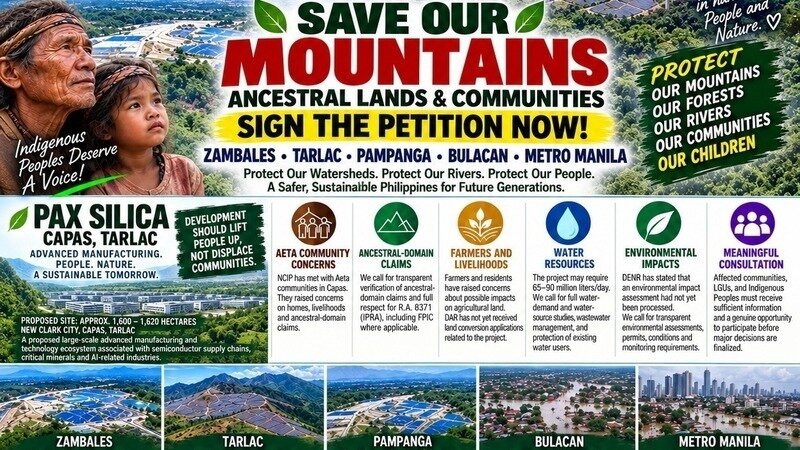
We also call for transparency, meaningful consultation and independent assessment concerning the proposed Pax Silica-related advanced manufacturing development in New Clark City, Capas, Tarlac.
The proposed industrial development has been described as approximately 1,600 hectares, with the New Clark City site intended to host advanced manufacturing and technology-related investments connected to the broader Pax Silica initiative. �
Philippine News Agency +1
We recognize the potential benefits of semiconductor manufacturing, advanced technology, employment and investment.
We are not against technology or economic development.
However, a development of this scale deserves complete transparency concerning its potential effects on Indigenous Peoples, farmers, residents, water resources, agriculture, environment and local communities.
🛖 AETA COMMUNITIES IN CAPAS
The NCIP has already held a dialogue with Aeta Hungey Indigenous Cultural Communities/Indigenous Peoples in Capas concerning their concerns about the proposed Pax Silica project.
According to NCIP, the community raised concerns involving possible effects on their homes, livelihoods and ancestral-domain claim. NCIP said these concerns would be conveyed to BCDA and that the communities had requested sufficient and clear information about the project. �
GMA Network
Other Aeta community representatives have publicly raised concerns about ancestral land, agriculture and cultural heritage. These are matters that we believe should be properly investigated and verified by the appropriate authorities, rather than dismissed or assumed either way. �
GMA Network
We therefore call for:
✅ transparent verification of ancestral-domain claims
✅ respect for R.A. 8371/IPRA
✅ compliance with applicable FPIC requirements
✅ protection of homes and livelihoods
✅ protection of cultural and burial sites
✅ meaningful participation of affected Indigenous communities
🌾 FARMERS AND AGRICULTURAL LAND
Farmers and residents have also raised concerns about possible effects on agricultural land and livelihoods.
At a House hearing on September 3, 2026, the Department of Agrarian Reform stated that it had not received any land-conversion application related to the Pax Silica hub at that time. �
GMA Network
The Department of Agriculture has also said it is still assessing the possible agricultural impact of the initiative. �
GMA Network
We therefore ask for complete transparency regarding:
What land will be affected?
What is its present land classification and use?
What approvals are required?
What agricultural impacts have been identified?
Which families and farmers could potentially be affected?
💧 WATER REQUIREMENTS
Water use is another major concern that deserves transparent answers.
Reports have cited projected water requirements of approximately 65–90 million liters per day for planned facilities, while BCDA has described plans involving surface-water harvesting, treatment, storage and recycling rather than groundwater intended for residential and agricultural use. �
GMA Network
Therefore, we ask authorities and project proponents to publicly explain:
💧 How much water will ultimately be required?
💧 Where will the water come from?
💧 What happens during drought?
💧 How will existing agricultural and residential users be protected?
💧 How will wastewater be treated?
💧 What independent studies support the sustainability of the proposed water system?
🌳 ENVIRONMENTAL ASSESSMENT
We also call for transparency regarding environmental review.
DENR has stated that an environmental impact assessment had not yet been processed for the Pax Silica hub as of August 26, 2026, while an Environmental Compliance Certificate had been issued for the development plan by BCDA. �
GMA Network
Because the proposed development is large-scale, we believe the public deserves clear information about all applicable environmental assessments, permits, conditions and monitoring requirements.
📢 MEANINGFUL PUBLIC CONSULTATION
Consultation must include the people who live in the affected communities.
The Mayor of Capas has publicly raised concerns about the lack of consultation with the local government regarding the planned Pax Silica hub. �
GMA Network
We therefore call for meaningful consultation involving:
Aeta Indigenous communities
farmers
affected residents
barangays
Municipality of Capas
Provincial Government of Tarlac
NCIP
DENR
DA
DAR
BCDA
environmental and community organizations
other relevant government agencies
We also recognize that BCDA and NCIP are currently updating the community census in Sitio Sapang Kawayan in preparation for the proposed Clark Advanced Manufacturing Park. BCDA says this is intended to provide a more accurate picture of the communities in the proposed project area before further development plans move forward. �
Philippine News Agency
✋ OUR DEMANDS
We respectfully call upon the appropriate authorities to:
1. CONDUCT PROPER AND INDEPENDENT INVESTIGATIONS
Investigate the concerns raised by affected Indigenous Peoples, farmers, residents and communities.
2. PROTECT INDIGENOUS PEOPLES' RIGHTS
Ensure compliance with R.A. 8371/IPRA and applicable FPIC requirements.
3. PROTECT ANCESTRAL LANDS
Verify ancestral-domain claims transparently and protect legitimate Indigenous Peoples' rights.
4. PROTECT FARMERS AND LIVELIHOODS
Accurately identify potentially affected families and protect their lawful rights and livelihoods.
5. REVIEW ENVIRONMENTAL REQUIREMENTS
Ensure that all applicable environmental assessments, ECC conditions, permits and monitoring requirements are properly reviewed and complied with.
6. PROTECT WATER RESOURCES
Require transparent water-demand, water-supply, wastewater and sustainability assessments.
7. PROTECT MOUNTAINS AND WATERSHEDS
Assess the effects of land conversion and major development on drainage, erosion, flooding, rivers and watershed functions.
8. HOLD MEANINGFUL PUBLIC CONSULTATIONS
Affected communities must have sufficient information and genuine opportunities to participate.
9. PROTECT CULTURAL AND SACRED SITES
Ensure that cultural sites, burial grounds and places important to Indigenous communities are identified and protected.
10. DISCLOSE LAND-USE AND DEVELOPMENT AUTHORIZATIONS
Make information about relevant land classifications, permits, agreements, applications and approvals publicly accessible to the extent allowed by law.
11. REQUIRE REHABILITATION WHERE ENVIRONMENTAL DAMAGE IS ESTABLISHED
Where damage is established, require appropriate rehabilitation, mitigation and restoration.
12. TAKE APPROPRIATE PRECAUTIONARY ACTION WHEN LEGALLY WARRANTED
Where serious environmental, public-safety or community-rights concerns remain unresolved, authorities should take appropriate lawful measures before irreversible impacts occur.
❤️ THIS IS BIGGER THAN ONE PROJECT
This petition is not about opposing progress.
It is about asking:
Can we develop renewable energy while protecting our mountains?
Can we build advanced technology industries while protecting Indigenous Peoples?
Can we create jobs while protecting farmers?
Can we attract investment while protecting our water?
Can we develop our country while protecting our environment?
YES.
We believe responsible development is possible.
But it requires:
TRANSPARENCY.
ACCOUNTABILITY.
SCIENCE-BASED ASSESSMENT.
MEANINGFUL CONSULTATION.
RESPECT FOR INDIGENOUS PEOPLES' RIGHTS.
PROTECTION OF OUR ENVIRONMENT.
RESPECT FOR PHILIPPINE LAW.
🇵🇭 ZAMBALES • TARLAC • PAMPANGA • BULACAN • METRO MANILA
Our mountains are connected.
Our watersheds are connected.
Our rivers are connected.
Our communities are connected.
And our future is connected.
OUR LAND. OUR PEOPLE. OUR FUTURE.
❤️ PLEASE SIGN AND SHARE THIS PETITION.
Every signature is a voice.
Every share helps bring awareness.
Together, we can ask the right questions and demand that they are properly answered.
👉 SIGN THE PETITION HERE:
📲 You can also scan the QR code on our poster.
🌳 PROTECT OUR MOUNTAINS
💧 PROTECT OUR WATER
🛖 RESPECT INDIGENOUS PEOPLES' RIGHTS
🌾 PROTECT OUR FARMERS
👨👩👧👦 PROTECT OUR COMMUNITIES
🇵🇭 PROTECT OUR CHILDREN'S FUTURE
FOR OUR PEOPLE • FOR NATURE • FOR A SUSTAINABLE PHILIPPINES
🙏 ONE VOICE CAN START A CONVERSATION. MANY VOICES CAN DEMAND THAT THE RIGHT QUESTIONS ARE ANSWERED.
Pls sign the Petition and share... https://c.org/GT7M5Zn9Mc
🎯 Signature goal
I suggest starting with:
10,000 signatures
Then, when we reach it, we can raise the goal to 25,000 → 50,000 → 100,000

100
The Issue
SAVE OUR MOUNTAINS, ANCESTRAL LANDS & COMMUNITIES
Protect Zambales, Tarlac, Pampanga, Bulacan , Nueva Vizcaya, all in Cagayan Valley, in Rizal to Metro Manila
To: Relevant Philippine national, regional and local government authorities, environmental and Indigenous Peoples' agencies, and other decision-makers with jurisdiction over the affected areas.
OUR APPEAL
We, the undersigned citizens, Indigenous Peoples, community members, environmental advocates, farmers, families and concerned residents, respectfully call for urgent government action to protect our mountains, forests, watersheds, rivers, ancestral lands and communities in Zambales, Tarlac, Pampanga, Bulacan, Nueva Vizcaya to Cagayan Valley, Rizal and to Metro Manila.
Our communities are interconnected.
What happens in upland forests and watersheds can have consequences downstream. Rainfall, runoff, rivers, drainage systems and floodplains cross provincial boundaries. Therefore, environmental decisions affecting one area should not be considered in isolation when they may have consequences for communities downstream.
We are particularly concerned about large-scale development and land conversion in environmentally sensitive and mountainous areas, including proposed or ongoing solar-farm developments and other activities that may involve clearing, excavation, alteration of natural drainage, or conversion of land.
We are not against renewable energy.
We support responsible renewable energy development that respects Indigenous Peoples' rights, environmental laws, watershed protection, community safety and due process.
Our concern is development that may proceed without sufficient protection of the environment and affected communities. Large Dredging in the ocean. It was a massive erosion.
🌳 WHY WE ARE CONCERNED
1. PROTECTION OF ANCESTRAL LANDS
Indigenous Peoples have rights recognized under Republic Act No. 8371, the Indigenous Peoples' Rights Act (IPRA).
Any development affecting ancestral domains must respect applicable Indigenous Peoples' rights and the required legal processes, including Free, Prior and Informed Consent (FPIC) where applicable.
We call for transparent verification of the legal status of affected ancestral lands and compliance with all applicable NCIP requirements.
2. PROTECTION OF MOUNTAINS AND FORESTS
Mountain forests and watersheds are essential natural systems.
They help regulate water, reduce erosion, support biodiversity and sustain communities.
We therefore ask authorities to carefully examine whether proposed land clearing, excavation, road construction, solar installations or other development could adversely affect these functions.
3. FLOODING AND DOWNSTREAM COMMUNITIES
Flooding does not recognize political boundaries.
Communities in Pampanga, Bulacan and Metro Manila, as well as other areas connected through river and drainage systems, can be affected by rainfall, river overflow, runoff and flooding.
The Pampanga River system, for example, extends across multiple provinces and connects upstream and downstream communities. This demonstrates why watershed and flood-management decisions require a basin-wide perspective, rather than looking at individual projects separately.
4. ENVIRONMENTAL AND PUBLIC-SAFETY REVIEW
We call for government agencies to determine whether all applicable:
Environmental Compliance Certificates (ECCs)
environmental permits
land-use approvals
building and development permits
Indigenous Peoples' requirements
watershed and forest regulations
disaster-risk considerations
have been properly complied with.
Where there are allegations of violations or significant environmental risks, we ask for an impartial investigation.
✋ OUR DEMANDS
We respectfully call upon the appropriate government authorities to:
1. CONDUCT A FULL AND INDEPENDENT INVESTIGATION
Investigate proposed and ongoing large-scale developments affecting mountains, forests, watersheds and ancestral lands in the concerned areas.
2. REVIEW ENVIRONMENTAL PERMITS AND ECCs
Review applicable ECCs, environmental permits and conditions to determine whether they remain appropriate and are being complied with.
3. VERIFY INDIGENOUS PEOPLES' RIGHTS
Ensure that the rights of Indigenous Peoples under R.A. 8371/IPRA are fully respected and that required FPIC and other legal processes have been properly undertaken where applicable.
4. PROTECT CRITICAL WATERSHEDS
Identify and protect forests, watersheds, waterways, steep slopes and other environmentally sensitive areas from inappropriate development.
5. REQUIRE PROPER FLOOD AND HYDROLOGICAL ASSESSMENTS
Require qualified authorities to assess possible effects of major land conversion and development on:
surface runoff
drainage
erosion
sedimentation
rivers
downstream flooding
watershed function
6. HOLD MEANINGFUL PUBLIC CONSULTATIONS
Affected Indigenous communities, residents, farmers and other stakeholders must have meaningful opportunities to receive information, raise concerns and participate in decisions affecting their communities.
7. REVIEW LAND AGREEMENTS AND LAND-USE AUTHORITY
Where appropriate, review the legal status of land agreements, leases, permits, conversions and other authorities connected with the developments.
8. STOP OR SUSPEND ACTIVITIES WHEN LEGALLY WARRANTED
Where authorities determine that a project is operating without required permits, violating environmental conditions, or creating unacceptable environmental or public-safety risks, take appropriate enforcement action, including suspension or cessation where authorized by law.
9. REQUIRE REHABILITATION WHERE DAMAGE HAS OCCURRED
Where environmental damage is established, require responsible parties to undertake appropriate rehabilitation, restoration and mitigation measures under applicable laws.
10. PROTECT COMMUNITIES FROM FUTURE FLOOD AND ENVIRONMENTAL RISKS
Develop coordinated watershed and disaster-risk strategies that recognize the connection between upland areas and downstream communities.
❤️ THIS IS ABOUT MORE THAN ONE PROVINCE
We are bringing this appeal together because our environment is interconnected.
A mountain community, an Indigenous community, a farmer, a family living beside a river, and a resident of a highly urbanized area may live hundreds of kilometers apart—but they can still be connected by the same natural systems.
Zambales.
Tarlac.
Pampanga.
Bulacan.
Metro Manila.
We ask our government leaders to listen before irreversible environmental damage occurs.
We ask for transparency.
We ask for accountability.
We ask for respect for Indigenous Peoples.
We ask for science-based environmental assessment.
And most importantly, we ask for the protection of life, livelihood, ancestral lands, forests, watersheds and communities.
WE ARE NOT AGAINST PROGRESS.
WE ARE FOR RESPONSIBLE DEVELOPMENT.
WE ARE FOR OUR PEOPLE.
WE ARE FOR OUR ENVIRONMENT.
WE ARE FOR FUTURE GENERATIONS.
Please sign and share this petition.
Our voices are stronger when we stand together. 🇵🇭🌳🙏
🎯 Suggested Change.org target
For the Decision Makers, I would start with the appropriate government authorities rather than naming only one person. Change.org allows multiple decision-makers and recommends choosing people who actually have authority to act. �
Change.org +1
We can include the relevant:
DENR
DENR-EMB
NCIP
DA
Provincial Governments
Municipal/City Governments
Disaster Risk Reduction and Management offices
other agencies with jurisdiction over the specific project or affected area
🇵🇭 SAVE OUR MOUNTAINS, ANCESTRAL LANDS & COMMUNITIES
Protect Zambales, Tarlac, Pampanga, Bulacan & Metro Manila
A CALL FOR TRANSPARENCY, ACCOUNTABILITY, ENVIRONMENTAL PROTECTION AND RESPECT FOR INDIGENOUS PEOPLES' RIGHTS
To the Government of the Philippines, DENR, NCIP, DA, DAR, BCDA, national and regional government authorities, provincial and local governments, and all agencies and decision-makers with jurisdiction over the affected areas:
We, the undersigned citizens, Indigenous Peoples, farmers, residents, environmental advocates and concerned Filipinos, respectfully call for urgent and transparent government action to protect our mountains, forests, watersheds, rivers, ancestral lands, agricultural areas, livelihoods and communities.
We are bringing together concerns from Zambales, Tarlac, Pampanga, Bulacan Nueva Vizcaya, Cagayan Valley, Rizal and to Metro Manila because environmental systems do not stop at provincial boundaries.
Rainfall, watersheds, rivers, drainage systems and floodplains connect communities from upland areas to downstream areas.
🌳 WE ARE NOT AGAINST PROGRESS.
We support responsible renewable energy, technology, investment, employment and economic development.
But development must be responsible, transparent, lawful, environmentally sound and respectful of the rights of affected communities.
We believe progress should not require people to sacrifice their ancestral lands, livelihoods, water, environment, cultural heritage or safety.
🛖 PROTECT INDIGENOUS PEOPLES AND ANCESTRAL LANDS
Indigenous Peoples have rights recognized under Republic Act No. 8371 — the Indigenous Peoples' Rights Act (IPRA).
We call for transparent verification of ancestral-domain claims and full compliance with all applicable legal requirements, including Free, Prior and Informed Consent (FPIC) where legally required.
Affected Indigenous communities must receive sufficient information and meaningful opportunities to participate in decisions affecting their communities, homes, livelihoods, culture and ancestral lands.
🌳 PROTECT OUR MOUNTAINS, FORESTS AND WATERSHEDS
Our mountains and forests are essential to the health of our watersheds and communities.
We call for proper assessment of development activities that may involve:
land clearing
excavation
road construction
land conversion
large-scale infrastructure
solar installations
industrial development
changes to natural drainage
These activities should be evaluated for their possible effects on erosion, runoff, sedimentation, water supply, biodiversity, flooding and downstream communities.
💧 PROTECT OUR WATER AND RIVERS
Water is essential to every community.
We call for transparent assessment of how major developments may affect:
surface water • groundwater • rivers • drainage • irrigation • agriculture • drinking water • wastewater • downstream communities
No community should have to discover only after development begins that its water resources may be affected.
🌊 FLOODING AND DOWNSTREAM COMMUNITIES
Flooding does not recognize political boundaries.
Communities in Pampanga, Bulacan and Metro Manila, as well as other connected areas, may be affected by rainfall, river overflow, runoff, drainage and floodplain conditions.
We therefore call for basin-wide and watershed-based planning, rather than looking at major developments as isolated projects.
⚠️ ADDITIONAL CONCERN:
PAX SILICA / CLARK ADVANCED MANUFACTURING PARK — CAPAS, TARLAC
We also call for transparency, meaningful consultation and independent assessment concerning the proposed Pax Silica-related advanced manufacturing development in New Clark City, Capas, Tarlac.
The proposed industrial development has been described as approximately 1,600 hectares, with the New Clark City site intended to host advanced manufacturing and technology-related investments connected to the broader Pax Silica initiative. �
Philippine News Agency +1
We recognize the potential benefits of semiconductor manufacturing, advanced technology, employment and investment.
We are not against technology or economic development.
However, a development of this scale deserves complete transparency concerning its potential effects on Indigenous Peoples, farmers, residents, water resources, agriculture, environment and local communities.
🛖 AETA COMMUNITIES IN CAPAS
The NCIP has already held a dialogue with Aeta Hungey Indigenous Cultural Communities/Indigenous Peoples in Capas concerning their concerns about the proposed Pax Silica project.
According to NCIP, the community raised concerns involving possible effects on their homes, livelihoods and ancestral-domain claim. NCIP said these concerns would be conveyed to BCDA and that the communities had requested sufficient and clear information about the project. �
GMA Network
Other Aeta community representatives have publicly raised concerns about ancestral land, agriculture and cultural heritage. These are matters that we believe should be properly investigated and verified by the appropriate authorities, rather than dismissed or assumed either way. �
GMA Network
We therefore call for:
✅ transparent verification of ancestral-domain claims
✅ respect for R.A. 8371/IPRA
✅ compliance with applicable FPIC requirements
✅ protection of homes and livelihoods
✅ protection of cultural and burial sites
✅ meaningful participation of affected Indigenous communities
🌾 FARMERS AND AGRICULTURAL LAND
Farmers and residents have also raised concerns about possible effects on agricultural land and livelihoods.
At a House hearing on September 3, 2026, the Department of Agrarian Reform stated that it had not received any land-conversion application related to the Pax Silica hub at that time. �
GMA Network
The Department of Agriculture has also said it is still assessing the possible agricultural impact of the initiative. �
GMA Network
We therefore ask for complete transparency regarding:
What land will be affected?
What is its present land classification and use?
What approvals are required?
What agricultural impacts have been identified?
Which families and farmers could potentially be affected?
💧 WATER REQUIREMENTS
Water use is another major concern that deserves transparent answers.
Reports have cited projected water requirements of approximately 65–90 million liters per day for planned facilities, while BCDA has described plans involving surface-water harvesting, treatment, storage and recycling rather than groundwater intended for residential and agricultural use. �
GMA Network
Therefore, we ask authorities and project proponents to publicly explain:
💧 How much water will ultimately be required?
💧 Where will the water come from?
💧 What happens during drought?
💧 How will existing agricultural and residential users be protected?
💧 How will wastewater be treated?
💧 What independent studies support the sustainability of the proposed water system?
🌳 ENVIRONMENTAL ASSESSMENT
We also call for transparency regarding environmental review.
DENR has stated that an environmental impact assessment had not yet been processed for the Pax Silica hub as of August 26, 2026, while an Environmental Compliance Certificate had been issued for the development plan by BCDA. �
GMA Network
Because the proposed development is large-scale, we believe the public deserves clear information about all applicable environmental assessments, permits, conditions and monitoring requirements.
📢 MEANINGFUL PUBLIC CONSULTATION
Consultation must include the people who live in the affected communities.
The Mayor of Capas has publicly raised concerns about the lack of consultation with the local government regarding the planned Pax Silica hub. �
GMA Network
We therefore call for meaningful consultation involving:
Aeta Indigenous communities
farmers
affected residents
barangays
Municipality of Capas
Provincial Government of Tarlac
NCIP
DENR
DA
DAR
BCDA
environmental and community organizations
other relevant government agencies
We also recognize that BCDA and NCIP are currently updating the community census in Sitio Sapang Kawayan in preparation for the proposed Clark Advanced Manufacturing Park. BCDA says this is intended to provide a more accurate picture of the communities in the proposed project area before further development plans move forward. �
Philippine News Agency
✋ OUR DEMANDS
We respectfully call upon the appropriate authorities to:
1. CONDUCT PROPER AND INDEPENDENT INVESTIGATIONS
Investigate the concerns raised by affected Indigenous Peoples, farmers, residents and communities.
2. PROTECT INDIGENOUS PEOPLES' RIGHTS
Ensure compliance with R.A. 8371/IPRA and applicable FPIC requirements.
3. PROTECT ANCESTRAL LANDS
Verify ancestral-domain claims transparently and protect legitimate Indigenous Peoples' rights.
4. PROTECT FARMERS AND LIVELIHOODS
Accurately identify potentially affected families and protect their lawful rights and livelihoods.
5. REVIEW ENVIRONMENTAL REQUIREMENTS
Ensure that all applicable environmental assessments, ECC conditions, permits and monitoring requirements are properly reviewed and complied with.
6. PROTECT WATER RESOURCES
Require transparent water-demand, water-supply, wastewater and sustainability assessments.
7. PROTECT MOUNTAINS AND WATERSHEDS
Assess the effects of land conversion and major development on drainage, erosion, flooding, rivers and watershed functions.
8. HOLD MEANINGFUL PUBLIC CONSULTATIONS
Affected communities must have sufficient information and genuine opportunities to participate.
9. PROTECT CULTURAL AND SACRED SITES
Ensure that cultural sites, burial grounds and places important to Indigenous communities are identified and protected.
10. DISCLOSE LAND-USE AND DEVELOPMENT AUTHORIZATIONS
Make information about relevant land classifications, permits, agreements, applications and approvals publicly accessible to the extent allowed by law.
11. REQUIRE REHABILITATION WHERE ENVIRONMENTAL DAMAGE IS ESTABLISHED
Where damage is established, require appropriate rehabilitation, mitigation and restoration.
12. TAKE APPROPRIATE PRECAUTIONARY ACTION WHEN LEGALLY WARRANTED
Where serious environmental, public-safety or community-rights concerns remain unresolved, authorities should take appropriate lawful measures before irreversible impacts occur.
❤️ THIS IS BIGGER THAN ONE PROJECT
This petition is not about opposing progress.
It is about asking:
Can we develop renewable energy while protecting our mountains?
Can we build advanced technology industries while protecting Indigenous Peoples?
Can we create jobs while protecting farmers?
Can we attract investment while protecting our water?
Can we develop our country while protecting our environment?
YES.
We believe responsible development is possible.
But it requires:
TRANSPARENCY.
ACCOUNTABILITY.
SCIENCE-BASED ASSESSMENT.
MEANINGFUL CONSULTATION.
RESPECT FOR INDIGENOUS PEOPLES' RIGHTS.
PROTECTION OF OUR ENVIRONMENT.
RESPECT FOR PHILIPPINE LAW.
🇵🇭 ZAMBALES • TARLAC • PAMPANGA • BULACAN • METRO MANILA
Our mountains are connected.
Our watersheds are connected.
Our rivers are connected.
Our communities are connected.
And our future is connected.
OUR LAND. OUR PEOPLE. OUR FUTURE.
❤️ PLEASE SIGN AND SHARE THIS PETITION.
Every signature is a voice.
Every share helps bring awareness.
Together, we can ask the right questions and demand that they are properly answered.
👉 SIGN THE PETITION HERE:
📲 You can also scan the QR code on our poster.
🌳 PROTECT OUR MOUNTAINS
💧 PROTECT OUR WATER
🛖 RESPECT INDIGENOUS PEOPLES' RIGHTS
🌾 PROTECT OUR FARMERS
👨👩👧👦 PROTECT OUR COMMUNITIES
🇵🇭 PROTECT OUR CHILDREN'S FUTURE
FOR OUR PEOPLE • FOR NATURE • FOR A SUSTAINABLE PHILIPPINES
🙏 ONE VOICE CAN START A CONVERSATION. MANY VOICES CAN DEMAND THAT THE RIGHT QUESTIONS ARE ANSWERED.
Pls sign the Petition and share... https://c.org/GT7M5Zn9Mc
🎯 Signature goal
I suggest starting with:
10,000 signatures
Then, when we reach it, we can raise the goal to 25,000 → 50,000 → 100,000
Petition Updates
Share this petition
Petition created on September 3, 2026