Don't Let the Future Look Like This! Alternative Designs for a Better Montrose

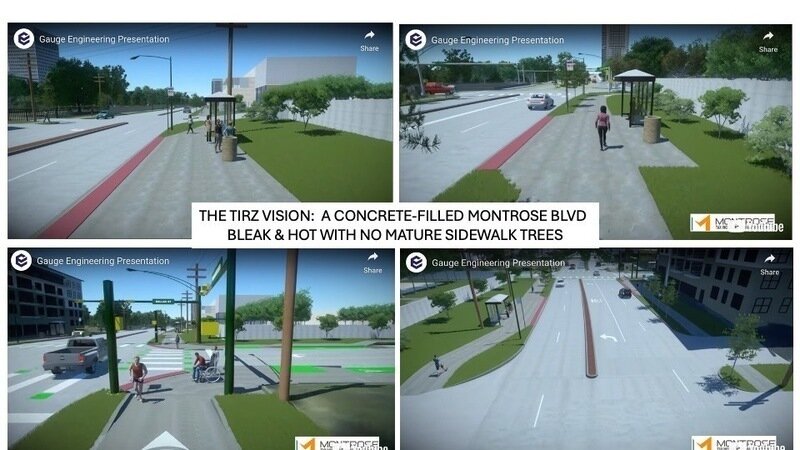
Their vision for Montrose Blvd is bleak and hot, with lots of concrete replacing our mature trees. Join us in advocating for changes to the current design for Montrose Blvd!
Please attend the next Montrose TIRZ public board meeting on Monday, April 15 at 6:30pm at St Stephen's Episcopal Church (1827 W Alabama St, Havens Center, Houston, TX 77098) or register here to attend online: https://tinyurl.com/2yu38p3e
Read below the latest info on their current design and our proposed alternatives which will not only save trees, but provide a less costly, simpler, and better design for Montrose.
Montrose Blvd Current Design
The TIRZ’s current design would:
- spend $15 million on only two blocks at the northern end of the boulevard
- “completely reconstruct” those two blocks by narrowing medians currently planted with majestic live oaks by 10 feet, shifting all the traffic lanes inward, and clearcutting all sidewalk trees: 59 in all, including three historic post oaks and many mature healthy live oaks, and building a sidewalk next to the Magnolia cemetery requiring removal of three historic live oaks, the Three Sisters of Montrose, each 160 years old.
- create a two-way, ten-foot path to nowhere to be shared by commuting cyclists and families walking with dogs and small children – traveling at dangerously divergent speeds.
We think the current design is bad for Montrose because it:
- is far too expensive for two blocks, at $15 million.
- leaves far too much of the boulevard reliant on the uncertainty of grant money to fund urgent sidewalk replacement work.
- is grossly overengineered, when a simpler design exists that meets community needs and saves the trees.
- greatly expands non-permeable concrete surfaces, totally unshaded, adding to the urban heat island effect.
- is likely to run Montrose Boulevard shops and restaurants out of business with years of construction and no funds to alleviate the financial impact.
- will set back existent tree canopies 40-50 years.
- is likely to drive extra traffic to quiet side streets residents currently use for walking dogs, strollers, etc.
- will create a “shared path” that puts both cyclists and pedestrians at risk.
Current Status in Planning and Funding
Since learning about the TIRZ’s current design in September, Montrose residents, including Save Montrose Live Oaks, have repeatedly asked the TIRZ to consider alternative plans that would leave the streets in place, replace and expand sidewalks, and preserve mature oaks. We are appealing to the City now, including City Council, because the TIRZ has refused to listen or to adopt any of the alternatives desired by a majority of Montrose citizens, over 4000 of whom have signed a petition with over 7800 total signatures, found here: www.change.org/SaveMontroseLiveOaks
The City recently issued a hold on all street redesign projects that would reduce lanes or lane width, yet engineers for the project at the March Montrose TIRZ board meeting asserted that the hold did not apply to the Montrose Boulevard Improvement Plan. Board members revealed at that meeting that the TIRZ had submitted the 100% plan to the City for final approval, without any board vote on the plan, even while claiming a desire to compromise with community members and a willingness to change the design, including preserving the three historic post oaks. The 100% plan makes none of these promised compromises. Further, the TIRZ board has indicated it will not make any changes to the current 100% plan unless the City requires it.
The TIRZ demonstrated its hardened position additionally with its submission on February 15, 2024 of a funding request to the Houston Galveston Area Council (H-GAC) for Phase 2 of this project which will continue the rest of the way down Montrose Blvd. to US 59. In its H-GAC submission, the TIRZ confirmed its intention to remove all trees on the east side of Montrose to at least Hawthorne Street. It also planned for dual 10-foot sidewalks that would leave no room for existent trees, disregarding the public outcry.
Save Montrose Live Oaks’ Suggested Alternatives for a Better Design
The City of Houston categorizes Montrose Boulevard as a major thoroughfare: “a street designed for fast, heavy traffic and intended to serve as a traffic artery of considerable length and continuity throughout the community.” It must remain so. Montrose Boulevard is a vital corridor to the Medical Center for ambulances and emergency vehicles traveling from points throughout central Houston. It’s also a corridor for public transit: Bus route 56 runs north to Crosstimbers and south through the Medical Center, crossing over 30 other bus routes.
Montrose Boulevard is also a neighborhood street, whose medians and sidewalks are lined with oaks, some of which residents planted many years ago, some of which we planted more recently, and we’ve watched them grow alongside our children. We care about preserving these trees, and we care about walkability, too. What Montrose residents want for our neighborhood matters.
The ideas below can help the TIRZ develop a better plan – one that preserves the trees of Montrose Boulevard while providing for the safety, accessibility and transportation needs of all Montrose residents and other Montrose Boulevard users.
This simpler design will also save significant taxpayer dollars, no longer having to spend the $15M currently planned just to reconstruct 2 blocks of Montrose Blvd. Savings could be spent much more wisely and to the benefit of all residents by making the rest of Montrose Blvd’s corners ADA-complaint with curb cuts and ramps.
1. Grant a sidewalk variance on the west side of Montrose Boulevard (between the Allen Parkway and West Dallas) in order to save the historic 160-year-old post oaks known as the Three Sisters:
- Ask again for a variance to omit the sidewalk on the west side of Montrose Boulevard that the last city administration previously denied.
- The current TIRZ plan would relocate power lines from the east side, where they currently run alongside the Ismaili Center, to the west side where the post oaks stand at the gate to Magnolia Cemetery. Shift the power line placement to ensure the trees are not damaged or leave them as-is on the east side.
2. Widen the sidewalks to 6 feet instead of 10 feet in the block between West Dallas and West Clay:
- Rebuild sidewalks on this block to widen to 6 feet, potentially narrowing to no less than 5 feet for certain trees. The project will still exceed ADA compliance while preserving nearly all existing oak trees on the west and east easements between West Dallas and West Clay.
- To achieve six feet sidewalks, or at least five feet for some trees, utilize root bridging as necessary. This technique allows a sidewalk to be built right up to the trunk of a tree, allowing the tree to grow while remaining smooth and virtually level.
- Provide any variances needed to allow the TIRZ to design the sidewalk and buffers within the “pedestrian realm” as defined in the City of Houston Infrastructure Design Manual.
- To reduce damage to the trees from over-trimming around power lines, use professional tree trimmers, not CenterPoint, and seek a partner such as Montrose Management District to help with the cost. Trees can meet safety standards while expanding above power lines.
3. Refrain from narrowing medians. Maintaining the current lane width, median width and pedestrian realm will:
- avoid cutting into median tree-root systems and removing much of the trees’ large branches and canopies to allow tall vehicles to pass underneath
- provide a safer place to wait on the median for pedestrians crossing the street
- protect the needed turning width for larger vehicles and first responders
- allow space for vehicles to yield to emergency vehicles
4. Build a safer crossing at West Clay:
- Install a pedestrian on-call flashing light / HAWK with a crosswalk on both sides of West Clay at Montrose Boulevard – as is used at many other pedestrian crossing locations in Houston – assuring safe passage for all cyclists, pedestrians, and wheelchair users.
- Employ crossing guards at this crossing for further safety during school zone hours, as is done at all other elementary schools in the area.
5. Ensure ample cycling facilities in neighborhood:
Montrose’s bike facilities have been transformed since Houston’s inaugural 2017 Bike Plan was adopted. A robust, intelligently designed bike network is happening now. That’s a worthy goal we support.
- The Montrose area now connects to 17 miles of recreational bike paths along Buffalo Bayou.
- There are four north-south bikeways built or soon to be built within a few blocks of Montrose Boulevard: Dedicated north-south on-street transport bikeways on Commonwealth and Waugh, dedicated shared on-street bikeway on Woodhead, and an on-street bikeway planned for Stanford.
- Going east-west, we have a dedicated on-street bikeway on West Dallas, a shared on-street bikeway on Hawthorne and a third proposed bikeway on Welch.
- The City’s Major Thoroughfare Freeway Plan (MTFP) states that multi-modal transportation does not mean putting every mode of transport on every block. Montrose Boulevard is not suited for expanded recreational nor transportation cycling, but neighboring streets are.
6. Leverage public transit for commuting cyclists in Montrose:
We propose, for commuters wishing to use the Montrose Boulevard corridor, free rides for cyclists and their bikes on the METRO buses on Montrose Boulevard to further promote multi-modal safe transportation, in partnership with METRO.
- Pursue congestion mitigation funding to support free rides for bicyclists.
- This can be a first project under a new comprehensive bike transportation plan that incorporates Metro and encourages multi-modal transportation. METRO can be a valuable partner.
Benefits of Adopting the Options above to Montrose Residents, Bicyclists, Pedestrians, & The Mobility-Impaired:
- Significant cost savings from avoiding full-blown road reconstruction, using less concrete, and leaving the lanes and medians as they are currently configured
- Preservation of the shade canopy & continued carbon sequestration
- Expansion of multi-modal transit options
- Reduced urban heat-island effect from less concrete and more mature trees
- Preservation of the unique character of Montrose Boulevard and our community
- Increased safety for residents, vehicles, cyclists and pedestrians and reduced crime.
- Preservation of habitat for wildlife and birds