Latest Info - AND - What you need to do NOW!

ACTION: We urgently need EVERYONE to send another email to the Montrose TIRZ board at info@montrosehtx.org protesting the tree loss this project will bring, as currently designed.
Please copy: districtc@houstontx.gov, districtk@houstontx.gov, atlarge2@houstontx.gov, atlarge5@houstontx.gov, publicworks@houstontx.gov, planningdepartment@houstontx.gov, savemontroseliveoaks@gmail.com
The TIRZ’s taxpayer-funded PR firm, Holloway Services, says they have received 276 emails since 9/18 to info@montrosehtx.org protesting the tree loss. I have asked that they post all of this input on the TIRZ website so that people’s written opinions are counted as much as the people who are able to regularly attend TIRZ board meetings in-person.
The TIRZ and Abbie Kamin are ignoring the feedback from the 6500+ of you who have signed the petition because they say many of you are from outside the area or are fake, even though I have provided the list of names and zip codes. YOU MUST WRITE AN EMAIL. DO IT NOW and MAKE YOUR VOICE COUNT!
What to say?
Let them know that you were not given sufficient advance information about this project and the tree destruction it brings. Ask that the project be placed on pause beyond Dallas St until the full impact to trees and traffic can be understood and until full plans for all of Montrose Blvd street are released. If you are among the people affected by the traffic changes or you own a business that will be impacted, please tell them that!
Read the ”Latest Info” section below about areas for potential compromise and include these suggestions in your email if you agree:
· Eliminate the sidewalk on the west side btwn Allen Pkwy and Dallas near the historic German cemetery
· Use 6” replacement trees, like what was done on Bagby for a similar walk/bike path project
· Build only to Dallas St for now to support the Ismaili center construction needs and schedule, but then pause until the full plans for the next segment to Westheimer are confirmed.
LATEST INFO: What happened at the 10/16 TIRZ board meeting and 10/17 site walk:
About two dozen people plus an unknown number on Zoom attended the 10/16 TIRZ board meeting to express opposition to the project moving forward with the current design until more representative input can be gathered.
A few people also participated in a site walk on Tuesday 10/17 accompanied by Joe Webb (Chair Montrose TIRZ), James Vick (SWA landscape architect), Mohammed Ali (lead engineer Gauge) and Craig Koehl (arborist).
We learned several things at the meeting and site walk that we want to pass along to keep you informed. You can also view the whole 10/16 meeting video on the TIRZ website and see the slides they presented. Here are the most important things we learned:
- The 9/29 TIRZ public statement about not removing healthy mature live oak trees was incorrect
The TIRZ corrected their prior project update memo statement that said “No healthy mature live oaks will be removed or replaced” in segment one. Their slide now reads “No healthy mature live oaks will be removed or replaced in the median”. This is no different than what has been planned all along and is exactly what we’ve reported (while being accused of spreading disinformation).
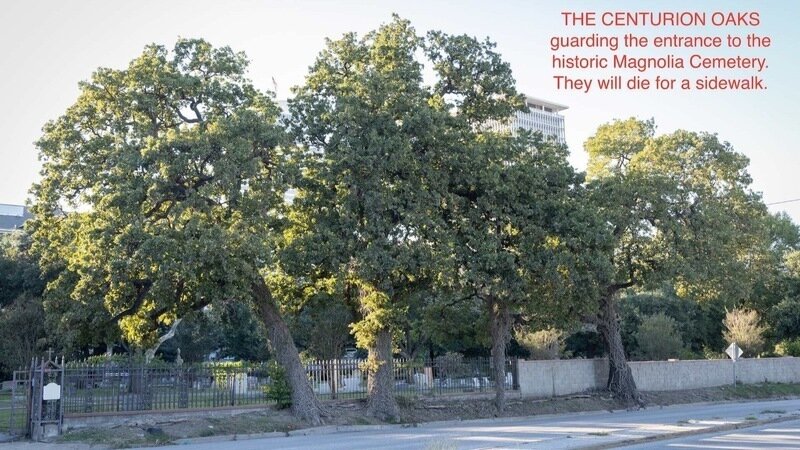
To be perfectly clear: Every single tree along both sides of Montrose from Allen Pkwy to W Clay will be cut down. This is 57 total trees: 27 of them are healthy Live Oaks that will be cut down because they are in the way of the planned sidewalk expansion and 2 are healthy century-old Post Oaks at the entrance of the historic German cemetery which will die because of the planned sidewalk construction.
There are 14 live oaks in the median that will be preserved, although with five feet being taken off each side of the median, many people have serious concerns about the longevity of those trees. The TIRZ assured us they will have a protection plan in place for each of those 14 trees so that they will survive in spite of the significant canopy cutting that will be required.
- No irrigation system, but now a commitment to a 4-year watering plan!
Some good news is that they have agreed to truck in water for the newly planted replacement trees for 4 years. Your advocacy and the public pressure is making a difference. Please keep it up.
- Implications for the rest of Montrose Blvd
We stressed that our biggest concern remains what the sidewalk design up to W Clay will mean when they finalize funding and continue the project beyond W Clay. We continue to be told that the project design beyond W Clay is completely amendable and that in no way does the construction of a 10’ wide shared-use sidewalk for the first two blocks of Montrose mean that it will continue any farther than that. Does that make sense to you? It doesn’t to many of us.
On the site walk, we had an architect, a landscape architect and a preservation professional to represent our questions and concerns. They also were seeking to find any areas for potential compromise. They dug deeper on this question of segment one’s implications for the rest of Montrose. Once again, they were reassured that the 10’ wide shared-use could possibly just end at W Clay. A bike path to nowhere? Seems strange, but I guess we will all see what comes to pass.
- New streetscape drawings coming soon
We pointed out the only streetscape renderings currently available show the same very wide sidewalk design all the way up to 59. That would mean literally hundreds of decades and century old live oaks coming down along both sides of the street. The lead engineer from Gauge assured us those rendering were from an earlier design. He promised that they were working on new streetscape renderings that would show how they intend to preserve trees. We are very keen to see that new design.
- Areas for potential compromise in Segment One
1. DON'T BUILD A SIDEWALK ALONG THE HISTORIC GERMAN CEMETERY
We understand that the TIRZ is open to the idea of re-considering whether a sidewalk is really needed on the west side of the street from West Dallas to Allen Parkway.
The two 150 year old 25-26” caliper healthy Post Oaks that guard the Magnolia cemetery entrance are doomed because per the TIRZ report “The project improvements, the sidewalk in particular, will likely irrecoverably impact these trees.” This very narrow area does not currently have a sidewalk. One of the main reasons it has been part of the design is because the City of Houston Public Work’s department requires builders who are putting in a new street to have sidewalks on each side. Because the TIRZ project moves the entire Montrose Blvd east towards the Ismaili center site, this is considered a new road and hence a Public Works variance would be needed to forego building a sidewalk on west side.
We think it is very much worth pursuing that variance. It would save the oldest trees, it would avoid building a sidewalk of questionable value and it would save money that could be spent on better replacement trees, or even potentially moving some of the trees which are capable of surviving. What’s more is that it preserves the dignity and sanctity of this historic German cemetery where Gus Wortham among other notable Houstonians is buried. You can write the public works department at publicworks@houstontx.gov or reach them on social media @HouPublicWorks to request this variance be granted.
2. BUILD ONLY FROM ALLEN PARKWAY TO DALLAS FOR NOW, THEN PAUSE TILL THE SEGMENT 2 DESIGN IS IN KNOWN
With the design beyond West Clay supposedly totally up in the air, does it make sense to build a 10’ shared-use sidewalk that goes to West Clay? We understand the need for the large sidewalk alongside the new Ismaili center, from Allen Parkway to Dallas, but wouldn’t it make more sense to stop at Dallas for now until the remainder of segment 2 (up to Westheimer) can be better evaluated and with the tree and traffic impact well understood before proceeding? We think so. If there is an honest opportunity to affect the segment 2 design, then that changed design would make much more sense starting at Dallas.
3. BIGGER REPLACEMENT TREES
The Deputy Chief of Staff for the Mayor, Walter Hambrick, suggested that we look at the replacement trees which were planted on Bagby near City Hall when they similarly had to remove some old growth Live Oaks for a shared pedestrian/bike path. He felt these replacement trees were not too bad, even though they are much smaller than many of the ones that had to be taken out.
We agree! These trees are much better than what is being proposed for the Montrose project. Instead of 3.5”trees, they put in ~6” caliper trees on Bagby. It makes a huge difference in how quickly the replacement trees begin to provide shade and how well they blend into the existing canopy of the surrounding areas. We think committing to put in 6” replacement trees would be a big win for Montrose and the Montrose TIRZ.
- Traffic safety updates
1. No traffic study for the nearby neighborhoods?! Just before the site walk started, a resident learned from Gauge that no traffic or safety studies were ever done for the residential side streets, only for Montrose itself. They committed to do a traffic study of Marconi and also Columbus on the east side, as we understand it.
2. There was also a great suggestion put forward by a couple of people at the 10/16 meeting to test the concept of closing the thru streets by doing it on a temporary basis first, to accurately determine the impact to the nearby neighborhoods and businesses, before proceeding with a permanent closure. There was no commitment one way or the other on this proposal.
3. Another big traffic safety concern that came up on the site walk is the placement of stop signs on the streets coming out to Montrose. The site walk team was told that the stop signs would be placed 16’ back from where each side street meets Montrose, behind the 10’ shared-use path and 6’ buffer zone.
This would mean that cars would stop at the stop sign and then need to move up to be able to see if it was safe to turn onto Montrose and to be ready to accelerate when they have an opening to merge into the Montrose traffic. Most of the day, cars will be blocking the envisioned path. Pedestrians of all mobility levels and cyclists will need to weave their way through however many cars are waiting for their change to turn. As it stands now, most drivers roll through the stop signs and we do not think the envisioned shared-use path makes that less likely, we think it makes it a worse safety hazard. This plan is an accident waiting to happen and since safety is the goal of many of these changes, it is worth another review and perhaps a test to see if this is really a good idea.
4. We have also suggested to the very vocal parents from Wharton Elementary who are advocating in favor of this project so that their children can cross Montrose at W. Clay that they do what most people do in order to cross major streets safely: Go to the nearest crosswalk with a traffic light. In this case, it's not even out of the way. The nearest street to cross Montrose safely and legally is West Gray which leads directly to the front door of the Wharton school! We think encouraging and role modeling for children to cross a major street where there is no traffic light to stop the cars is not a safe practice.
Communication failure and suggestions for improvement
The overwhelming message on 10/16 was how blind-sided half the room felt about the project in general and the impact to trees and side street safety in particular.
Many business owners in the area are also just now becoming aware of the tree and traffic flow implications of this project, as well as the upheaval their businesses will experience during the construction process. The TIRZ is just now beginning to hear from them - more evidence of the need for much better community engagement and communications.
SIGNAGE is the answer to avoid this in the future!
The suggestion has been raised several times now that whenever a TIRZ project which has major potential implications to a neighborhood’s traffic flow, drainage, safety, or involves the loss of numerous trees is in the planning stages, there should be signs put up on the intended site. Not at the 90% engineering plan completion phase but at the very start when there is still a genuine opportunity for change.
We intend to push the requirement for advance information signage at city council and all TIRZ boards across Houston. This weekend, we spoke to Martha Castex-Tatum the city council person for District K who is Chairperson for the Economic Development committee (which the TIRZ falls under). We will be meeting with her shortly to discuss this project’s failings and how to prevent future repeats.