Fobbed off, bought off, ripped off: answers required

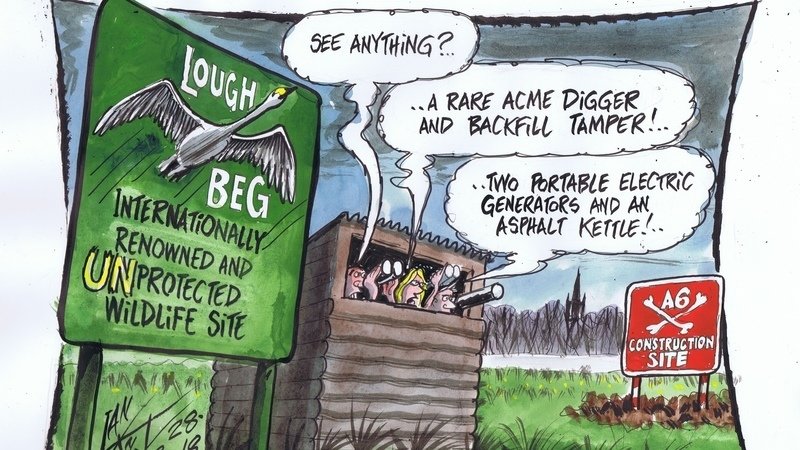
Incredible as it may seem, the construction of the A6 dual carriageway through Ireland’s most important site for Icelandic Whooper Swans carries the Royal Society for the Protection of Bird’s seal of approval. ‘An opportunity for further strategic buy-in’ is how RSPB views this environmental desecration.
Across the world organisations are fighting to ensure habitats that support rare and vulnerable wildlife are protected from the worst impacts of human development. Logging of Poland’s primeval forest has just been curtailed with the backing of Greenpeace whilst in Bulgaria, WWF is challenging the government’s plans for a 12-fold increase in ski resorts in the Pirin National Park, the realm of bears and wolves. Ireland’s wetlands are our contribution towards global biodiversity: for bear, bison, wolf and lynx read Whooper Swan, Black-tailed Godwit, Golden Plover and Curlew.
Please consider asking RSPB for prompt and unambiguous answers:
· Lough Beg’s mosaic of wet grassland habitats supports the greatest diversity of freshwater birdlife in Ireland. The route will directly impact on more than 30 fields that are at the heart of the third most important site for migratory swans in the British Isles, the Creagh Meadows. Why has RSPB not worked to ensure that all of these wet grasslands are properly protected in accordance with EU nature law?
· Initially RSPB objected, quoting the EU nature laws. Days before the public inquiry RSPB conditionally withdrew its objection. A meeting behind closed doors followed with only the Department for Infrastructure and the public inquiry inspector present. What evidence was so compelling for you to conditionally withdraw your objection? Have those conditions been met in full prior to construction? Is there a record of that meeting with the public inquiry inspector?
· Why does RSPB view this road through the Creagh Meadows as ‘an opportunity for further strategic buy-in’? What does this mean for the Whooper Swans and other wildlife that are dependent on the wet grasslands and what evidence is there for RSPB to think birds like the Icelandic Greylag Goose, Lapwing and Golden Plover can find somewhere else to live when their traditional feeding grounds in the Creagh Meadows are lost to the footprint of the route?
· You have described as being acceptable mitigation for the direct loss of protected habitat: a tasteful swan viewing facility, nest boxes for tree sparrows, a 5-year PhD study and 3-years of post construction swan monitoring. Aren’t these measures more helpful for RSPB than for swans and does your understanding of the legal distinction between mitigation and compensation comply with the Birds and Habitats Directives?
· What land management is in place in perpetuity to compensate for the direct loss of habitat in the Creagh Meadows arising from the route RSPB regards as ‘an opportunity for further strategic buy-in’?
· How does removing field boundaries at a place called Gortgill, compensate for the degradation and fragmentation of the internationally important Creagh Meadows?
Please write to: Mike Clarke, Chief Executive & Kevin Cox, Chairman
RSPB, The Lodge, Sandy, Bedfordshire, SG19 2DL, UK
Mike.Clarke@rspb.org.uk
Kevin.Cox@rspb.org.uk
Looking for more information? RSPB have an open casework file on the routing of the A6, including RSPB Northern Ireland’s September 2016 briefing: https://www.rspb.org.uk/our-work/our-positions-and-casework/casework/cases/a6-dualling-proposals/
Postscript:
A legal review paper* published in July 2017 states ‘Decades of systemic failure to take environmental protection seriously has brought Northern Ireland to the brink of environmental, and now political and economic disaster.’
Public scrutiny of our environmental guardians is recommended. ‘There is a perception that some environmental Non-Governmental Organisations have lost some of their distinctiveness and independence and have become (or are becoming) like an arms-length public body that is only consulted, and listened to, on a selective basis by government.’
* Northern Ireland Legal Quarterly 68(2): Political, economic and environmental crisis in Northern Ireland - the true cost of environmental governance failures and opportunities for reform (pages 123-157)