Victories, Revelations, and What Comes Next

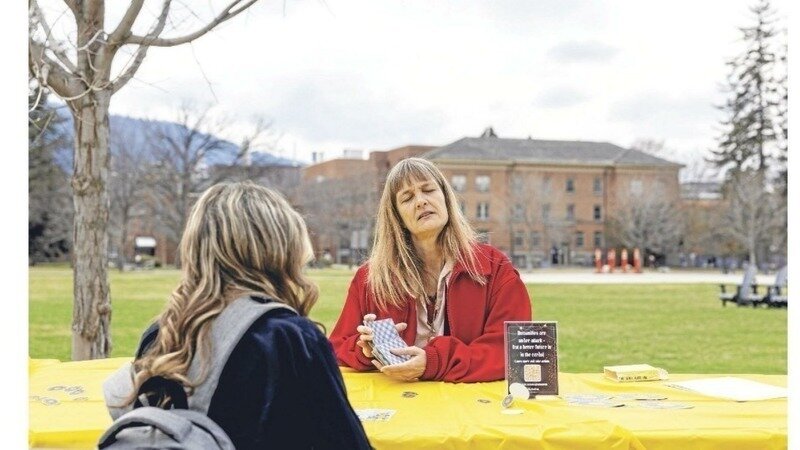
Our Cards Against Cuts event was a huge success! Countless people in the UM and Missoula community showed up to push back against cuts to the humanities, and we provided dozens of free readings and deep conversations in just an hour. We even made it to the front page of the Missoulian!
But that’s not all – the day after the event, the Faculty Senate at large joined their ASCRC and Grad Council subcommittees in voting overwhelmingly to reject the cuts! Many professors from across campus raised urgent concerns with the lack of transparency and flawed reasoning behind the administration’s proposals, as well as their devastating impact to UM’s liberal arts education.
Fact Checking the Administration: These Cuts Don’t Add Up
If you weren’t able to attend the event, you’re probably wondering what revelations we had in store. This semester, humanities students and faculty have been working tirelessly to engage in good faith with the Provost’s Office, the Graduate School, and shared governance to get basic facts, justifications, and clarifications regarding these proposals. Unfortunately, their story falls apart under the careful scrutiny that English students cultivate in our studies – raising grave concerns about the true motivations behind these weighty decisions.
Here are some of the most pressing errors and contradictions from the administration so far:
Claim: UM spokesperson Dave Kuntz claimed that program termination proposals were developed “in conjunction with faculty.” (Source: interview with NBC)
Verdict: False. These proposals were developed entirely without faculty or student input, and all feedback or attempts to collaborate have been stonewalled. The ASCRC, Grad Council, and Faculty Senate have voted to overwhelmingly reject these proposals, but the administration has made it clear that it does not care about the perspectives of students, faculty, and community members.
Claim: UM spokesperson Dave Kuntz claimed that the “data is telling us” that the targeted programs are in “enrollment decline” and are therefore unsustainable. (Source: interview with NBC)
Verdict: False. Vice Provost John DeBoer admitted that the University’s data does not clearly indicate enrollment decline, and that enrollment figures were not the primary factor driving the proposed cuts. (Source: Provost’s Office documents provided to Grad Council)
Claim: UM spokesperson Dave Kuntz suggested that no one studies in these programs anymore, saying that “in 2026 students are studying things differently than they studied in 1996 and 1976. (Source: interview with NBC)
Verdict: False. While we are enthusiastic about positive changes and pedagogical innovation, humanities skills and study remain as important as ever in the 21st century – even the administration acknowledges the need for quality information literacy and writing instruction in the age of AI. In fact, Literature and Rhetoric was one of the founding disciplines of our institution – with MA courses recorded as early as 1897 – and it has always remained relevant and valuable through the centuries! Vice Provost John DeBoer acknowledged that students in these programs are highly successful and make important contributions to the research of the University. (Source: Provost’s Office documents provided to Grad Council)
Claim: UM spokesperson Dave Kuntz said that “we’ve been working on this process for the past couple of years” and that UM wants to “be the best stewards of both our tuition dollars and taxpayer dollars.” (Source: interview with NBC)
Verdict: Misleading. If true, the administration has been developing secret plans behind closed doors without transparency or accountability. When pressed by shared governance, the administration admitted that it could not explain why these particular programs were selected for termination. How can we allow major financial and academic decisions to be made without explanation?
Claim: UM spokesperson Dave Kuntz claimed that the targeted programs are simply too expensive and that cost savings are necessary. (Source: interview with NBC)
Verdict: False or misleading. While each program is unique, overall the affected departments are not facing financial ruin; in fact, in many cases the departments themselves indicate strong financial health! Later in the same interview, Kuntz claimed that “any cost savings” of the proposed cuts “will be deployed right away over the summer time to programs that will be kicking up in the fall.” In other words, this has nothing to do with the solvency of the targeted programs, and the administration has already made plans to spend the money they’re robbing from these departments before their proposals have even been finalized!
Claim: Vice Provost John DeBoer claimed that English literature education can continue unharmed at UM. (Source: The Kaimin)
Verdict: False. The administration’s proposal to fold graduate literature studies into the Creative Writing program makes no sense, and is deeply disturbing to the English department themselves. MA Literature students are the core of the department’s research output and without them, the productivity of the English department will plummet – an unacceptable loss given UM’s purported goal of maintaining R1 status. As forced enrollment declines result in an inevitable reduction of literature education, the entire English department – including undergraduate and Creative Writing students – will suffer, potentially threatening our long-held status as a top English program in the region and the nation.
So, What’s Next?
Although the faculty near-unanimously rejected these proposals, they must still be sent to the Board of Regents and the Office of the Commissioner of Higher Education, who will make the final decision – most likely at or by the Board of Regents’ next meeting in May.
This is our critical moment. The UM community is united in our opposition to these cuts, but we have to keep these statewide decision-makers on the hook. The will and wisdom of the UM students, faculty, and community should not be brushed aside by the whims of a handful of administrators who can’t even keep their own story straight!
Now more than ever, please stay in touch with us by following us on Substack and Instagram – we’ll be sharing more ways to help soon. We’re also almost at 1,000 signatures on our open letter – please sign now!
As always, if you’d like to speak out against these cuts, please share letters or suggestions with us at umtenglishstudents@gmail.com.