
Rethink the Western Island Plan for Singapore: Save the Coral Reefs
The Issue
Singapore’s future should not come at such high cost for nature.
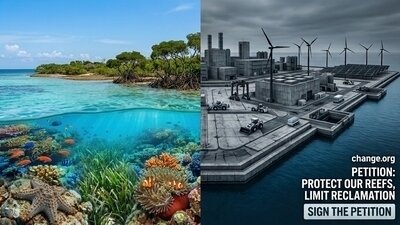
Singapore is considering a massive land reclamation project to merge Pulau Semakau, Pulau Bukom and Pulau Sudong into a new Western Island. But beneath these surrounding waters lies something irreplaceable: approximately 60% of Singapore’s coral reefs, alongside precious mangroves and seagrass meadows that sustain our marine ecosystems.
These natural habitats do far more than beautify our coastline. Together, they store carbon, help regulate our environment, support marine biodiversity and provide essential habitats for fish and other marine life. They are living ecosystems that have taken generations to develop — and once destroyed, they cannot simply be rebuilt.
Some of Singapore’s corals are thousands of years old, with certain coral structures estimated to be around 8,000 years old. To bury them permanently beneath reclaimed land would mean losing an irreplaceable part of our natural heritage, potentially sacrificing a vital marine ecosystem for development that may be achievable through alternative means.
Singapore deserves more than economic success alone.
Singapore is already one of Asia’s economic powerhouses. But surely, our aspirations as a nation should extend beyond economic growth.
What makes Singapore truly special is not merely what we build, but also what we choose to preserve. Our natural spaces, marine biodiversity and unique ecosystems are part of our national identity. If we pursue development at the expense of everything that makes us distinctive, what will remain that sets us apart from any other modern city?
A city that looks like every other city risks becoming a city that could be replaced.
Coral relocation can be a last resort.
Singapore has attempted coral relocation before. During the development of Jurong Island in the 1990s, volunteer divers undertook efforts to rescue corals threatened by reclamation and relocate them to other areas, including Sentosa. However, historical research documented poor survival among some transplanted corals, highlighting the challenges of finding suitable recipient sites and ensuring that relocated colonies survive.
If the Government is considering coral relocation for the Western Island project, we call for a publicly available, independently reviewed relocation plan before any reclamation begins. This plan should disclose:
- The proposed budget: How much will be allocated to coral surveys, relocation, specialist personnel, equipment, monitoring and long-term maintenance?
- The scientific methodology: Which coral species and colonies will be moved? How will recipient sites be selected, and how will water quality, sedimentation, depth and currents be assessed?
- Measurable survival targets: What survival, growth and ecological recovery outcomes are expected at six months, one year, five years and beyond?
- Independent monitoring and public reporting: Who will verify the results, how often will findings be published, and what corrective action will follow if targets are not met?
- Clear accountability: Which agencies and contractors will be responsible for the outcomes, and what happens if the relocation programme fails?
Community participation is valuable, but protecting a national marine ecosystem of this scale must not depend on volunteer labour as a substitute for adequately funded, professionally managed conservation.
We also encourage the Government to publish the scientific studies and independent evaluations underpinning its proposed relocation methods, including evidence of their effectiveness under conditions comparable to those around the Western Islands.
Our first priority must be to avoid destroying these habitats wherever possible. Relocation and restoration should only be considered for unavoidable impacts, after less damaging alternatives have been thoroughly assessed. Artificial reefs and transplanted corals cannot guarantee the recreation of an ancient, functioning reef that has developed over thousands of years.
We should not have to choose between progress and nature without first exploring whether both can coexist. Cities such as Amsterdam and Wellington offer examples of how urban planning can incorporate environmental considerations and work towards a more balanced relationship between development and nature.
Singapore, with our reputation for long-term planning and innovation, should be capable of pursuing similarly thoughtful solutions.
We call on the Government to reconsider the Western Island plan.
We urge Singapore’s Ministry of National Development, Prime Minister Lawrence Wong, Minister Chee Hong Tat and the Government of Singapore to:
- Reconsider the current Western Island development plan in light of the potentially irreversible loss of marine habitats.
- Explore alternative solutions that balance our long-term development needs with the protection of coral reefs, mangroves and seagrass meadows.
- Ensure that environmental considerations meaningfully shape the decision-making process, including transparent assessments of ecological impacts and viable alternatives before irreversible decisions are made.
Singapore should not be a country that speaks about sustainability while allowing irreplaceable natural ecosystems to disappear when alternatives have yet to be fully explored.
Let us demonstrate that a nation's development does not have to come at such a high cost to its natural spaces. Let us set an example for the world by showing that economic ambition and environmental responsibility can go hand in hand.
Low-carbon technologies and sustainable infrastructure are important, but they cannot simply replace the living ecosystems we destroy. Nature is not interchangeable. Once an ancient coral reef is buried, no number of sustainability initiatives can bring that same ecosystem back.
Plans can change. Priorities can evolve. The future can be planned differently.
We have the opportunity to make a better decision before it is too late.
Sign this petition to protect what makes Singapore extraordinary.
By signing this petition, you are standing up for Singapore’s marine biodiversity, our natural heritage and the generations who deserve the chance to experience these living ecosystems.
Help us call for the protection of approximately 60% of Singapore’s coral reefs and urge our leaders to find a way forward that does not require us to sacrifice our irreplaceable natural assets.
Let us build a Singapore that is not only prosperous, but also deeply conscious of what it chooses to preserve.
Our natural heritage is part of who we are. Let us not lose it without first exhausting every possible alternative.
Contact: zoahtan@gmail.com
-------------------------------------------------------------------------------------
Further Reading
Local voices and organisations
- Ocean Purpose Project — https://www.linkedin.com/posts/ocean-purpose-project_oceanpurposeproject-westernisland-blueeconomy-activity-7498612164488900608--nNb
- Nature Society Singapore — https://www.linkedin.com/posts/nature-society-singapore-_a-monumental-decision-with-generational-consequences-activity-7501532216020234241-ordE
News coverage
- CNA — Marine community fears loss of biodiversity hotspot to proposed western island development: https://www.channelnewsasia.com/singapore/western-island-marine-biodiversity-ndr-2026-6339051
- CNA — Singapore nature groups fear biodiversity loss from proposed western island project: https://www.channelnewsasia.com/watch/singapore-nature-groups-fear-biodiversity-loss-proposed-western-island-project-6340406
- CNA Commentary — If Singapore can plan 50 years ahead for infrastructure, can it do the same for nature?: https://www.channelnewsasia.com/commentary/ndr-2026-western-island-development-marine-nature-6341481
- Lianhe Zaobao — Environmental concerns over the Western Island plan: https://www.zaobao.com.sg/news/singapore/story20260824-9564845
- Lianhe Zaobao — Government response and environmental studies: https://www.zaobao.com.sg/news/singapore/story20260825-9569521
- Lianhe Zaobao — Announcement of the Western Island development plan: https://www.zaobao.com.sg/news/singapore/story20260823-9562016
Scientific Publications
- NUS Reef Ecology Lab — Coral Reefs of Singapore: https://coralreef.nus.edu.sg/singapore.html
- NUS Reef Ecology Lab — Research on Singapore’s reef ecology: https://coralreef.nus.edu.sg/
- Lee Kong Chian Natural History Museum, NUS — Comprehensive Marine Biodiversity Survey: https://lkcnhm.nus.edu.sg/our-research/comprehensive-marine-biodiversity-survey-i-ii-science-meets-the-sea/
- NUS Faculty of Science — Interactions between corals and macroalgae on Singapore’s urban reefs: https://www.science.nus.edu.sg/blog/2021/11/interactions-between-corals-and-macroalgae-on-singapores-urban-reefs/
-
NParks Handbook on Habitat Restoration (reef restoration in Singapore): https://www.nparks.gov.sg/-/media/handbook-on-habitat-restoration/handbook-on-habitat-restoration-chapter-26.pdf
84
The Issue
Singapore’s future should not come at such high cost for nature.
Singapore is considering a massive land reclamation project to merge Pulau Semakau, Pulau Bukom and Pulau Sudong into a new Western Island. But beneath these surrounding waters lies something irreplaceable: approximately 60% of Singapore’s coral reefs, alongside precious mangroves and seagrass meadows that sustain our marine ecosystems.
These natural habitats do far more than beautify our coastline. Together, they store carbon, help regulate our environment, support marine biodiversity and provide essential habitats for fish and other marine life. They are living ecosystems that have taken generations to develop — and once destroyed, they cannot simply be rebuilt.
Some of Singapore’s corals are thousands of years old, with certain coral structures estimated to be around 8,000 years old. To bury them permanently beneath reclaimed land would mean losing an irreplaceable part of our natural heritage, potentially sacrificing a vital marine ecosystem for development that may be achievable through alternative means.
Singapore deserves more than economic success alone.
Singapore is already one of Asia’s economic powerhouses. But surely, our aspirations as a nation should extend beyond economic growth.
What makes Singapore truly special is not merely what we build, but also what we choose to preserve. Our natural spaces, marine biodiversity and unique ecosystems are part of our national identity. If we pursue development at the expense of everything that makes us distinctive, what will remain that sets us apart from any other modern city?
A city that looks like every other city risks becoming a city that could be replaced.
Coral relocation can be a last resort.
Singapore has attempted coral relocation before. During the development of Jurong Island in the 1990s, volunteer divers undertook efforts to rescue corals threatened by reclamation and relocate them to other areas, including Sentosa. However, historical research documented poor survival among some transplanted corals, highlighting the challenges of finding suitable recipient sites and ensuring that relocated colonies survive.
If the Government is considering coral relocation for the Western Island project, we call for a publicly available, independently reviewed relocation plan before any reclamation begins. This plan should disclose:
- The proposed budget: How much will be allocated to coral surveys, relocation, specialist personnel, equipment, monitoring and long-term maintenance?
- The scientific methodology: Which coral species and colonies will be moved? How will recipient sites be selected, and how will water quality, sedimentation, depth and currents be assessed?
- Measurable survival targets: What survival, growth and ecological recovery outcomes are expected at six months, one year, five years and beyond?
- Independent monitoring and public reporting: Who will verify the results, how often will findings be published, and what corrective action will follow if targets are not met?
- Clear accountability: Which agencies and contractors will be responsible for the outcomes, and what happens if the relocation programme fails?
Community participation is valuable, but protecting a national marine ecosystem of this scale must not depend on volunteer labour as a substitute for adequately funded, professionally managed conservation.
We also encourage the Government to publish the scientific studies and independent evaluations underpinning its proposed relocation methods, including evidence of their effectiveness under conditions comparable to those around the Western Islands.
Our first priority must be to avoid destroying these habitats wherever possible. Relocation and restoration should only be considered for unavoidable impacts, after less damaging alternatives have been thoroughly assessed. Artificial reefs and transplanted corals cannot guarantee the recreation of an ancient, functioning reef that has developed over thousands of years.
We should not have to choose between progress and nature without first exploring whether both can coexist. Cities such as Amsterdam and Wellington offer examples of how urban planning can incorporate environmental considerations and work towards a more balanced relationship between development and nature.
Singapore, with our reputation for long-term planning and innovation, should be capable of pursuing similarly thoughtful solutions.
We call on the Government to reconsider the Western Island plan.
We urge Singapore’s Ministry of National Development, Prime Minister Lawrence Wong, Minister Chee Hong Tat and the Government of Singapore to:
- Reconsider the current Western Island development plan in light of the potentially irreversible loss of marine habitats.
- Explore alternative solutions that balance our long-term development needs with the protection of coral reefs, mangroves and seagrass meadows.
- Ensure that environmental considerations meaningfully shape the decision-making process, including transparent assessments of ecological impacts and viable alternatives before irreversible decisions are made.
Singapore should not be a country that speaks about sustainability while allowing irreplaceable natural ecosystems to disappear when alternatives have yet to be fully explored.
Let us demonstrate that a nation's development does not have to come at such a high cost to its natural spaces. Let us set an example for the world by showing that economic ambition and environmental responsibility can go hand in hand.
Low-carbon technologies and sustainable infrastructure are important, but they cannot simply replace the living ecosystems we destroy. Nature is not interchangeable. Once an ancient coral reef is buried, no number of sustainability initiatives can bring that same ecosystem back.
Plans can change. Priorities can evolve. The future can be planned differently.
We have the opportunity to make a better decision before it is too late.
Sign this petition to protect what makes Singapore extraordinary.
By signing this petition, you are standing up for Singapore’s marine biodiversity, our natural heritage and the generations who deserve the chance to experience these living ecosystems.
Help us call for the protection of approximately 60% of Singapore’s coral reefs and urge our leaders to find a way forward that does not require us to sacrifice our irreplaceable natural assets.
Let us build a Singapore that is not only prosperous, but also deeply conscious of what it chooses to preserve.
Our natural heritage is part of who we are. Let us not lose it without first exhausting every possible alternative.
Contact: zoahtan@gmail.com
-------------------------------------------------------------------------------------
Further Reading
Local voices and organisations
- Ocean Purpose Project — https://www.linkedin.com/posts/ocean-purpose-project_oceanpurposeproject-westernisland-blueeconomy-activity-7498612164488900608--nNb
- Nature Society Singapore — https://www.linkedin.com/posts/nature-society-singapore-_a-monumental-decision-with-generational-consequences-activity-7501532216020234241-ordE
News coverage
- CNA — Marine community fears loss of biodiversity hotspot to proposed western island development: https://www.channelnewsasia.com/singapore/western-island-marine-biodiversity-ndr-2026-6339051
- CNA — Singapore nature groups fear biodiversity loss from proposed western island project: https://www.channelnewsasia.com/watch/singapore-nature-groups-fear-biodiversity-loss-proposed-western-island-project-6340406
- CNA Commentary — If Singapore can plan 50 years ahead for infrastructure, can it do the same for nature?: https://www.channelnewsasia.com/commentary/ndr-2026-western-island-development-marine-nature-6341481
- Lianhe Zaobao — Environmental concerns over the Western Island plan: https://www.zaobao.com.sg/news/singapore/story20260824-9564845
- Lianhe Zaobao — Government response and environmental studies: https://www.zaobao.com.sg/news/singapore/story20260825-9569521
- Lianhe Zaobao — Announcement of the Western Island development plan: https://www.zaobao.com.sg/news/singapore/story20260823-9562016
Scientific Publications
- NUS Reef Ecology Lab — Coral Reefs of Singapore: https://coralreef.nus.edu.sg/singapore.html
- NUS Reef Ecology Lab — Research on Singapore’s reef ecology: https://coralreef.nus.edu.sg/
- Lee Kong Chian Natural History Museum, NUS — Comprehensive Marine Biodiversity Survey: https://lkcnhm.nus.edu.sg/our-research/comprehensive-marine-biodiversity-survey-i-ii-science-meets-the-sea/
- NUS Faculty of Science — Interactions between corals and macroalgae on Singapore’s urban reefs: https://www.science.nus.edu.sg/blog/2021/11/interactions-between-corals-and-macroalgae-on-singapores-urban-reefs/
-
NParks Handbook on Habitat Restoration (reef restoration in Singapore): https://www.nparks.gov.sg/-/media/handbook-on-habitat-restoration/handbook-on-habitat-restoration-chapter-26.pdf
The Decision Makers

Petition Updates
Share this petition
Petition created on 9 October 2026