What's the purpose of paid parking anyway? Control? Or cash?

Thank you, NBC10 and Cydney Long for terrific reports at 4:30pm and 6pm on Thursday, September 28, 2023. WATCH HERE!
__________
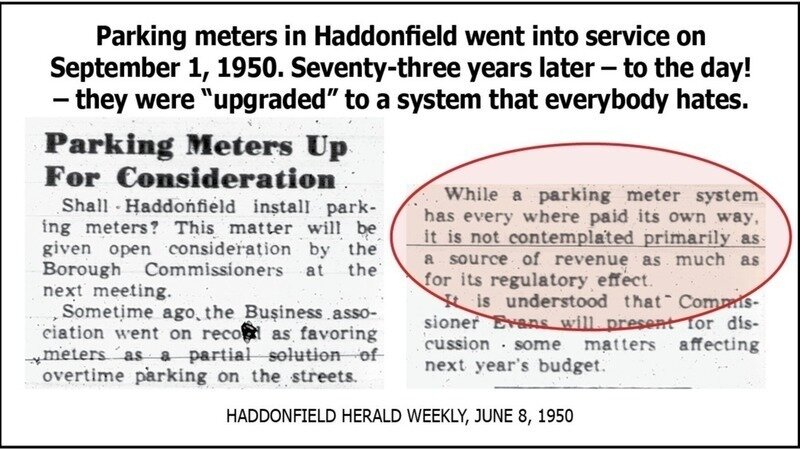
Our natural inclination is to think that the purpose of pay-to-park systems in downtowns is to raise money for municipal coffers. Certainly, the money received must pay to operate and maintain the system, at least. But that’s not the prime purpose.
Wikipedia (the ultimate authority) gets it right: Parking meters can be used by municipalities as a tool for enforcing their integrated on-street parking policy, usually related to their traffic and mobility management policies, but are also used for revenue.
Note the order of priority:
- Implement traffic management policies;
- Enforce parking policy;
- (and also) Generate revenue.
Ever since meters went into operation in Haddonfield – on September 1, 1950 – the main purpose of parking meters has been to deter those who work in the downtown business district from parking on Kings Highway and adjacent streets, thus making space on those streets available to shoppers.
The theory was that to avoid paying for parking, most workers would park remotely and walk from their cars to their places of work. Meters originally operated during typical office hours: 8:30am to 6pm. Parking was free before 8:30am (originally; later 9am) and after 6pm, which encouraged some folks to go downtown for breakfast and others for dinner.
Long-term parking was made available in several remote lots – at the end of Snowden Avenue (behind the Borough Hall), for example – where workers could park very economically for up to 12 hours. The Borough also enabled businesses to purchase permits so their employees could park in designated areas of lots such as the one off Chestnut Street (the Baptist Church/“Mini Mall” lot).
Most meters also gave drivers the first 12 minutes for free. This feature not only enabled drivers to run quick errands without having to pay but also gave them a psychological incentive to get it done and move on, thus making the spot available for another driver. This feature worked especially well at the Post Office and the Public Library.
The Borough’s new pay-to-park scheme, effective September 1, 2023, has thrown these control mechanisms out the window.
Now, anyone can park anywhere, for as long as they like. For example: A technician who works in a beauty salon downtown can park directly in front of the Post Office from 9am to 4pm (provided she’s willing to pay $7.35). It would cost her the same to park several blocks away, so why not park much closer to her place of work?
Now, a business owner who goes to the Post Office five or six days a week to collect mail has to pay $1.35 each day. That adds up to $350 to $400 a year to do something that used to be free. Many folks are parking and not paying, running the risk of getting a ticket.
The same thing’s happening at the UPS Store on Kings Highway, at the Public Library, and in the vicinity of restaurants, where drivers for DoorDash, Uber Eats, and Grubhub are taking the risk. Or they’re abiding by the law and adding $1.35 to the cost of each meal. The Borough’s new traffic management policy – if there is one – is actually encouraging drivers to flout the law.
Here's a good question! Does the Borough actually have a traffic management policy?
If so, what is it? And how does the new pay-to-park scheme:
- Implement traffic management policies?
- Enforce parking policy?
- Generate revenue?
This space is available to the commissioners, if they care to tell us. If they provide responsive, detailed answers, we'll publish them. If they don't, we won't.
[A suggestion: Spare us the "news" – published recently in the Haddonfield Sun – that "Sundays [will be] free!" and "we will continue offering FREE parking during the Holiday season, a plus for retail businesses, visitors, and residents!" Give the 1,700+ folks who signed the petition to date – and everyone else who's affected – the real news, the true facts, and the detailed rationale ... sans the exclamation marks!]