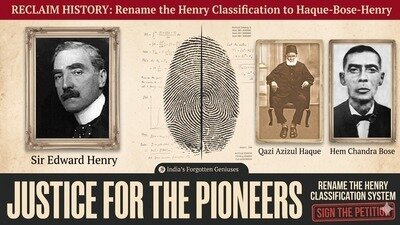

Rename the "Henry Classification System" to Honor Azizul Haque and Hem Chandra Bose
The Issue
The Story That History Tried to Silence
For over a century, forensic science across the globe has relied on a foundational breakthrough known worldwide as the "Henry Classification System." From solving cold cases to establishing modern criminal justice, this fingerprint identification method changed forensic science forever.
The credit for this landmark innovation has overwhelmingly gone to Sir Edward Henry, the British Inspector General of Police in Bengal during colonial rule.
The mathematical genius and methodical labor behind this system did not come from Henry. It came from two forgotten Indian pioneers: Qazi Azizul Haque and Hem Chandra Bose.
Erased by Colonial Privilege
In the late 1890s, at the Calcutta Anthropometric Bureau—which later became the world’s first official Fingerprint Bureau in 1897—Edward Henry found himself facing an intractable challenge: how to sort, categorize, and cross-reference thousands of fingerprint cards quickly and accurately.
Unable to solve the mathematical riddle himself, Henry assigned the task to two brilliant sub-inspectors:
Qazi Azizul Haque, a gifted mathematician, spent months developing a complex mathematical formula and filing architecture capable of sorting prints into 1,024 distinct categories. This breakthrough forms the mathematical core of fingerprint classification used worldwide.
Hem Chandra Bose, an astute forensic mind, developed the telegraphic code system for transmitting fingerprint data and refined the single-digit classification systems that enabled rapid communication between police departments.
When the system was presented to the world, Edward Henry claimed sole authorship. He published the monumental work Classification and Uses of Finger Prints in 1900 under his name alone, rode the wave of international acclaim to become the Commissioner of London's Metropolitan Police at New Scotland Yard, and was knighted for his supposed achievement.
Haque and Bose received meager belated honorariums and minimal local recognition decades later, while their names were completely erased from global textbooks, forensic manuals, and international history.
A Message from India to the World
This petition is about setting the historical record straight and giving credit where it belongs.
Throughout colonial history, indigenous genius across Asia, Africa, and the Global South was routinely absorbed, rebranded, and credited to colonial administrators. The erasure of Haque and Bose is a glaring example of how history was written by those with systemic power, while the thinkers behind the breakthroughs were relegated to footnotes.
Science belongs to humanity, but honesty belongs to history. India has contributed profoundly to mathematics, medicine, astronomy, and modern technology. Acknowledging that truth requires confronting and correcting historical injustices.
Giving credit where it is due is an act of basic integrity. It ensures that future generations of young scientists, innovators, and students know that their ancestors were pioneers of global modern science.
What We Demand
We call upon the International Association for Identification (IAI), forensic science academic institutions, criminology faculties, and law enforcement organizations worldwide to:
Officially rename and refer to the methodology as the "Haque-Bose-Henry Classification System."
Update forensic textbooks, academic curricula, and training literature to accurately document the mathematical and scientific breakthroughs developed by Qazi Azizul Haque and Hem Chandra Bose.
Acknowledge and teach the full history of the Calcutta Fingerprint Bureau of 1897, honoring the true innovators who laid the foundations of modern forensic identification.
History cannot be rewritten, but justice can be restored.
Please sign and share this petition to ensure Azizul Haque and Hem Chandra Bose finally receive the global respect and rightful recognition they deserve.

9
The Issue
The Story That History Tried to Silence
For over a century, forensic science across the globe has relied on a foundational breakthrough known worldwide as the "Henry Classification System." From solving cold cases to establishing modern criminal justice, this fingerprint identification method changed forensic science forever.
The credit for this landmark innovation has overwhelmingly gone to Sir Edward Henry, the British Inspector General of Police in Bengal during colonial rule.
The mathematical genius and methodical labor behind this system did not come from Henry. It came from two forgotten Indian pioneers: Qazi Azizul Haque and Hem Chandra Bose.
Erased by Colonial Privilege
In the late 1890s, at the Calcutta Anthropometric Bureau—which later became the world’s first official Fingerprint Bureau in 1897—Edward Henry found himself facing an intractable challenge: how to sort, categorize, and cross-reference thousands of fingerprint cards quickly and accurately.
Unable to solve the mathematical riddle himself, Henry assigned the task to two brilliant sub-inspectors:
Qazi Azizul Haque, a gifted mathematician, spent months developing a complex mathematical formula and filing architecture capable of sorting prints into 1,024 distinct categories. This breakthrough forms the mathematical core of fingerprint classification used worldwide.
Hem Chandra Bose, an astute forensic mind, developed the telegraphic code system for transmitting fingerprint data and refined the single-digit classification systems that enabled rapid communication between police departments.
When the system was presented to the world, Edward Henry claimed sole authorship. He published the monumental work Classification and Uses of Finger Prints in 1900 under his name alone, rode the wave of international acclaim to become the Commissioner of London's Metropolitan Police at New Scotland Yard, and was knighted for his supposed achievement.
Haque and Bose received meager belated honorariums and minimal local recognition decades later, while their names were completely erased from global textbooks, forensic manuals, and international history.
A Message from India to the World
This petition is about setting the historical record straight and giving credit where it belongs.
Throughout colonial history, indigenous genius across Asia, Africa, and the Global South was routinely absorbed, rebranded, and credited to colonial administrators. The erasure of Haque and Bose is a glaring example of how history was written by those with systemic power, while the thinkers behind the breakthroughs were relegated to footnotes.
Science belongs to humanity, but honesty belongs to history. India has contributed profoundly to mathematics, medicine, astronomy, and modern technology. Acknowledging that truth requires confronting and correcting historical injustices.
Giving credit where it is due is an act of basic integrity. It ensures that future generations of young scientists, innovators, and students know that their ancestors were pioneers of global modern science.
What We Demand
We call upon the International Association for Identification (IAI), forensic science academic institutions, criminology faculties, and law enforcement organizations worldwide to:
Officially rename and refer to the methodology as the "Haque-Bose-Henry Classification System."
Update forensic textbooks, academic curricula, and training literature to accurately document the mathematical and scientific breakthroughs developed by Qazi Azizul Haque and Hem Chandra Bose.
Acknowledge and teach the full history of the Calcutta Fingerprint Bureau of 1897, honoring the true innovators who laid the foundations of modern forensic identification.
History cannot be rewritten, but justice can be restored.
Please sign and share this petition to ensure Azizul Haque and Hem Chandra Bose finally receive the global respect and rightful recognition they deserve.
Petition Updates
Share this petition
Petition created on 23 October 2026