Mast Planning Application resubmitted - Please Object

Update
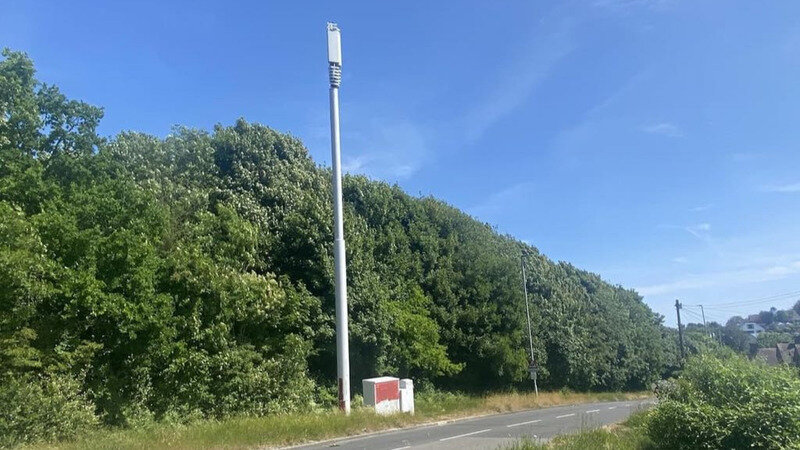
Thank you for signing our petition for the removal of the mast next to Wallands Primary School we would be very grateful if you could submit an objection to the retrospective planning application which has now been submitted. We really need your help with getting this mast removed. The removal is supported by a cross-party group of local councillors, including the new Mayor of Lewes Matthew Bird, and the prospective parliamentary candidate for Lewes, James MacCleary.
The council confirmed that the mast does not have planning permission as it was built in the wrong place using the wrong design of mast. The operator, Three, has now submitted a retrospective planning application to keep the mast in its place.
This is an opportunity for the community to submit comments and objections. Comments must be received by 14th August – but the sooner the better.
How to submit your objection to the mast application
Points to include in your objection
The council can refuse to grant permission for the mast based on its appearance and siting. You may wish to mention some or all of the points below in your objection. It is useful, although not essential, to include references to planning policies as we have done below, as this may make your concerns harder for the council to ignore.
APPEARANCE:
Negative impact on the National Park
- The mast spoils one of the South Downs National Park’s key protected views (View 11 in the Lewes Neighbourhood Plan), from above the Nevill into Lewes, contravening South Downs National Park Strategic Policy SD6: Safeguarding Views.
- The protected view is from a registered historic battlefield towards Lewes Castle and the surrounding Conservation Area. So the mast has an adverse effect on the setting of all three historical assets. This is in direct contradiction with South Downs National Park Strategic Policy SD6, SD15, and the Code of Practice for Wireless Network Development in England.
- A higher standard of design is expected in a National Park, but the operator has made no attempt to minimise the visual impact of the mast – contrary to national and local policies, including the National Planning Policy Framework paragraph 176, the Government’s Code of Practice for Wireless Network Development in England, the General Permitted Development Order (GPDO), South Downs Local Plan policy SD44, and the National Parks England and Mobile UK Joint Accord / Memorandum of Understanding.
Negative impact on the local neighbourhood
- The mast is poorly designed, overbearing and visually intrusive. It is detrimental to the visual appearance and character of the semi-rural, residential area - contrary to the National Planning Policy Framework paragraphs 126 and 130.
- The mast is highly visible from most of the adjacent Nevill estate, resulting in detriment to the visual amenity of the area, as well as a harmful impact on the outlook of residential properties.
- It is out of scale with existing developments - significantly taller and considerably wider than nearby street lamps and the surrounding two-storey residential buildings.
- The stark, incongruous visual impact of the mast contravenes the National Planning Policy Framework paragraph 115, which requires equipment to be “sympathetically designed and camouflaged”.
- The mast’s imposing and overbearing impact on the amenity of the surrounding area causes local residents unnecessary distress, upset, and anxiety from fear of harm, impacting the quality of life in the local area.
SITING:
Poor choice of location
- The application provides no justification for focusing on such a narrow target search area. There is no Three 5G coverage anywhere else in Lewes, so there is a very wide range of potential sites. However, contrary to Government requirements, Three did not fully consider alternative locations.
- Some other sites were discounted due to their proximity to residences. This should also be the case for the Nevill Road site, which is directly opposite houses. The fact that this site is next to a nursery and primary school makes it an even less appropriate site.
- There is no indication that Three considered upgrading existing sites, sharing sites, or siting apparatus on buildings, as required by South Downs National Park Local Plan Policy SD44, National Planning Policy Framework paragraphs 115 and 117, and the Code of Practice for Wireless Network Development in England.
- Because the chosen site is next to a school, the mast cannot transmit in all directions. This means the mast has only two antennae, instead of the usual three. This makes this one of the least efficient locations for a mast, in direct contradiction with the National Planning Policy Framework paragraph 115, which requires the number of masts to be kept to a minimum.
Proximity to the school
- The application ignores the sloping ground behind the mast, which means the school and nursery are the same height as the antennae – dangerously close to the mast’s “exclusion zone” (the area close to a mast that it is not safe for the public to enter).
- The location of the mast next to Wallands Primary School and Nursery could impact the school’s ability to attract pupils and therefore funding.
- Several local authorities, including Brighton & Hove and Worthing, have recently rejected applications for masts next to primary schools, and such decisions have been upheld by the Planning Inspectorate on appeal.
- Some local authorities, eg Birmingham, now have policies against siting masts next to schools. And, nationally, only around 40% of all mast applications are being approved.
OTHER POINTS:
- The application contains no evidence of consultation with the school, contrary to the National Planning Policy Framework, para 117.
- Ask the planning authority to apply NPPF paras 174, 179, 180 & 185 which are protective of our health, living conditions and the natural environment. Additionally, NPPF paras 110 to 117 should be met. Full fibre broadband to the home could be prioritised over the use of 5G.
- There are NO safety studies on the cumulative effects on health from exposure to these radiation emissions 24/7 over a lifetime, while over 2,000 studies show harms and risks to human health, wildlife, and the environment. https://icbe-emf.org/ https://www.orsaa.org/
- No environmental impact assessment has been undertaken to assess the impact of the mast on surrounding trees, insects and bats.
- No equality impact assessment has been undertaken, despite the fact that the telecoms industry body ICNIRP recognises that its own safety standards do not cover anyone with metal in the body (eg dental braces, implants, pacemakers etc), due to the unpredictable action of EMF where metal is present. This means that a substantial number of people living, working or studying near the mast are not covered