Reinstate 24/7 waste service on Lake Temagami
The Issue
NOTE: NO DONATIONS REQUIRED. SKIP DONATION. NO OTHER PETITIONS NEED BE SIGN. YOU CAN CLOSE YOUR WINDOW ONCE YOU HAVE SIGNED. SHARE IF YOU WISH. YOUR NAME WILL FORM PART OF A PAPER COPY OF THE PETITION.
To: Mayor Dan O’Mara, Municipality of Temagami, Ontario
We, the undersigned, represent many of the residents and businesses on Lake Temagami and the primary users of the Waste Transfer Station at the landing for the Lake Temagami Access Road.
We object strongly to the new waste service put in place by the municipality, and call for reinstatement of a 24/7 waste service, with improvements describe below.
BACKGROUND
Until May 19, 2023, the municipality ran a 24/7 Waste Transfer Station (WTS) at the landing of the Lake Temagami Access Road, without major incidents or breaks in service over a period of several decades.
Provincial Orders for improvements in 2015 from the Ontario Ministry of Environment, Conservation and Parks (MOECP) were addressed in 2016 by the municipality to the satisfaction of the Ministry. These included the installation of covers to prevent bear access to waste, security cameras, public consultation to determine the best course of action, and active monitoring and education during peak hours. In correspondence dated December, 2016 the MoECP “advises that the ministry is satisfied that the development of the Action Plan submitted by the municipality fulfils the requirements of the Orders or constitutes a reasonable alternative to the requirements of the Orders.” This includes approval to operate the site 7 days per week, 24 hours per day.
Since that time there have been no further orders from the Ministry.
In correspondence dated July 10, 2023 (attached), the Ministry responded to an inquiry from the Temagami Lakes Association indicating that waste transfer stations can be operated 24 hours per day and that “the presence of “attendants” is usually not a requirement that is spelled out in the conditions.”
More generally, the very large number of seasonal and permanent users on the lake and severe limitations on means to safely dispose of waste justifies flexibility when providing access to waste disposal at a remote and well used location. Waste Transfer Stations with similar circumstances run by other municipalities in the province have also been granted flexibility by the Ministry, so long as they meet specified conditions.
Given this background and existing approvals from the Ministry, there was and remains no compelling rationale for the drastically reduced service and significant increase in costs imposed by the municipality.
IMPACTS
Closure of access to the Waste Transfer Station Fridays and irregular, highly limited hours of operation (typically three hours a day) has had the following immediate impacts on the lake and lake users:
· Significantly increased boat traffic and high levels of congestion at the landing during the limited hours of operation of the waste station;
· Disruption of operations by camps and lodges that coordinate client pick up and drop off with waste removal. More frequent trips to the landing, and associated costs, are a related consequence;
· Reorientation of plans by individuals for landing departure and arrival around the restricted hours of the waste station, when weather, safety and other considerations should be paramount to movement on the lake;
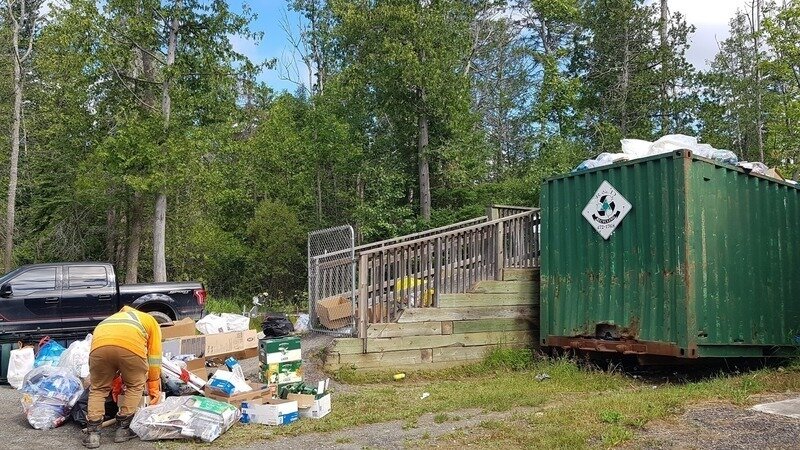
· Increased risk of bear and other wildlife encounters if and when waste is deposited inappropriately at the landing;
· Increased risk of inappropriate dumping of waste at remote mainland locations due to perceived inconvenience, with serious long term implications for water and land pollution;
· Higher costs for a lesser service, including purchase of a municipal vehicle to shuttle between the Temagami town municipal office, the landing and the land fill, twice daily and potentially with partially filled containers. To commit the municipality to an intensive and regular use of a public vehicle and fossil fuels for no good reason is a wasteful use of resources and, in and of itself, fails to address any practical concerns.
· More generally, the drastically reduced service does not meet basic needs on the lake and presents new risks to the environment, at a location frequented by thousands of lake users from across the province and internationally.
GOVERNANCE
The decision by the municipality to close the station and reopen with restricted hours raises several broader municipal governance issues. First, the financing of a capital expenditure (a specially equipped municipal truck) through user fees rather than from general tax revenues, without any prior consideration or consultation with taxpayers, is not acceptable. An equivalent action would be to purchase a new garbage truck for the town of Temagami and cover the capital cost through the relatively small user base in the town rather than the broader tax base provided by all Temagami property owners. Furthermore, the fee is not a true “user fee” because it does not reflect actual use of the facility by rate payers on a waste volume or other basis. We reject this financial action categorically.
Second, the records of Council resolutions on this matter refer only to continuing the hiring process for a new position with the municipality, and do not provide clear approvals for the restricted hours of service. This is a failure by Council to follow due process.
Third, the working group of residents convened by the municipality to provide advice on the Waste Transfer Station was not treated with respect. No clear mandate or council resolution was provided to the members who dedicated time to the matter over a period of more than a year, and their recommendations and concerns were not conveyed to Council through a report or presentation by members prior to making significant changes to the waste station.
Finally, implementation of the new procedure for waste, announced on a Friday before the May holiday weekend and hours revised a week later, shows a disregard for users of the facility and tax payers. Since then, operation of the facility has been uneven and sometimes chaotic.
NEXT STEPS
We categorically reject the contention that the 24/7 waste transfer station was regularly abused. Minor problems reported by the municipality could have been mitigated. We call and for reinstatement of a 24/7 service. Some options for improvements include:
· Detailed signage on policies and procedures for recycling, management of hazardous waste, and other directions appropriate to reducing risk and enhancing waste diversion from the Briggs landfill;
· Systematic tracking and reporting on the number of bins and bin volume, and waste sources and waste types (residential, commercial, construction) taken to the Briggs landfill. It seems that the municipality is not collecting data at the level of detail needed to monitor and report on what is entering the Briggs Landfill, or to control for hazardous waste;
· An appropriate additional recycling bin, accessed from above rather than the end (the new bin presents serious injury risks as people carry their recycling into a dark enclosure);
· Specific policies and signage regarding the disposal of fridges and other cooling devices, including provisions and budget for Public Works to manage non-compliance;
· Directions to contractors to deliver construction waste directly to the Briggs landfill;
· Designation of a bin for non-commercial construction waste, covered and accessible only during staffed hours or by appointment. Repurposing the scrap wood bin for construction waste could be considered. This would address construction waste coming from individuals who are unable to directly transport construction waste to the landfill, and keep the construction waste separate from the domestic waste bins. Tipping fees or other service cost would apply;
· Designating and covering a small area for “reuse” items (useable furniture and other small items), thereby extending the lifecycle of useful items and keeping them out of the landfill;
· Development of a more feasible system for the disposal of common hazardous waste (paint cans, etc.). The current system is unworkable and under-used because it is simply too inconvenient and costly for individuals to transport a few items to North Bay facilities. Non-compliance cannot be corrected by staffing the site as every waste bag would need to be inspected carefully. An alternative such as one-day hazardous waste depots run by staff and held periodically in the spring, summer and fall should be considered, a service common elsewhere in Ontario. It may also be feasible to tender a contract for a service of this nature;
· Staffing or contracting a person to monitor the site during peak hours only, and to educate users. The position could include other relevant services such as education and inspection of boats for invasive species, and distribution of local tourism information. Cooperation with the Chamber of Commerce and the Temagami Lakes Association could be considered for an enhanced and multifunctional municipal presence at the landing.
Please note that by means of this letter we are also requesting that the upcoming September 14 Council meeting allocate time for us and others to directly present our concerns to full Council.
Sincerely,
Lorie Hunter,
Temagami South West Arm
Daniel Buckles
Temagami South Arm
Paul Tamburro
President, Temagami Lakes Association
William Bateman
President, Lake Temagami Group

643
The Issue
NOTE: NO DONATIONS REQUIRED. SKIP DONATION. NO OTHER PETITIONS NEED BE SIGN. YOU CAN CLOSE YOUR WINDOW ONCE YOU HAVE SIGNED. SHARE IF YOU WISH. YOUR NAME WILL FORM PART OF A PAPER COPY OF THE PETITION.
To: Mayor Dan O’Mara, Municipality of Temagami, Ontario
We, the undersigned, represent many of the residents and businesses on Lake Temagami and the primary users of the Waste Transfer Station at the landing for the Lake Temagami Access Road.
We object strongly to the new waste service put in place by the municipality, and call for reinstatement of a 24/7 waste service, with improvements describe below.
BACKGROUND
Until May 19, 2023, the municipality ran a 24/7 Waste Transfer Station (WTS) at the landing of the Lake Temagami Access Road, without major incidents or breaks in service over a period of several decades.
Provincial Orders for improvements in 2015 from the Ontario Ministry of Environment, Conservation and Parks (MOECP) were addressed in 2016 by the municipality to the satisfaction of the Ministry. These included the installation of covers to prevent bear access to waste, security cameras, public consultation to determine the best course of action, and active monitoring and education during peak hours. In correspondence dated December, 2016 the MoECP “advises that the ministry is satisfied that the development of the Action Plan submitted by the municipality fulfils the requirements of the Orders or constitutes a reasonable alternative to the requirements of the Orders.” This includes approval to operate the site 7 days per week, 24 hours per day.
Since that time there have been no further orders from the Ministry.
In correspondence dated July 10, 2023 (attached), the Ministry responded to an inquiry from the Temagami Lakes Association indicating that waste transfer stations can be operated 24 hours per day and that “the presence of “attendants” is usually not a requirement that is spelled out in the conditions.”
More generally, the very large number of seasonal and permanent users on the lake and severe limitations on means to safely dispose of waste justifies flexibility when providing access to waste disposal at a remote and well used location. Waste Transfer Stations with similar circumstances run by other municipalities in the province have also been granted flexibility by the Ministry, so long as they meet specified conditions.
Given this background and existing approvals from the Ministry, there was and remains no compelling rationale for the drastically reduced service and significant increase in costs imposed by the municipality.
IMPACTS
Closure of access to the Waste Transfer Station Fridays and irregular, highly limited hours of operation (typically three hours a day) has had the following immediate impacts on the lake and lake users:
· Significantly increased boat traffic and high levels of congestion at the landing during the limited hours of operation of the waste station;
· Disruption of operations by camps and lodges that coordinate client pick up and drop off with waste removal. More frequent trips to the landing, and associated costs, are a related consequence;
· Reorientation of plans by individuals for landing departure and arrival around the restricted hours of the waste station, when weather, safety and other considerations should be paramount to movement on the lake;
· Increased risk of bear and other wildlife encounters if and when waste is deposited inappropriately at the landing;
· Increased risk of inappropriate dumping of waste at remote mainland locations due to perceived inconvenience, with serious long term implications for water and land pollution;
· Higher costs for a lesser service, including purchase of a municipal vehicle to shuttle between the Temagami town municipal office, the landing and the land fill, twice daily and potentially with partially filled containers. To commit the municipality to an intensive and regular use of a public vehicle and fossil fuels for no good reason is a wasteful use of resources and, in and of itself, fails to address any practical concerns.
· More generally, the drastically reduced service does not meet basic needs on the lake and presents new risks to the environment, at a location frequented by thousands of lake users from across the province and internationally.
GOVERNANCE
The decision by the municipality to close the station and reopen with restricted hours raises several broader municipal governance issues. First, the financing of a capital expenditure (a specially equipped municipal truck) through user fees rather than from general tax revenues, without any prior consideration or consultation with taxpayers, is not acceptable. An equivalent action would be to purchase a new garbage truck for the town of Temagami and cover the capital cost through the relatively small user base in the town rather than the broader tax base provided by all Temagami property owners. Furthermore, the fee is not a true “user fee” because it does not reflect actual use of the facility by rate payers on a waste volume or other basis. We reject this financial action categorically.
Second, the records of Council resolutions on this matter refer only to continuing the hiring process for a new position with the municipality, and do not provide clear approvals for the restricted hours of service. This is a failure by Council to follow due process.
Third, the working group of residents convened by the municipality to provide advice on the Waste Transfer Station was not treated with respect. No clear mandate or council resolution was provided to the members who dedicated time to the matter over a period of more than a year, and their recommendations and concerns were not conveyed to Council through a report or presentation by members prior to making significant changes to the waste station.
Finally, implementation of the new procedure for waste, announced on a Friday before the May holiday weekend and hours revised a week later, shows a disregard for users of the facility and tax payers. Since then, operation of the facility has been uneven and sometimes chaotic.
NEXT STEPS
We categorically reject the contention that the 24/7 waste transfer station was regularly abused. Minor problems reported by the municipality could have been mitigated. We call and for reinstatement of a 24/7 service. Some options for improvements include:
· Detailed signage on policies and procedures for recycling, management of hazardous waste, and other directions appropriate to reducing risk and enhancing waste diversion from the Briggs landfill;
· Systematic tracking and reporting on the number of bins and bin volume, and waste sources and waste types (residential, commercial, construction) taken to the Briggs landfill. It seems that the municipality is not collecting data at the level of detail needed to monitor and report on what is entering the Briggs Landfill, or to control for hazardous waste;
· An appropriate additional recycling bin, accessed from above rather than the end (the new bin presents serious injury risks as people carry their recycling into a dark enclosure);
· Specific policies and signage regarding the disposal of fridges and other cooling devices, including provisions and budget for Public Works to manage non-compliance;
· Directions to contractors to deliver construction waste directly to the Briggs landfill;
· Designation of a bin for non-commercial construction waste, covered and accessible only during staffed hours or by appointment. Repurposing the scrap wood bin for construction waste could be considered. This would address construction waste coming from individuals who are unable to directly transport construction waste to the landfill, and keep the construction waste separate from the domestic waste bins. Tipping fees or other service cost would apply;
· Designating and covering a small area for “reuse” items (useable furniture and other small items), thereby extending the lifecycle of useful items and keeping them out of the landfill;
· Development of a more feasible system for the disposal of common hazardous waste (paint cans, etc.). The current system is unworkable and under-used because it is simply too inconvenient and costly for individuals to transport a few items to North Bay facilities. Non-compliance cannot be corrected by staffing the site as every waste bag would need to be inspected carefully. An alternative such as one-day hazardous waste depots run by staff and held periodically in the spring, summer and fall should be considered, a service common elsewhere in Ontario. It may also be feasible to tender a contract for a service of this nature;
· Staffing or contracting a person to monitor the site during peak hours only, and to educate users. The position could include other relevant services such as education and inspection of boats for invasive species, and distribution of local tourism information. Cooperation with the Chamber of Commerce and the Temagami Lakes Association could be considered for an enhanced and multifunctional municipal presence at the landing.
Please note that by means of this letter we are also requesting that the upcoming September 14 Council meeting allocate time for us and others to directly present our concerns to full Council.
Sincerely,
Lorie Hunter,
Temagami South West Arm
Daniel Buckles
Temagami South Arm
Paul Tamburro
President, Temagami Lakes Association
William Bateman
President, Lake Temagami Group
Petition Updates
Share this petition
Petition created on September 3, 2023