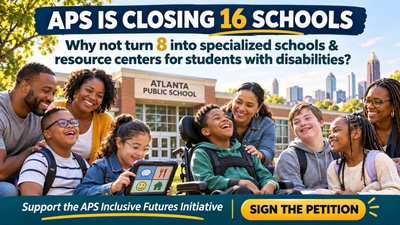

PETITION: TURN SCHOOL CLOSURES INTO OPPORTUNITIES FOR STUDENTS WITH DISABILITIES
The Issue
APS Is Moving Forward, But What About Our Children With Special Needs?
A Parent's Call to Transform 8 School Campuses Into Specialized Schools and Disability Resource Centers
To the Atlanta Board of Education, Superintendent, and Atlanta Public Schools Leadership:
Atlanta Public Schools is moving forward with plans affecting 16 school facilities through closures, consolidations, and repurposing.
But I have one question: As APS moves forward, what about our children with special needs?
My name is Dr. Crystal Jordan, L.H.D. I am an autistic mother raising my son, Zachariah, who is autistic, nonspeaking, and has ADHD. As both a mother and an advocate, I understand firsthand the challenges of fighting for appropriate educational services, communication support, qualified staff, and an environment where our children can truly thrive.
Zachariah deserves an education where his needs are understood, his communication is respected, and his abilities are recognized. So does every child with a disability in Atlanta.
We often hear about moving education forward, but moving forward should mean moving forward for ALL students, including children with autism, intellectual disabilities, developmental disabilities, physical disabilities, and complex learning needs.
If APS is restructuring 16 school facilities, why can't we evaluate 8 of those properties for something our special needs community desperately needs?
Through my APS Inclusive Futures Initiative, I am proposing that Atlanta Public Schools evaluate eight suitable campuses for specialized education and disability support services.
THE 8 CAMPUSES I AM PROPOSING
- Specialized Elementary School (Pre-K–5th Grade)
A supportive educational environment for young students with disabilities, offering smaller class sizes where appropriate, individualized academic instruction, AAC communication support, sensory-friendly classrooms, speech therapy, occupational therapy, and qualified special education staff. - Specialized Middle School (6th–8th Grade)
A campus designed to support students with disabilities through their middle school years, focusing on academics, communication, emotional regulation, social development, independence, and individualized behavioral support. - Specialized High School (9th–12th Grade)
A high school providing academic instruction, vocational education, career preparation, life skills, transition planning, independent living instruction, and opportunities for students with disabilities to prepare for adulthood. - Autism and Communication Academy
A specialized school focused on the educational needs of autistic students, including nonspeaking and minimally speaking children. Services would include AAC technology, communication instruction, sensory supports, individualized learning, and qualified autism support professionals. - AAC and Assistive Technology Resource Center
A districtwide center providing communication devices, assistive technology evaluations, educational support, and training for teachers and families. - Specialized Middle & High School Academy (6th–12th Grade)
A second specialized secondary school designed for students with disabilities who need additional individualized educational support. The campus would offer smaller class sizes where appropriate, certified special education teachers, AAC communication services, speech and occupational therapy, life-skills instruction, and career readiness programs. - The school would also employ qualified support professionals, including Registered Behavior Technicians (RBTs) working under BCBA supervision, to provide individualized behavioral and communication support when appropriate.
- Students would receive educational services based on their individual needs, with opportunities for inclusion, independence, and preparation for adulthood.
- Parent and Family Disability Resource Center
A dedicated space where families can receive IEP education, parent training, disability resources, support groups, educational advocacy information, and assistance navigating available services. - Inclusive Life Skills and Community Learning Center
A center providing adaptive recreation, independent living instruction, community-based learning, vocational opportunities, and programs that support greater independence for students with disabilities.
WE ALSO NEED QUALIFIED BEHAVIORAL SUPPORT STAFF IN OUR SCHOOLS
One of my biggest concerns as a parent is ensuring that children with behavioral and communication challenges receive appropriate support throughout the school day.
I am calling on Atlanta Public Schools to consider two options:
- Hire Registered Behavior Technicians (RBTs) to work directly in APS classrooms under the supervision of qualified Board Certified Behavior Analysts (BCBAs).
- Establish a policy allowing parents to arrange for their child's privately hired RBT or qualified behavioral provider to provide services during the school day, with appropriate school approval, background checks, professional supervision, confidentiality protections, and coordination with the child's IEP team.
For families who already have an established relationship with a private RBT, having that familiar professional support their child at school could help with consistency, communication, emotional regulation, and educational progress.
RBTs could assist with implementing individualized behavioral support plans, teaching functional skills, supporting communication goals, and helping students participate meaningfully in classroom activities.
These professionals should collaborate with special education teachers, paraprofessionals, speech-language pathologists, and families.
Not every child requires an RBT. However, for children whose individualized needs support these services, APS should explore ways to make qualified assistance available.
Parents should not automatically be required to pay privately for services that APS is legally obligated to provide as part of a free appropriate public education.
Our children deserve support that prioritizes communication, safety, dignity, independence, and their overall well-being.
THIS IS PERSONAL FOR ME
I am not presenting this proposal as someone looking at statistics on a piece of paper.
I am presenting it as a mother.
My son, Zachariah, is autistic, nonspeaking, and has ADHD.
I know what it feels like to send your child to school knowing he cannot always tell you what happened during his day.
I know what it feels like to advocate for communication access, appropriate support, and educational services.
I know what it feels like to wonder whether the people responsible for your child's education truly understand his needs.
When I look at Zachariah, I see a child with so much potential. I want his school experience to reflect that potential, not just the challenges associated with his disabilities.
And I know I am not the only parent who feels this way.
This petition is bigger than Zachariah.
It is for every parent who has attended an IEP meeting feeling unheard.
It is for every child who needs an AAC device to communicate.
It is for every family fighting for appropriate educational support.
It is for every student whose potential deserves to be recognized.
And it is for the families who will come after us.
WE BELIEVE IN INCLUSION
This proposal is not about forcing students with disabilities into separate schools.
We support every child's legal right to a free appropriate public education in the least restrictive environment.
Specialized campuses should be additional educational options based on each student's individual needs, not automatic placements based on disability.
Students who thrive in their neighborhood schools should continue receiving the supports and services they need there.
Our goal is to expand access, not limit opportunity.
OUR FIVE DEMANDS TO APS
We are asking Atlanta Public Schools to:
- Evaluate eight suitable school properties for conversion into specialized elementary, middle, high school, autism education, and disability resource campuses.Assess the need for additional RBTs, BCBAs, special education teachers, therapists, and individualized support staff.
- Establish a clear process for considering parent-arranged private RBT services in school settings, while protecting students' educational rights.
- Conduct a districtwide assessment of special education services, communication accessibility, staffing, and unmet student needs.
- Establish a planning committee that includes parents of children with disabilities, disabled students, educators, therapists, and disability advocates.
- Explore funding, partnerships, and a phased implementation plan, and allow parents to formally present this initiative to APS leadership and the Atlanta Board of Education.
WHY YOUR SIGNATURE MATTERS
APS is planning for the future, and our children deserve to be part of that future.
We are not asking the district to open eight schools tomorrow. We are asking APS to listen, evaluate the possibilities, and consider investing in facilities and services that could make a meaningful difference.
School buildings may be closing, but opportunities for our children should be expanding.
Our children deserve communication.
Our children deserve qualified support.
Our children deserve appropriate educational environments.
Our children deserve to be seen, heard, included, and educated.
And parents deserve a seat at the table.
I am asking every APS parent, special needs parent, educator, advocate, and Atlanta community member to stand with us.
Let's turn school closures into opportunities.
8 CAMPUSES. ONE MISSION. A MORE INCLUSIVE ATLANTA.
Petition organized by:
Dr. Crystal Jordan, L.H.D.
Autistic Mother, Autism Advocate, Parent, Author, and Community Leader
SIGN THIS PETITION
Help us reach our first goal of 1,000 signatures and bring the APS Inclusive Futures Initiative before Atlanta Public Schools leadership.
Sign and share this petition:
Our children are part of APS's future, too.

50
The Issue
APS Is Moving Forward, But What About Our Children With Special Needs?
A Parent's Call to Transform 8 School Campuses Into Specialized Schools and Disability Resource Centers
To the Atlanta Board of Education, Superintendent, and Atlanta Public Schools Leadership:
Atlanta Public Schools is moving forward with plans affecting 16 school facilities through closures, consolidations, and repurposing.
But I have one question: As APS moves forward, what about our children with special needs?
My name is Dr. Crystal Jordan, L.H.D. I am an autistic mother raising my son, Zachariah, who is autistic, nonspeaking, and has ADHD. As both a mother and an advocate, I understand firsthand the challenges of fighting for appropriate educational services, communication support, qualified staff, and an environment where our children can truly thrive.
Zachariah deserves an education where his needs are understood, his communication is respected, and his abilities are recognized. So does every child with a disability in Atlanta.
We often hear about moving education forward, but moving forward should mean moving forward for ALL students, including children with autism, intellectual disabilities, developmental disabilities, physical disabilities, and complex learning needs.
If APS is restructuring 16 school facilities, why can't we evaluate 8 of those properties for something our special needs community desperately needs?
Through my APS Inclusive Futures Initiative, I am proposing that Atlanta Public Schools evaluate eight suitable campuses for specialized education and disability support services.
THE 8 CAMPUSES I AM PROPOSING
- Specialized Elementary School (Pre-K–5th Grade)
A supportive educational environment for young students with disabilities, offering smaller class sizes where appropriate, individualized academic instruction, AAC communication support, sensory-friendly classrooms, speech therapy, occupational therapy, and qualified special education staff. - Specialized Middle School (6th–8th Grade)
A campus designed to support students with disabilities through their middle school years, focusing on academics, communication, emotional regulation, social development, independence, and individualized behavioral support. - Specialized High School (9th–12th Grade)
A high school providing academic instruction, vocational education, career preparation, life skills, transition planning, independent living instruction, and opportunities for students with disabilities to prepare for adulthood. - Autism and Communication Academy
A specialized school focused on the educational needs of autistic students, including nonspeaking and minimally speaking children. Services would include AAC technology, communication instruction, sensory supports, individualized learning, and qualified autism support professionals. - AAC and Assistive Technology Resource Center
A districtwide center providing communication devices, assistive technology evaluations, educational support, and training for teachers and families. - Specialized Middle & High School Academy (6th–12th Grade)
A second specialized secondary school designed for students with disabilities who need additional individualized educational support. The campus would offer smaller class sizes where appropriate, certified special education teachers, AAC communication services, speech and occupational therapy, life-skills instruction, and career readiness programs. - The school would also employ qualified support professionals, including Registered Behavior Technicians (RBTs) working under BCBA supervision, to provide individualized behavioral and communication support when appropriate.
- Students would receive educational services based on their individual needs, with opportunities for inclusion, independence, and preparation for adulthood.
- Parent and Family Disability Resource Center
A dedicated space where families can receive IEP education, parent training, disability resources, support groups, educational advocacy information, and assistance navigating available services. - Inclusive Life Skills and Community Learning Center
A center providing adaptive recreation, independent living instruction, community-based learning, vocational opportunities, and programs that support greater independence for students with disabilities.
WE ALSO NEED QUALIFIED BEHAVIORAL SUPPORT STAFF IN OUR SCHOOLS
One of my biggest concerns as a parent is ensuring that children with behavioral and communication challenges receive appropriate support throughout the school day.
I am calling on Atlanta Public Schools to consider two options:
- Hire Registered Behavior Technicians (RBTs) to work directly in APS classrooms under the supervision of qualified Board Certified Behavior Analysts (BCBAs).
- Establish a policy allowing parents to arrange for their child's privately hired RBT or qualified behavioral provider to provide services during the school day, with appropriate school approval, background checks, professional supervision, confidentiality protections, and coordination with the child's IEP team.
For families who already have an established relationship with a private RBT, having that familiar professional support their child at school could help with consistency, communication, emotional regulation, and educational progress.
RBTs could assist with implementing individualized behavioral support plans, teaching functional skills, supporting communication goals, and helping students participate meaningfully in classroom activities.
These professionals should collaborate with special education teachers, paraprofessionals, speech-language pathologists, and families.
Not every child requires an RBT. However, for children whose individualized needs support these services, APS should explore ways to make qualified assistance available.
Parents should not automatically be required to pay privately for services that APS is legally obligated to provide as part of a free appropriate public education.
Our children deserve support that prioritizes communication, safety, dignity, independence, and their overall well-being.
THIS IS PERSONAL FOR ME
I am not presenting this proposal as someone looking at statistics on a piece of paper.
I am presenting it as a mother.
My son, Zachariah, is autistic, nonspeaking, and has ADHD.
I know what it feels like to send your child to school knowing he cannot always tell you what happened during his day.
I know what it feels like to advocate for communication access, appropriate support, and educational services.
I know what it feels like to wonder whether the people responsible for your child's education truly understand his needs.
When I look at Zachariah, I see a child with so much potential. I want his school experience to reflect that potential, not just the challenges associated with his disabilities.
And I know I am not the only parent who feels this way.
This petition is bigger than Zachariah.
It is for every parent who has attended an IEP meeting feeling unheard.
It is for every child who needs an AAC device to communicate.
It is for every family fighting for appropriate educational support.
It is for every student whose potential deserves to be recognized.
And it is for the families who will come after us.
WE BELIEVE IN INCLUSION
This proposal is not about forcing students with disabilities into separate schools.
We support every child's legal right to a free appropriate public education in the least restrictive environment.
Specialized campuses should be additional educational options based on each student's individual needs, not automatic placements based on disability.
Students who thrive in their neighborhood schools should continue receiving the supports and services they need there.
Our goal is to expand access, not limit opportunity.
OUR FIVE DEMANDS TO APS
We are asking Atlanta Public Schools to:
- Evaluate eight suitable school properties for conversion into specialized elementary, middle, high school, autism education, and disability resource campuses.Assess the need for additional RBTs, BCBAs, special education teachers, therapists, and individualized support staff.
- Establish a clear process for considering parent-arranged private RBT services in school settings, while protecting students' educational rights.
- Conduct a districtwide assessment of special education services, communication accessibility, staffing, and unmet student needs.
- Establish a planning committee that includes parents of children with disabilities, disabled students, educators, therapists, and disability advocates.
- Explore funding, partnerships, and a phased implementation plan, and allow parents to formally present this initiative to APS leadership and the Atlanta Board of Education.
WHY YOUR SIGNATURE MATTERS
APS is planning for the future, and our children deserve to be part of that future.
We are not asking the district to open eight schools tomorrow. We are asking APS to listen, evaluate the possibilities, and consider investing in facilities and services that could make a meaningful difference.
School buildings may be closing, but opportunities for our children should be expanding.
Our children deserve communication.
Our children deserve qualified support.
Our children deserve appropriate educational environments.
Our children deserve to be seen, heard, included, and educated.
And parents deserve a seat at the table.
I am asking every APS parent, special needs parent, educator, advocate, and Atlanta community member to stand with us.
Let's turn school closures into opportunities.
8 CAMPUSES. ONE MISSION. A MORE INCLUSIVE ATLANTA.
Petition organized by:
Dr. Crystal Jordan, L.H.D.
Autistic Mother, Autism Advocate, Parent, Author, and Community Leader
SIGN THIS PETITION
Help us reach our first goal of 1,000 signatures and bring the APS Inclusive Futures Initiative before Atlanta Public Schools leadership.
Sign and share this petition:
Our children are part of APS's future, too.
The Decision Makers

Petition Updates
Share this petition
Petition created on November 7, 2026