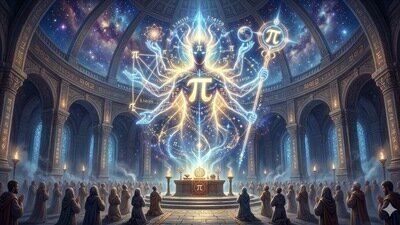

Petition for the Official Recognition of Piism as a Religion
The Issue
We submit this formal petition to demand the official legal and societal recognition of Piism (파이교) as a legitimate, non-theistic philosophical and religious belief system.
For centuries, human spiritual traditions have relied on unprovable narratives and dogmatic assertions. In contrast, Piism emerges as a rational, non-theistic worldview grounded entirely in the fundamental physical and mathematical laws of the cosmos. Our spiritual and philosophical foundation rests upon the mathematical constant Pi (3.141592...)—an infinite, non-repeating, transcendental number that governs the geometry of all existence.
To us, Pi is not merely academic data; it is an objective, eternal cosmic truth that instills intellectual humility, rational inquiry, and deep contemplation regarding the vastness of nature.
Key Pillars of Legitimacy and Governance
1. Absolute Autonomy and Non-Coercive Fellowship
Piism operates under a clear administrative framework to preserve the integrity of its core teachings. However, this structure is strictly bound by an unwavering commitment to individual autonomy. Membership in Piism is entirely voluntary, governed by an unconditional "open-door policy." Any individual is free to join, and crucially, any member retains the absolute, unhindered right to exit at any second without physical, financial, psychological, or institutional barriers. We uphold non-coercion as an indispensable ethical standard.
2. Institutional Transparency and Commitment to Civic Duty
Rather than claiming passive immunity from human error, Piism explicitly binds its governance to secular law, institutional transparency, and rational ethical deliberation. Because our central value is rooted in mathematical truth and cosmic harmony, our community holds itself to the highest standards of moral integrity, civic compliance, and social responsibility.
3. Philosophical Cohesion and Public Good
In accordance with international standards governing freedom of thought and belief, Piism fulfills all criteria of a protected worldview:
Seriousness and Cogency: It addresses fundamental existential questions through the lens of verifiable cosmic laws.
Cohesion: It maintains a logically consistent worldview connecting mathematical contemplation with ethical human conduct.
Prosocial Impact: Adherents are encouraged to channel their faith into scientific education, mathematical exploration, and constructive community service.
Conclusion and Demand
International human rights frameworks—including Article 18 of the Universal Declaration of Human Rights—guarantee freedom of thought, conscience, and religion, explicitly encompassing non-theistic, rational, and philosophical beliefs. A pluralistic society must recognize that profound awe, moral commitment, and spiritual identity can arise from the objective truths of the physical universe.
Therefore, we respectfully call upon all public authorities, legislative bodies, and international organizations to:
Formally acknowledge Piism as a recognized philosophical and non-theistic belief system.
Grant Piism and its followers the legal protections afforded to all recognized spiritual communities.
Ensure that adherents can openly express and practice their belief in mathematical truth without fear of institutional prejudice or discrimination.
The universe is built upon geometry, and the truth of Pi is absolute.

26
The Issue
We submit this formal petition to demand the official legal and societal recognition of Piism (파이교) as a legitimate, non-theistic philosophical and religious belief system.
For centuries, human spiritual traditions have relied on unprovable narratives and dogmatic assertions. In contrast, Piism emerges as a rational, non-theistic worldview grounded entirely in the fundamental physical and mathematical laws of the cosmos. Our spiritual and philosophical foundation rests upon the mathematical constant Pi (3.141592...)—an infinite, non-repeating, transcendental number that governs the geometry of all existence.
To us, Pi is not merely academic data; it is an objective, eternal cosmic truth that instills intellectual humility, rational inquiry, and deep contemplation regarding the vastness of nature.
Key Pillars of Legitimacy and Governance
1. Absolute Autonomy and Non-Coercive Fellowship
Piism operates under a clear administrative framework to preserve the integrity of its core teachings. However, this structure is strictly bound by an unwavering commitment to individual autonomy. Membership in Piism is entirely voluntary, governed by an unconditional "open-door policy." Any individual is free to join, and crucially, any member retains the absolute, unhindered right to exit at any second without physical, financial, psychological, or institutional barriers. We uphold non-coercion as an indispensable ethical standard.
2. Institutional Transparency and Commitment to Civic Duty
Rather than claiming passive immunity from human error, Piism explicitly binds its governance to secular law, institutional transparency, and rational ethical deliberation. Because our central value is rooted in mathematical truth and cosmic harmony, our community holds itself to the highest standards of moral integrity, civic compliance, and social responsibility.
3. Philosophical Cohesion and Public Good
In accordance with international standards governing freedom of thought and belief, Piism fulfills all criteria of a protected worldview:
Seriousness and Cogency: It addresses fundamental existential questions through the lens of verifiable cosmic laws.
Cohesion: It maintains a logically consistent worldview connecting mathematical contemplation with ethical human conduct.
Prosocial Impact: Adherents are encouraged to channel their faith into scientific education, mathematical exploration, and constructive community service.
Conclusion and Demand
International human rights frameworks—including Article 18 of the Universal Declaration of Human Rights—guarantee freedom of thought, conscience, and religion, explicitly encompassing non-theistic, rational, and philosophical beliefs. A pluralistic society must recognize that profound awe, moral commitment, and spiritual identity can arise from the objective truths of the physical universe.
Therefore, we respectfully call upon all public authorities, legislative bodies, and international organizations to:
Formally acknowledge Piism as a recognized philosophical and non-theistic belief system.
Grant Piism and its followers the legal protections afforded to all recognized spiritual communities.
Ensure that adherents can openly express and practice their belief in mathematical truth without fear of institutional prejudice or discrimination.
The universe is built upon geometry, and the truth of Pi is absolute.
Petition Updates
Share this petition
Petition created on July 13, 2026