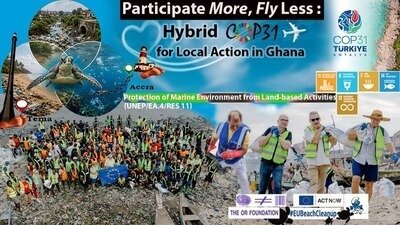

PARTICIPATE MORE ,FLY LESS : A CALL FOR HYBRID COP31 for LOCAL ACTION IN GHANA
The Issue
Ghana faces a major climate implementation and funding gap, so much so that its 2025 National Adaptation Plan (NAP), published by the UNFCCC on 10 April 2026, was prepared with GCF financial support through UNEP.
At the Conference of the Parties (COP28) in 2023, Ghana - one of West Africa’s five largest greenhouse gas emitters - flew 618 delegates to Dubai: more than twice Togo’s 250 and more than double Denmark’s 271. How many more people must travel for climate conferences before more climate finance reaches the communities and ecosystems that need it?
Ghana, Togo and Denmark all attended COP1 in Berlin in 1995 - the UN’s forum for negotiating and tracking joint climate action. Yet decades later, the contrast is stark: At #EUBeachCleanUp 2026, EU Ambassador to Ghana Rune Skinnebach of Denmark publicly called for action on Accra’s polluted beaches, describing them as worse than when he first arrived 32 years ago. India’s High Commissioner Surinder Bhagat likewise invoked Mahatma Gandhi’s emphasis on sanitation and independence. Meanwhile, Togo has invested millions in keeping its beaches pristine.
International conferences have their place. Networking matter and negotiations are important but implementation is the immediate emergency because people and ecosystems are already experiencing the consequences. Climate change is affecting how Ghanaians eat, drink, work, stay healthy and remain out of poverty. With only four years to achieve the 17 SDGs, we cannot afford a conference economy of meeting, discussing, reporting and returning home as usual
To match international representation with visible domestic investment for local action. Ghana needs measurable results to translate:
Talk into Implementation.
Travel into Infrastructure.
Meetings into Measurable Outcomes.
Conference Economy into Circular Economy.
Reports into Results.
These are our four immediate, low-hanging-fruit demands;
1. REDUCE UNNECESSARY PHYSICAL TRAVEL WHILE MAINTAINING EFFECTIVE REPRESENTATION.
Ghana can use a smaller core negotiating team supported by a wider virtual network. This reduces fossil-fuel emissions from international travel and aligns participation with the Paris Agreement’s objectives. Publish COP31 delegation costs and funding sources; government, donors/agencies and private sponsors to track resources that could be redirected towards domestic implementation.
2. KEEP TWO GREATER ACCRA BEACHES PRISTINE.
Concentrate resources on two fully monitored demonstration beaches rather than dispersed one-off cleanups. First, prevent plastic and other waste from reaching the coast throughout the September 2026–March 2027 sea-turtle nesting season; then document results for expansion.
3. LET THE EPA DEMONSTRATE SOURCE SEGREGATION BEFORE ASKING OTHERS TO DO IT.
The Environmental Protection Authority (EPA) launched waste segregation on 22nd November 2013 but the 2nd generation has never missed a single COP participation thereafter. They should demonstrate institutional leadership as happening in the Embassy of Japan, the European Union Delegation’s office, Movenpick and Kempinski Hotel. Ahead of the 1 January 2027 nationwide Styrofoam ban they should create a barrier of eliminating problematic single-use plastics from its premises.
4. USE LOCAL PURCHASING TO SUPPORT RURAL LIVELIHOODS AND FOOD SECURITY AT THE MICROLEVEL.
Ghana prefers many foreign products while local agricultural produce face post-harvest losses. This undermines the objectives of SDG 2 and SDG 12. Public institutions and other major purchasers should priorities locally produced food where quality, supply and procurement requirements can be met. The local tomato-purchasing initiative associated with Deputy Agric Minister, John Dumelo could be extended to rice and other produce ahead of the December 2026 festive season.
Even the COP31 Presidency is prioritizing implementation, zero waste, food security and climate-resilient cities. If Ghana has already done the talking with Africa’s fifth-largest COP delegation, then the first sub-Saharan African nation to gain independence must now walk the talk.

141
The Issue
Ghana faces a major climate implementation and funding gap, so much so that its 2025 National Adaptation Plan (NAP), published by the UNFCCC on 10 April 2026, was prepared with GCF financial support through UNEP.
At the Conference of the Parties (COP28) in 2023, Ghana - one of West Africa’s five largest greenhouse gas emitters - flew 618 delegates to Dubai: more than twice Togo’s 250 and more than double Denmark’s 271. How many more people must travel for climate conferences before more climate finance reaches the communities and ecosystems that need it?
Ghana, Togo and Denmark all attended COP1 in Berlin in 1995 - the UN’s forum for negotiating and tracking joint climate action. Yet decades later, the contrast is stark: At #EUBeachCleanUp 2026, EU Ambassador to Ghana Rune Skinnebach of Denmark publicly called for action on Accra’s polluted beaches, describing them as worse than when he first arrived 32 years ago. India’s High Commissioner Surinder Bhagat likewise invoked Mahatma Gandhi’s emphasis on sanitation and independence. Meanwhile, Togo has invested millions in keeping its beaches pristine.
International conferences have their place. Networking matter and negotiations are important but implementation is the immediate emergency because people and ecosystems are already experiencing the consequences. Climate change is affecting how Ghanaians eat, drink, work, stay healthy and remain out of poverty. With only four years to achieve the 17 SDGs, we cannot afford a conference economy of meeting, discussing, reporting and returning home as usual
To match international representation with visible domestic investment for local action. Ghana needs measurable results to translate:
Talk into Implementation.
Travel into Infrastructure.
Meetings into Measurable Outcomes.
Conference Economy into Circular Economy.
Reports into Results.
These are our four immediate, low-hanging-fruit demands;
1. REDUCE UNNECESSARY PHYSICAL TRAVEL WHILE MAINTAINING EFFECTIVE REPRESENTATION.
Ghana can use a smaller core negotiating team supported by a wider virtual network. This reduces fossil-fuel emissions from international travel and aligns participation with the Paris Agreement’s objectives. Publish COP31 delegation costs and funding sources; government, donors/agencies and private sponsors to track resources that could be redirected towards domestic implementation.
2. KEEP TWO GREATER ACCRA BEACHES PRISTINE.
Concentrate resources on two fully monitored demonstration beaches rather than dispersed one-off cleanups. First, prevent plastic and other waste from reaching the coast throughout the September 2026–March 2027 sea-turtle nesting season; then document results for expansion.
3. LET THE EPA DEMONSTRATE SOURCE SEGREGATION BEFORE ASKING OTHERS TO DO IT.
The Environmental Protection Authority (EPA) launched waste segregation on 22nd November 2013 but the 2nd generation has never missed a single COP participation thereafter. They should demonstrate institutional leadership as happening in the Embassy of Japan, the European Union Delegation’s office, Movenpick and Kempinski Hotel. Ahead of the 1 January 2027 nationwide Styrofoam ban they should create a barrier of eliminating problematic single-use plastics from its premises.
4. USE LOCAL PURCHASING TO SUPPORT RURAL LIVELIHOODS AND FOOD SECURITY AT THE MICROLEVEL.
Ghana prefers many foreign products while local agricultural produce face post-harvest losses. This undermines the objectives of SDG 2 and SDG 12. Public institutions and other major purchasers should priorities locally produced food where quality, supply and procurement requirements can be met. The local tomato-purchasing initiative associated with Deputy Agric Minister, John Dumelo could be extended to rice and other produce ahead of the December 2026 festive season.
Even the COP31 Presidency is prioritizing implementation, zero waste, food security and climate-resilient cities. If Ghana has already done the talking with Africa’s fifth-largest COP delegation, then the first sub-Saharan African nation to gain independence must now walk the talk.
The Decision Makers


Petition Updates
Share this petition
Petition created on September 24, 2026