Demo Review & Deconstruction Policies NOW!
The Issue
Demolition rates in Philadelphia have been steadily climbing for nearly a decade. As a result, countless historic places have been destroyed. Philadelphia is one of the oldest and least protected cities in the country (fewer than 3% of its buildings are listed on the local register) and it is long overdue to adopt a demolition review ordinance.
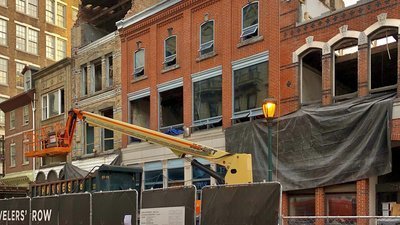
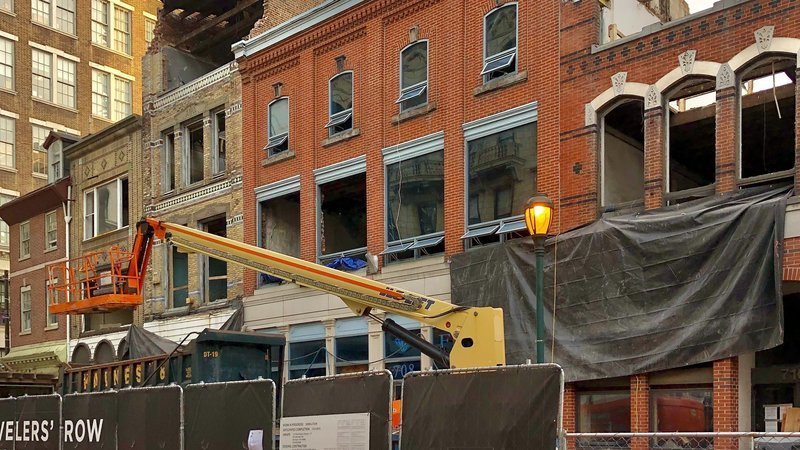
Philadelphians can no longer tolerate the impacts of excessive demolition in their neighborhoods. With incentives like the Tax Abatement driving new development, savvy speculators reap short-term economic rewards at the expense of residents’ cultural and environmental well-being. Neighborhoods have lost places with important cultural connections like Jeweler’s Row, the Gloria Casarez mural, the Henry Minton House, and the Christian Street Baptist Church, Temple Beth Israel/Christian Love Baptist Church, thousands of interstitial buildings, and countless places whose significance was not known or recognized. In addition to the loss of culturally and historically significant places, demolition poses other risks, too.
Ways demolition puts our population at risk:
- Health impacts including increased lead levels, dust and air quality, noise, and quality of life.
- Increased safety risk including structural damage and collapse of neighboring properties.
- Environmental impacts including but not limited to, contribution of waste to landfills and the loss of embodied energy in building materials that are thrown away rather than reused as well as the carbon emissions of new materials associated with new construction. (Philadelphia only diverts 94,000 tons of C&D waste annually with 350,000 tons evading the reporting system; meanwhile, Chicago diverts 500,000 tons from landfills annually)
- It ignores the benefits of rehabilitation, which includes the production of higher quality and more localized jobs than new construction, is more sustainable, and helps retain existing and naturally occurring affordable housing. (Job creation, environmental sustainability, housing security and affordability, etc.)
- It eliminates places that people have cultural connections to, resulting in the loss of places of communal memory.
Our proposed solution to this problem: Demolition Review
A demolition review ordinance would initiate a review period when a demolition permit is filed, allowing City agencies to assess a building’s potential future based on cultural, historical, or architectural merit. Cities across the country successfully implement such ordinances in a variety of ways and often pair them with other preservation and environmentally-minded policies and incentives. Without adequate protection and with no historic resource survey, it is inexcusable that a city historically rich and varied such as Philadelphia does not already have a demo review ordinance and we the people are paying for it every day.
RePoint demands the following:
- Implement an age-based demolition review, which would be applied universally across the city, making it more socially, racially, and culturally inclusive.
- Introduce deconstruction, recycling, and salvage mandates that will help create jobs, strengthen our economy, protect our citizens, and promote environmental sustainability.
- Use the demolition review period to assess the following: a building's cultural and historical significance, the reuse and salvage potential of its materials, and take into account the structural risk posed by demolition to adjacent buildings.
- The Philadelphia Historical Commission should require independent engineers with specialized knowledge and experience of older buildings to provide reviews for any demolition permit applications related to structural problems or imminently dangerous violations of buildings on the Philadelphia Register of Historic Places.
- Focus city efforts on creating financial incentives that help citizens maintain their properties and promote adaptive reuse to decrease housing insecurity and increase housing affordability, such as requiring new development to pay into a preservation fund to help lower income residents maintain historic properties.
- Stop making excuses for not enacting a demo review ordinance. While we are far behind in terms of proactive preservation, we are as capable of taking this step as any other city. Historic resource surveys are not required to create or perform demo review. However, once established, Philadelphia’s upcoming survey should integrate with the demo review policy, as well as other progressive preservation policies such as tiered historic districts, recommended by the Mayor’s Historic Preservation Task Force.
Existing buildings and materials must be reused to provide affordable and realistic market-rate housing as an obvious, logical, and environmentally friendly approach to development. Instead, Philly residents are routinely exposed to the safety, social, economic, and environmental impacts of demolition while losing the places and landscapes that make the city special.
We deserve to live in a world class city that has cultural and environmental protective measures just as our peers do!
What can you do?
Stand with RePoint to demand better from our City government: sign this petition, contact the Mayor, contact your dedicated community planner, the Philadelphia Historical Commission, and call your council district and at-large council members!
To stay updated on this and other matters, sign up for RePoint’s newsletter on our website and follow us on Twitter, Instagram, and FB.

Petition Closed
The Issue
Demolition rates in Philadelphia have been steadily climbing for nearly a decade. As a result, countless historic places have been destroyed. Philadelphia is one of the oldest and least protected cities in the country (fewer than 3% of its buildings are listed on the local register) and it is long overdue to adopt a demolition review ordinance.
Philadelphians can no longer tolerate the impacts of excessive demolition in their neighborhoods. With incentives like the Tax Abatement driving new development, savvy speculators reap short-term economic rewards at the expense of residents’ cultural and environmental well-being. Neighborhoods have lost places with important cultural connections like Jeweler’s Row, the Gloria Casarez mural, the Henry Minton House, and the Christian Street Baptist Church, Temple Beth Israel/Christian Love Baptist Church, thousands of interstitial buildings, and countless places whose significance was not known or recognized. In addition to the loss of culturally and historically significant places, demolition poses other risks, too.
Ways demolition puts our population at risk:
- Health impacts including increased lead levels, dust and air quality, noise, and quality of life.
- Increased safety risk including structural damage and collapse of neighboring properties.
- Environmental impacts including but not limited to, contribution of waste to landfills and the loss of embodied energy in building materials that are thrown away rather than reused as well as the carbon emissions of new materials associated with new construction. (Philadelphia only diverts 94,000 tons of C&D waste annually with 350,000 tons evading the reporting system; meanwhile, Chicago diverts 500,000 tons from landfills annually)
- It ignores the benefits of rehabilitation, which includes the production of higher quality and more localized jobs than new construction, is more sustainable, and helps retain existing and naturally occurring affordable housing. (Job creation, environmental sustainability, housing security and affordability, etc.)
- It eliminates places that people have cultural connections to, resulting in the loss of places of communal memory.
Our proposed solution to this problem: Demolition Review
A demolition review ordinance would initiate a review period when a demolition permit is filed, allowing City agencies to assess a building’s potential future based on cultural, historical, or architectural merit. Cities across the country successfully implement such ordinances in a variety of ways and often pair them with other preservation and environmentally-minded policies and incentives. Without adequate protection and with no historic resource survey, it is inexcusable that a city historically rich and varied such as Philadelphia does not already have a demo review ordinance and we the people are paying for it every day.
RePoint demands the following:
- Implement an age-based demolition review, which would be applied universally across the city, making it more socially, racially, and culturally inclusive.
- Introduce deconstruction, recycling, and salvage mandates that will help create jobs, strengthen our economy, protect our citizens, and promote environmental sustainability.
- Use the demolition review period to assess the following: a building's cultural and historical significance, the reuse and salvage potential of its materials, and take into account the structural risk posed by demolition to adjacent buildings.
- The Philadelphia Historical Commission should require independent engineers with specialized knowledge and experience of older buildings to provide reviews for any demolition permit applications related to structural problems or imminently dangerous violations of buildings on the Philadelphia Register of Historic Places.
- Focus city efforts on creating financial incentives that help citizens maintain their properties and promote adaptive reuse to decrease housing insecurity and increase housing affordability, such as requiring new development to pay into a preservation fund to help lower income residents maintain historic properties.
- Stop making excuses for not enacting a demo review ordinance. While we are far behind in terms of proactive preservation, we are as capable of taking this step as any other city. Historic resource surveys are not required to create or perform demo review. However, once established, Philadelphia’s upcoming survey should integrate with the demo review policy, as well as other progressive preservation policies such as tiered historic districts, recommended by the Mayor’s Historic Preservation Task Force.
Existing buildings and materials must be reused to provide affordable and realistic market-rate housing as an obvious, logical, and environmentally friendly approach to development. Instead, Philly residents are routinely exposed to the safety, social, economic, and environmental impacts of demolition while losing the places and landscapes that make the city special.
We deserve to live in a world class city that has cultural and environmental protective measures just as our peers do!
What can you do?
Stand with RePoint to demand better from our City government: sign this petition, contact the Mayor, contact your dedicated community planner, the Philadelphia Historical Commission, and call your council district and at-large council members!
To stay updated on this and other matters, sign up for RePoint’s newsletter on our website and follow us on Twitter, Instagram, and FB.
The Decision Makers
Petition Updates
Share this petition
Petition created on March 17, 2021